Full article about Arco da Calheta: Dawn on a Green Amphitheatre
Watch sunrise spill over terraced ridges, 1791 chapel frescoes and levada-whispered vineyards.
Hide article Read full article
The shape of the land
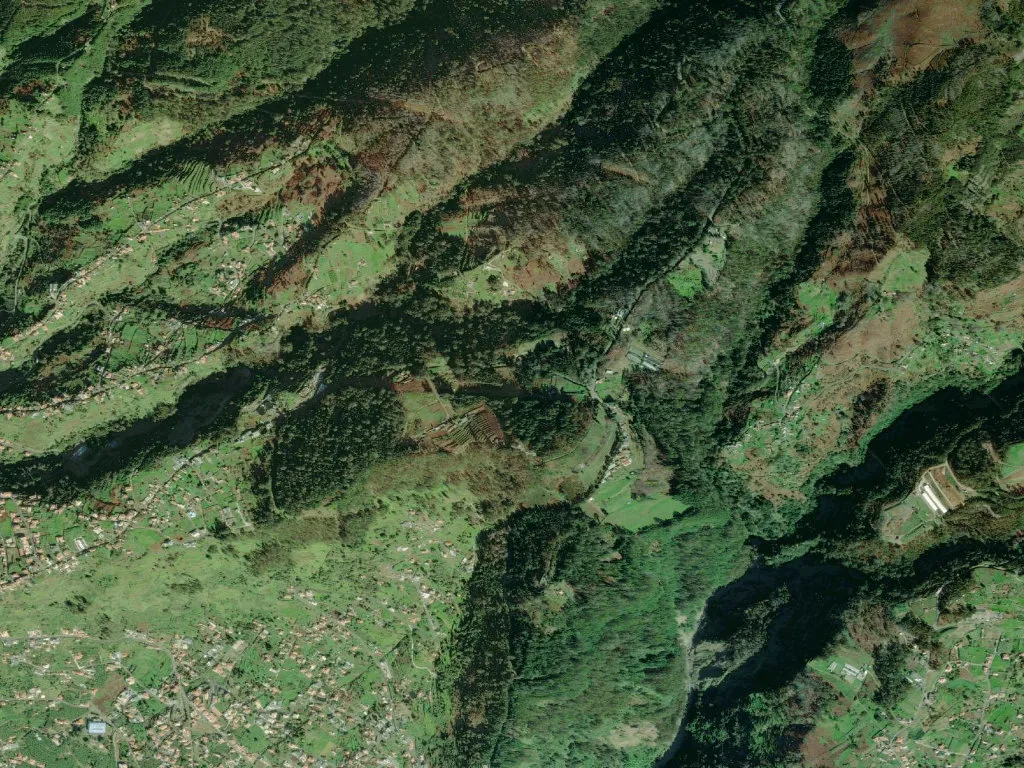
At 796 m above the Atlantic, dawn slips over a horseshoe of terraced ridges and strikes the whitewash of Igreja de São Brás before the coast below has stirred. The bell tolls eight; the note rolls across red-tiled roofs and subsides into the whisper of water—not surf, but the levadas that lace the parish from end to end. Fed by the Madre Grande and Rabaçal channels, the constant flow keeps banana fronds glossy and vineyard rows rigid even when the island’s south is dust-dry.
Arco da Calheta is literally an arc: stand on the ER101 between the church square and Lombada do Loreto and the topography curves away like a green amphitheatre. The parish was carved from Calheta in 1472, one of the earliest on Madeira, and its first vicar, Pedro Delgado, said mass in a tiny chapel of cane and thatch. The present sandstone church rose between 1744 and 1754 after Cristóvão Gomes outbid his neighbours for the construction contract; it was consecrated on New Year’s Day 1755 while the lime wash was still damp.
Stone, lime and a 1791 fresco
Half-way up the slope, the chapel of Nossa Senhora do Loreto has guarded the ridge since the 1510s. Inside, a fresco signed by Nicolau Ferreira (1791) fades from terracotta to the colour of dried rose petals; Manueline ribs survive in the vault. The council has restored the granite fountains that once served as parish noticeboards—cold water running over worn lips, perfect for filling a bottle before the climb to Paul da Serra.
Below, the ruins of João Fernandes do Arco’s 15th-century sugar mill are threaded with bougainvillea. Fernandes, one of Madeira’s early senhores de engenho, held 200 hectares of cane and the private chapel privilege that only the Crown could grant. The land register still carries his name; the terraced fields remember the slave paths that irrigated European sugar for the first time.
Inside the laurel forest
Arco da Calheta spills into the Madeira Natural Park and, beyond the last vineyard, the Laurissilva World Heritage site begins. Til, vinhático and bay laurel knit a canopy so dense the air condenses and drips; the temperature drops five degrees in ten paces. In July, cattle wearing brass bells graze the high meadows; the sound drifts down the valley like a distant xylophone. Locals walk here for the silence, broken only by a blackbird’s phrase or the soft knock of trekking poles on basalt.
Back in the village, Sr. António’s wood-fired oven at Lombada bakery is loaded at six every Wednesday; the yeast scent drifts through the lanes before the sun clears the ridge. Traditional houses still wear half-round tiles, basalt cornerstones and wooden balconies where onions dry in plaits. At Casa Grande winery, grapes are trodden in stone lagares exactly as they were when Shackleton’s supply ships loaded Madeira cask wine in nearby Funchal.
The day ends as it began: bell water, levada water, then the first lamp reflected in the polished brass of the church door—an arc of sound and light holding the mountain and the sea together.