Full article about Estreito da Calheta
16th-century chapels, comet-coat-of-arms vines and Atlantic salt on the wind
Hide article Read full article
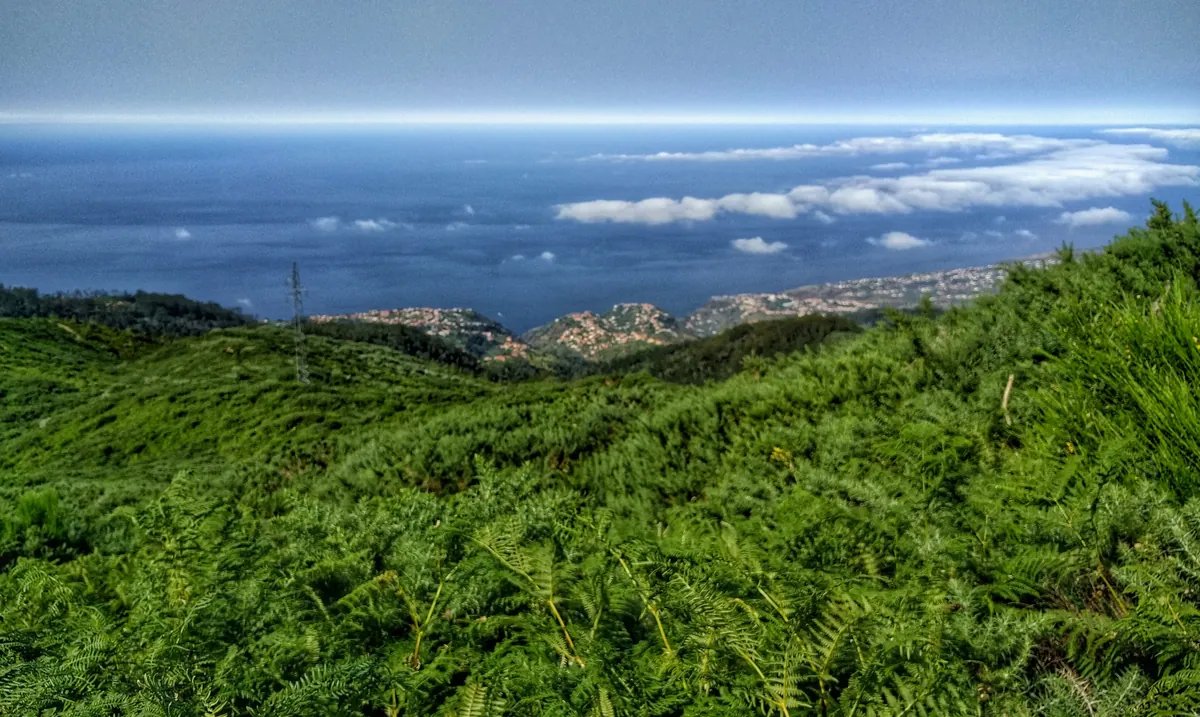
The Atlantic suddenly vanishes as the road climbs, and the temperature drops five degrees in as many minutes. At 740 m the ridge narrows to a blade barely two terraces wide: São Bartolomeu stream on one side, Ribeira Funda on the other, both gnawing the basalt until the plateau feels more like a gangway. Vines run in ruled lines above dry-stone walls that pin down the scarlet laterite when winter rain arrives, and the updraft carries salt on the edge of wood-smoke from a kitchen chimney below.
A Morgado and the Star of Kings
Parish records begin in 1518, when a tiny chapel – Nossa Senhora da Graça – served as the administrative seat. Its founder, João de França, had died fifteen years earlier, but the morgado (entailed estate) he created kept his surname tethered to the slope for three centuries while sugar, then wine, then wheat dictated the rhythm of life. In 1529 Francisco Homem de Gouveia added the Capela dos Reis Magos, still stocked with a sixteenth-century Flemish altarpiece whose cedar panels smell of beeswax and frankincense, their gilt dulled to a candle-lit bronze. Diogo Perestrelo Bisforte, sixth captain of neighbouring Porto Santo, married the heiress of the estate and spent long seasons here; devotion to the Magi ossified into stone and gold leaf.
The present parish church, completed in 1791 at royal expense, stands white and unadorned on a shelf called Lombo da Igreja. Bracken now forces its way between the tomb-slabs of the churchyard. Higher up, the 1670 chapel of Nossa Senhora da Conceição and, at the far western edge, the 1858 Nossa Senhora do Livramento complete a quartet of belfries that still toll 7 a.m. mass across the ravines.
Trellises, comets and a building coming apart
The parish coat of arms shows a grape-trellis beneath a comet: a nod to both the Epiphany star and the wine that has always paid the bills. These south-facing slopes belong to the Madeira DOC, and the traditional vinha de enforcado – vines draped over trellises suspended between chestnut posts – survives in a handful of plots. You will not find “Estreito cuisine” on any menu, yet ask for cod espada skewered with bay and served over onion stew, or a broth of kale thickened with yam, or bolo do caco split and anointed with garlic butter, and the cook will know you have been talking to locals.
At the hamlet’s centre the Venda Grande, an early-20th-century general store and townhouse, is crumbling quietly. Stone walls bulge, glassless windows funnel rain into interior staircases that end in mid-air, and the silence is that of a place whose population has fallen from 4 938 in 1930 to 1 578 today. The 2021 census counted 437 residents over 65 and only 205 under 30; bracken and heather have replaced maize fields, and no one scythes the stone paths any more.
Between Paul da Serra and the sea
The parish runs vertically from the coastal cliffs to almost 1 300 m on the shoulder of Paul da Serra. The entire gradient lies within Madeira Natural Park and brushes the Laurissilva World Heritage forest. Walking the old footpaths is a lesson in altitude: vegetable terraces give way to gorse and tree heath, then to moss-draped laurels where the air tastes of wet iron. Water is never out of earshot – every ravine carries a silver thread that slips under the road and reappears ten metres below.
From Lombo dos Reis the view south-west is a saw-edge of black basalt and terracotta roofs. The light turns honey-gold when the sun drops behind the plateau, or pewter when cloud rivers pour off Paul da Serra and smother the ridge in damp that seeps into bone as well as stone. Father César Teixeira da Fonte, born here in 1905 and buried here in 1989, used to say that salvation on this coast was measured not in kilometres but in vertical metres: every sin required another climb.
At dusk the terrace shadows lengthen and the wind drops, leaving only the smell of wet earth and the faint bronze note of the Graça bell. The Magi star painted on the coat of arms feels less like heraldry than astronomy; hung above the slope, it steers anyone still climbing towards whatever remains when everything else has emptied out.