Full article about Fajã da Ovelha: Atlantic fades, vines cling to 702 m sky
Stone lagares drip purple, terraces breathe salt; 812 souls keep mountain time
Hide article Read full article
The climb that begins at sea level
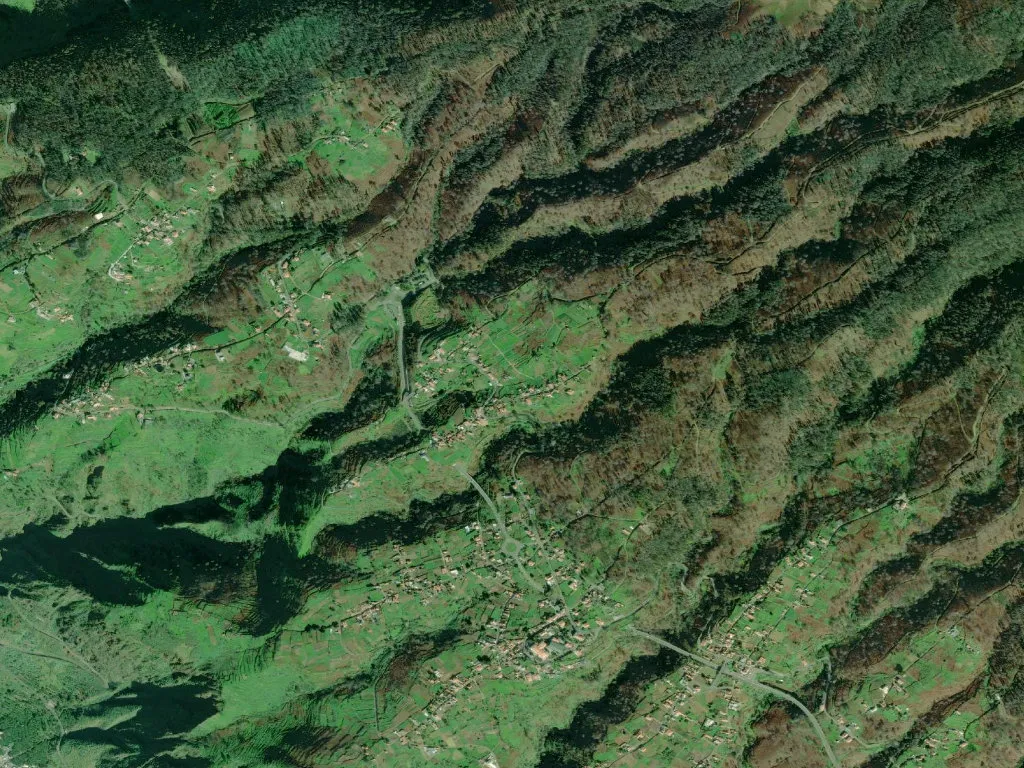
The tarmac corkscrews upward until the Atlantic is reduced to a blue smear in the rear-view mirror and the air tastes of wet heather. At 702 m your ears pop like on a descent into Heathrow; below, the ocean looks as though someone has taken a turpentine rag to an oil painting, rubbing it into pale, dissolving patches. Eight hundred and twelve people live here, their houses clinging to the gradient like cats to a curtain—each one bargained for its foothold and lost a little ground to the mountain.
Between laurisilva and last-year’s grapes
At the northern edge the forest eats itself alive. You enter a dripping tunnel of bay and laurel where time is measured in cold drops: first on your collar, then in your shoe, finally nowhere you can feel. Round the next bend the smell of mould is elbowed aside by the sour-sweet reek of rubbery must: the abandoned stone lagares of the Levada do Moinho still carry a purple stain where juice once ran between the grooves. Vines survive on terraces too narrow for anything but a child-sized tractor; every bunch of Tinta Negra carries a faint crust of salt blown three kilometres uphill. The schist radiates heat like a griddle, scorching the bare feet of grandchildren drafted in for the harvest—first lesson in work, first coat of beeswax cracked into the skin.
Geography of a cul-de-sac
The ER 222 unravels in stages: a pothole the size of a crater, a motionless brown cow, then a ravine where the road simply surrendered to last winter’s cloudburst. Calheta is 18 km away but the clock here is sundial-slow. Of the 812 residents, 264 can no longer bend to tie their laces; you read the statistic in the queue at Bar Neves where the interval between espressos is measured in emigration yarns. There are 81 children on the parish roll, but three of them sleep in Lisbon on school nights and another in a French suburb the locals pronounce “Touloose”. The primary school still smells of 1997 vegetable soup; the teacher marks the register with the same blue Bic she had the year Princess Diana died.
Textures of the everyday
At seven the first diesel cough belongs to Zé do Penedo’s Hiace, off to fetch yesterday’s bread from Calheta. It arrives already soft, but no one complains: it doesn’t taste of ship’s biscuit. The levadas are not picture-postal; they are open canals where kids learnt to swim eyes-wide so their mothers couldn’t spot them. When the Levada do Moinho runs thin someone has left a tap open in Sr Jacinto’s cabbage patch. On fog-days Celestino’s dog barks at the same telegraph pole for hours—horizontal movement in a vertical world. When the sun cuts through, light ricochets off greenhouse glass and throws tiny rainbows onto kitchen walls; grandmothers complain of glare and send grandchildren to slam the warped wooden shutters that chatter like ill-fitting dentures.
How the day ends
The sun doesn’t set—it punches through the sea like a hot coin dropped into chocolate cake. Stones that scorched fingers at noon now release their heat to stretching cats. The smell of dry manure drifts across the lane and collides with sardines grilling on Zeca’s terrace; dinner is eaten standing because the table is stacked with 25 kg sacks of 4-4-8. Windows light up not by magic but because EDP finally sent a meter reader. No crackling log fires here: only the click of vertebrae that have bent all day over kale beds, the groan of the iron bedstead where the grandfather will die as he was born—staring at a ceiling whose damp maps he has memorised. Night drops like a slammed hatch, swallows the last tractor parked on the incline, leaves only the lighthouse beam of a fishing boat that, far below, blinks like an insomnia you can’t quite shake.