Full article about Paul do Mar: bananas, basalt & Atlantic thunder
In Madeira’s shortest parish road, lava cliffs echo dawn swell and banana-sweet air
Hide article Read full article
Where the Stone Meets the Atlantic
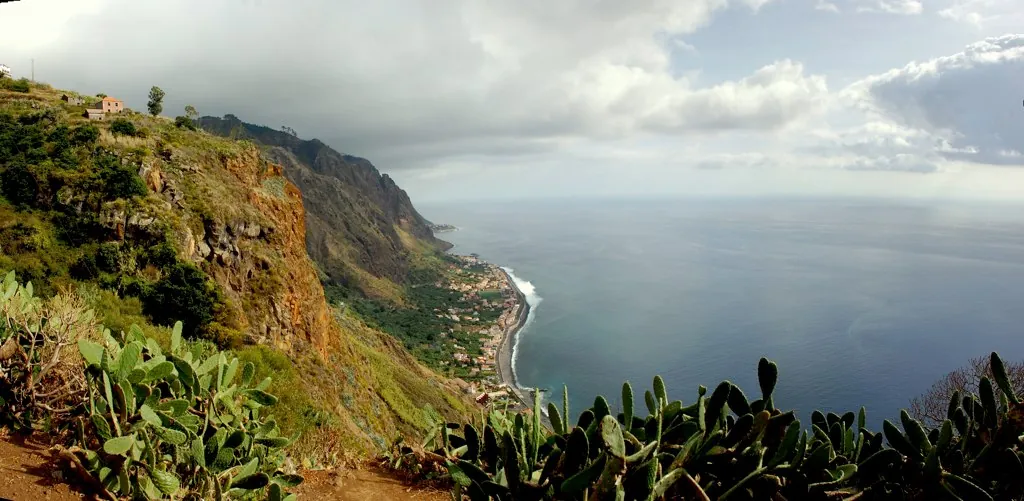
The first thing you hear at dawn in Paul do Mar is the ocean picking a fight with the island. A low, metronomic thud of swell against basalt travels through the schist terrace walls and up the cliff until it reaches the banana leaves, making them tremble like eavesdroppers. The fajã – a slim lava shelf no wider than a Heathrow runway is long – wakes to the smell of salt crusted on dried seaweed and the sugary fug of ripe bananas that hang, bunch by bunch, from the tiered plots above the lane. Here the parish road clocks in at 1.2 km, the shortest on Madeira, yet distance is meaningless; what counts is verticality and volume.
A parish launched by necessity, not charter
Santo António was officially erected in 1550, but its real beginning was earlier and simpler: men in small boats looking for a slit of leeward coast between Jardim do Mar and Fajã da Ovelha. They found a natural hook of basalt that calmed the water enough to beach a wooden lancha. The name tells its own story – paul, the alluvial plain, married to the sea. For four centuries bananas and sugar cane slithered down the ravine to the tiny quay, then on to Funchal and Liverpool. Black-scabbard fish and tuna kept the rhythms of households; the catch had to be ashore before the thermals changed or the fog sealed the cliff road.
In 1835 the Crown folded Paul do Mar into neighbouring Jardim do Mar; autonomy did not return until 1989, by which time Calheta municipality had adopted the parish. None of that altered daily life: 635 people still wedged between basalt and breakwater, trading bananas for fish, gossip for songs.
Inside the eighteenth-century parish church the gilded retable is built like an upturned boat – keel, ribs and all – a quiet admission that every pew has looked seaward for salvation. Below the old quay the chapel of Nossa Senhora da Boa Viagem sent off crews who genuinely needed a good voyage; the nineteenth-century stone cross in the forecourt lists men who didn’t get one. Ask nicely and someone will play you the 1962 RDP recording of Mariazinha de Santo António singing janeiras – New Year carols – in a voice that sounds fortified by sea spray.
Big-wave cred without the marketing department
No-one planned Paul do Mar’s career as a surf break. The reef is simply a submerged shoulder of lava that kicks North Atlantic power into uniform, freight-train rights. In 2001 the World Tow-In Championships turned up unannounced and crowned the place “Europe’s heaviest”. Between October and March the line-up is a United Nations of quiver bags – Californian step-ups, Australian guns, French fish. When the swell drops, swimmers take over the natural rock lido created by high-tide surges; children leap into green chambers while parents time the sets from blue-and-white deckchairs.
Climb 220 m to the Pontão lookout and the village becomes a ruled pencil line: dark Laurissilva forest on one side, 2,000 m of indigo on the other. The Guardian once listed the sunset from this balcony among the world’s ten best. It is not journalistic hyperbole; it is physics – a clear western exposure, 32 km of unobstructed ocean, and Saharan dust that turns the sun into a mercury spill.
Dinner follows the boat, not the menu
Black-scabbard fish is still wheeled from boat to plate within two hours. In the minuscule “Tasca da Sereia” Sr António fries local banana da terra until the edges caramelise, then paints the fillet with a passion-fruit reduction that has spent an hour reducing while he stirs and swears at the television. Dona Lurdes, who lives two doors along, crosses the ridge from Jardim do Mar carrying her own clay pot – “the ones in Paul are too thin for a proper stew” – and layers grouper, black bream and monkfish with tomatoes, onion and marjoram. Eat it with bolo do caco grilled until the rims char, then rubbed with garlic butter that was bashed the night before. Grilled limpets need nothing but lemon and a glass of Calheta white that José keeps in the same 1978 Electrolux chest his father bought second-hand. Finish with dark, spice-heavy honey cake and a tangerine poncha that steams in the evening fog rolling off the water.
Between vineyard wall and ocean swell
The Levada do Paul is only three kilometres long but it stitches together a vertical world: banana palms above your head, black basalt terrace walls (up to three metres high) on either side, Atlantic glinting 200 m below. The PR 7 footpath continues all the way to Calheta, eight cliff-hanging kilometres that smell of fennel and wet stone. At kilometre-five someone nicknamed Zé da Horta wedged a plastic bottle of water and an unpeeled lemon into a wall niche three years ago; walkers still top it up, no-one ever removes it.
The entire parish sits inside Madeira Natural Park; turn your binoculars seaward at 18:00 and you may see the monk seal that commutes from the Desertas to snack on sole. Locals swear she surfaces for conversation rather than fish.
When the boats nose into the tiny Madalena quay and the sodium lamps flick on, the slap of sandals on basalt merges with mandolin chords from Bar Estrela – the same tune since 1982. No-one is in a hurry; the tempo was set long ago by rock that refuses to move and water that refuses to stay still.