Full article about Fog-Wrapped Curral das Freiras Where Nuns Once Hid
Terracotta roofs cling to a basalt gorge perfumed by wood smoke and roasting chestnuts.
Hide article Read full article
Fog, chestnuts and the echo of nuns
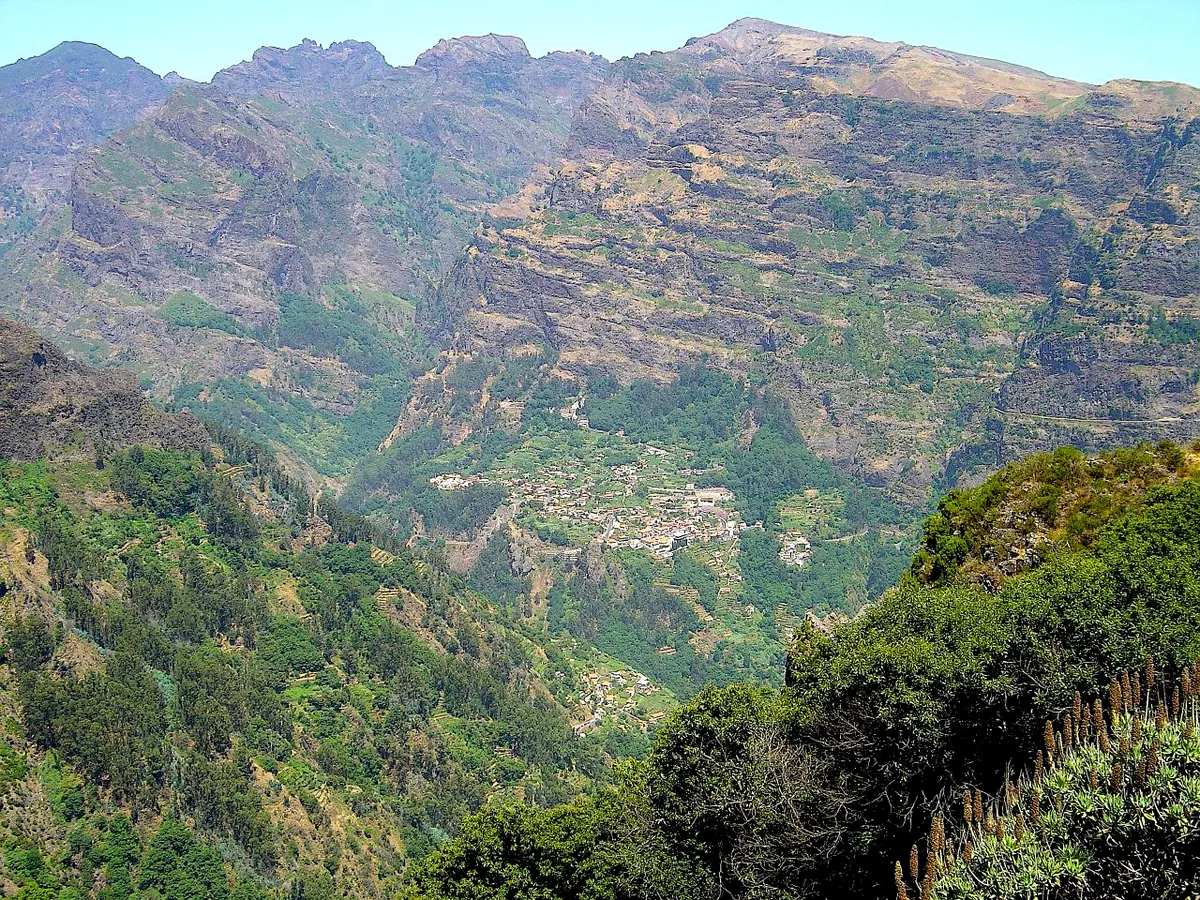
White vapour detaches itself from the basalt walls and drifts downhill until the valley floor swallows it. Below, terracotta roofs are pressed so tightly together that vegetable plots have to be prucked into whatever flat slice of land remains. The air smells of wet basalt and of oak logs ticking over in kitchen stoves; somewhere the Ribeira dos Socorridos sluices through moss-slick boulders. From Curral das Freiras the outside world is nothing more than a rumour—exactly as it was for three centuries.
Refuge of nuns and shepherds
The name is not folklore but an entry in a convent ledger. On 4 October 1566 the French corsair Bertrand de Montluc raided Funchal; the Poor Clare nuns of Santa Clara walked here for three days, guided by shepherds who knew every invisible ledge. What had been a communal high-summer pasture—“Curral da Serra”—since 1462 became, overnight, a hiding place, then a settlement, finally a parish when Queen Maria I signed the royal charter on 23 August 1790. The church she ordered, Nossa Senhora do Livramento, went up in three years using Ançã limestone for its bell tower; a marble plaque still dedicates it to the Queen of Heaven. An earlier 1570 hermitage to St Anthony survives only in the toponym “Sítio da Capela”, where schist foundations poke through the grass. Isolation remained brutal: the first public telephone arrived in 1933 (in the house of Manuel Nunes Marques), the first asphalt in 1959, and women such as Maria da Conceição—“A Tia Cotinha”—died without ever seeing the Atlantic, a mere fifteen kilometres away as the crow flies.
The edible valley
The chestnut dictates the year. November’s Chestnut Festival (since 1984) turns the main street into a medieval fair: thirty thousand people climb 1,095 m to sip 30-proof roasted-shell liqueur, to tear into cakes that have spent twelve hours in wood-fired ovens, to chew sourdough broas made with dark wheat. In the cafés along Rua da Igreja thimble-sized glasses of ginja-and-chestnut fire the blood. Less photogenic is the brigalhó tuber (Dioscorea communis) that once kept the village alive during the famine of 1852; it must be boiled for a full day in black clay pots from Camacha before it loses its toxins. The May Brigalhó Exhibition revives the resulting porridge with goat’s milk and the “soup of seven greens” that sustained families when wheat had to be carried in by donkey from Caniço. Mountain honey, once produced by the dark Iberian bee in laurel hollows, has been scarce since the varroa mite arrived in 1988, though the parish crest—two blue bees flanking a golden chestnut, approved 1996—still remembers it.
Laurissilva and perpetual mist
The entire parish lies inside Madeira Natural Park (created 1982) and is ringed by the 15-thousand-hectare Laurissilva forest, a UNESCO site since 1999. The Vereda do Urzal—ten kilometres between Fajã dos Cardos (820 m) and the village centre (640 m)—cuts through tunnels of til, vinhático and bay laurel where relative humidity never drops below 85 %. The Levada do Curral, built 1960-68, snakes past tree ferns and moss cushions that drink directly from the fog. Above, the viewpoints trade in vertigo: Eira do Serrado lets you stare straight down the rock amphitheatre; Boca dos Namorados (1,030 m) is a picnic shelf facing Pico Grande (1,657 m); Montado do Paredão offers absolute silence except for the wind. After dark the upper ridges echo with the call of Zino’s petrel, the seabird rediscovered in 1969 whose wail reminded shepherds of the nuns’ lament.
Nativity sets and tunnels
The nine Childbirth Masses—5.30 am and 6.30 am from 16 December to 6 January—precede the switching-on of the civic-centre nativity, assembled since 1978 by the Casa do Povo and stocked with 250 clay figurines modelled by Margarida Amélia de Freitas, lit by 12,000 LEDs. Christmas underlines the valley’s Catholic spine, yet it also marks the moment modernity punched through the mountain: on 15 December 2004 the 2.4 km Curral Tunnel replaced the serpentine ER228 that for decades had been the only artery to the coast. Inside, the thermometer drops from 18 °C to 12 °C and the sodium lamps hum at 50 Hz. Exit the bore and the basin reassembles itself—green, secretive, cupped like a closed hand.
Even outside November the air carries a ghost of roasted chestnut. In hamlets such as Murteira and Colmeal, smoke from wine-seasoned chouriço coils through black-thatch eaves. Here isolation is not marketing copy; it is the daily texture, thick as the mist that never quite lifts—even when the sat-nav insists Funchal is only fifteen kilometres away.