Full article about Estreito de Câmara de Lobos
Terraced vineyards, laurel forest & sudden dusk at 550 m on Madeira’s mid-slope balcony
Hide article Read full article
Estreito de Câmara de Lobos: Where the Vine Breathes Above the Clouds
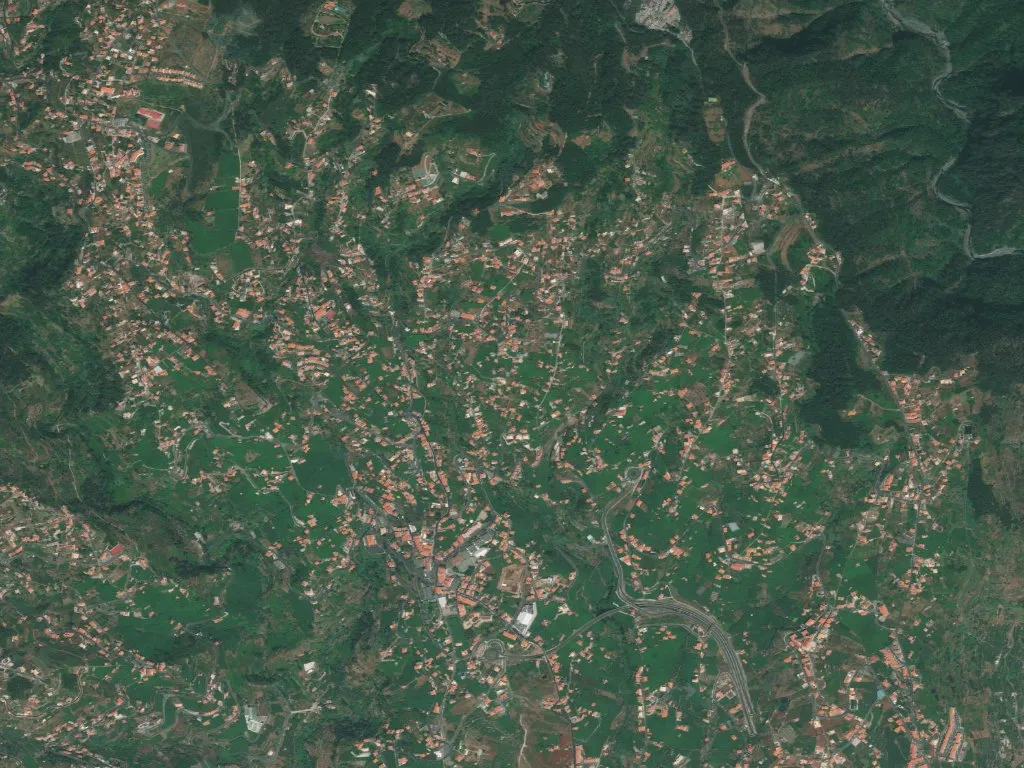
The road corkscrews upward and the air changes. Not just cooler – the very oxygen feels different, carrying the scent of wet laurel and volcanic soil. At 550 metres, the red-tiled roofs of Câmara de Lobos shrink to terracotta confetti beside the Atlantic, while the Estreito plateau opens like a suspended stage between ocean and mountain. Eight square kilometres hold 9,348 souls, a density of 1,188 per kilometre that ought to feel cramped, yet the slope parcels life into terraces, staircases, walled gardens of dark basalt where vines cling with the stubbornness of things that have learned to live vertically.
An amphitheatre above the sea
Estreito occupies a liminal zone in Madeira’s topography: neither shoreline nor high interior, but a mid-slope balcony that dictates everything grown here. Morning light arrives oblique, filtered by the island’s own ramparts, gilding the poios – the local term for stone-walled terraces – for a brief hour before the sun climbs high enough to bleach colour to white. By late afternoon the process reverses; shadows spill from the ridges of Madeira Natural Park and the temperature drops so fast that jackets materialise on café chairs before the espresso is finished.
The average elevation of 544 metres situates the parish in a climatic band prized for one crop above all others. These terraces supply a sizeable share of the grapes that become Madeira wine. The vines are trained high on wires and stakes; in summer their leaves knit a green canopy over the narrow paths that thread the parcels, turning alleyways into vegetal tunnels.
Laurissilva: the forest older than memory
Beyond the last cultivated terrace the ground tilts into the Natural Park and the Laurissilva forest – a 15-million-year-old relic classified as a UNESCO World Heritage Site in 1999. This laurel forest, persisting since before the last Ice Age, is a living organism of disorientating complexity. The floor is padded with rust-brown leaf litter, damp even on days when the ridge above is in sunshine. Bay laurel trunks twist under moss and lichen that give them a faintly mammalian pelt. Silence here is not absence but pressure: the continuous hiss of water seeping through roots and volcanic fissures, feeding the levadas that descend to the parish taps and irrigation channels.
Proximity to this primeval forest is not a marketing slogan; it is measurable in metres. From a street where diesel vans deliver bread, a five-minute climb places you beneath a canopy dense enough to black out the sky and raise relative humidity to skin-prickling levels.
A parish that neither ages nor gentrifies
Census returns show 1,350 residents under fourteen and 1,414 over sixty-five – a near-perfect demographic symmetry rare in rural Portugal. Estreito is not emptying, nor is it swelling; it simply continues, a stability reflected in the tempo of its streets – neither torpor nor rush. The generation in between still tends the terraces, prunes the vines, keeps the small commerce alive: a bakery that sells bolo do caco warm at seven, a bar where contractors argue over coffee grounds.
Population density – among the highest of any Portuguese rural parish – guarantees services: primary school, chemist, a parish council that organises the September wine harvest festival. Afternoons retain enough human traffic to prevent the place from becoming a postcard.
Wine as first language
To speak of Estreito without speaking of wine would be to describe the Atlantic and omit salt. The parish lies at the heart of Madeira’s demarcated region; vines are not scenery but structure – economic, social, topographical. The poios were built for them, the levadas designed to feed them, the liturgical calendar still defers to their rhythm: January pruning, spring sulphur-dusting, late-summer pick.
Altitude gifts the grapes an acidity and aromatic concentration absent from coastal vineyards. The resulting wine carries the signature of this vertical geography – taut, saline, shaped by the diurnal swing that can drop ten degrees once the fog rolls in.
Fog as neighbour
And it is fog – the northeasterly Atlantic haar that locals call vimeiro – which is Estreito’s most constant resident. It ascends the valley at dusk or descends from the summit before dawn, erasing walls, softening headlamps into yellow halos, beading every leaf. When it lifts, the terraces re-emerge one by one, the Atlantic re-appears far below like a distant promise, and the vines glitter with condensation collected drip by drip in the hush that precedes the first cockerel.