Full article about Quinta Grande: Vine-Walled Hamlet Above Câmara de Lobos
Sip tangerine poncha amid 648 m terraces, ox-powered lagars & Santo António’s roof-raising arraial.
Hide article Read full article
A Place Named for a Farm
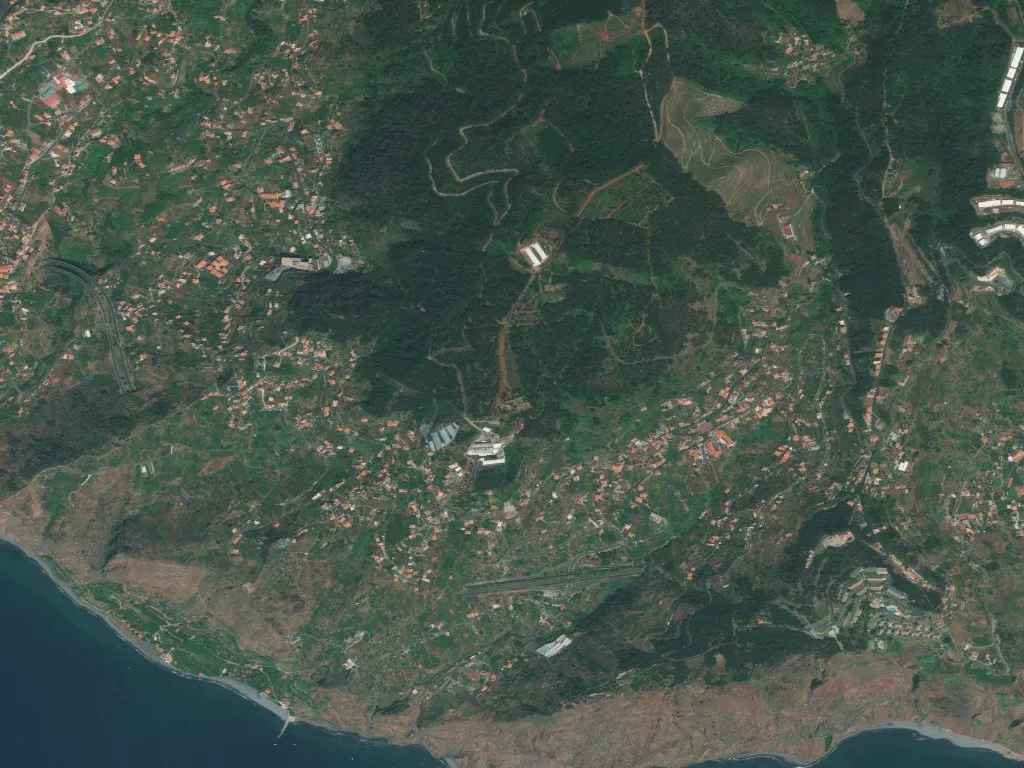
The scent of burnt laurel rises in spirals, mingling with the smoke of beef skewers sizzling over charcoal. Below, the Atlantic spreads like indigo silk between terraces of vines that step down the escarpment to the tiny lava delta of Câmara de Lobos. At 648 m above sea level the air is thin enough to carry both the murmur of the Quinta Grande stream and the chatter of a weekend arraial – the Madeiran version of a street party where every neighbour arrives with a bottle of home-pressed tangerine poncha.
The manor that christened the parish
When settlers began climbing the basalt ramparts above Câmara de Lobos in the sixteenth century they spoke of an unusually large holding whose stone wine press could swallow eight barrels of must in a single treading. Locals simply called it “the big quinta”; the label stuck even after the estate fragmented into pocket-handkerchief plots. The original ox-powered lagar is still there – a hulking block of black basalt half-hidden beneath a pergola of ancient Tinta Negra vines – though it now serves as a conversation piece for the family who tend the vegetable patch above it.
Stone walls ripple across the hillsides like contour lines on an OS map, each one laid by hands that knew which angle would cheat gravity for another generation. The geometry is best appreciated from the Lombo de Santo António lookout where the coast arcs west to Cabo Girão, Europe’s second-highest sea cliff, and the ocean shifts from cobalt to pewter as the sun drops behind Paul da Serra.
Church bells and watermills
The parish church of Santo António was rebuilt in 1940 after a candle toppled into the cedar roof of its 1830 predecessor. Inside, gilded rocaille woodwork glimmers against freshly limewashed walls; on 13 June the statue of the saint is carried through lanes barely wider than a donkey, escorted by a brass band and the smell of garlic butter browning on bolo do caco griddles. Quieter is the eighteenth-century Capela de Nossa Senhora da Conceição, its single-nave interior lined with azulejos that recall December pilgrimages when fog settles so low that pilgrims seem to walk on clouds.
Between the two places of worship the Ribeira de Quinta Grande tumbles eight kilometres from the Paul da Serra plateau, feeding a string of abandoned watermills whose stone shoots are now draped in bracken and maidenhair fern. Follow the PR17 levada eastwards and you enter the Laurissilva UNESCO site within minutes, walking under tunnels of bay laurel, til and the rare vinhático whose timber once framed Madeiran harpsichords.
Terraces in a glass
Back in the village, miniature wine caves – essentially garages hacked into tuff – contain chestnut barrels slowly oxidising Madeira wine into its trademark burnt-caramel note. The same families ferment tangerine peel, sugar-cane rum and mountain honey into poncha, pouring it from heavy glass flagons whose volume is judged by the distance between finger and thumb. The resulting liquor is the colour of late-afternoon light and tastes like marmalade with a blowtorch.
Taste of the poios
Order espetada here and the waiter arrives with a bay branch still smouldering, its fat hissing onto the coals. Milho frito – polenta cubes fried until the crust shatters – arrives in a cast-iron pan while bolo do caco, the island’s flatbread, is prised off a slab of basalt and anointed with garlic-parsley butter. Caldeirada de cherne, a grouper stew thickened with yam and sweet potato, is served in clay bowls that keep it volcanic-hot until the last spoonful. Finish with a slice of honey cake dense enough to slow a bread knife, the molasses, walnuts and spices a reminder that Madeira once provisioned sugar plantations from Brazil to Barbados.
When the church clock strikes six the floodlights on Campo da Quinta – the municipality’s first proper football pitch, laid out in 1934 – flicker on long enough for a final penalty shoot-out before dusk swallows the ball. Night brings the smell of chestnut-wood fires and the rhythmic clink of water in the levada, a soundtrack that continues until the next morning when laurel smoke will once again curl above the terraces and the Atlantic reappears, sharp and blue, between the vines.