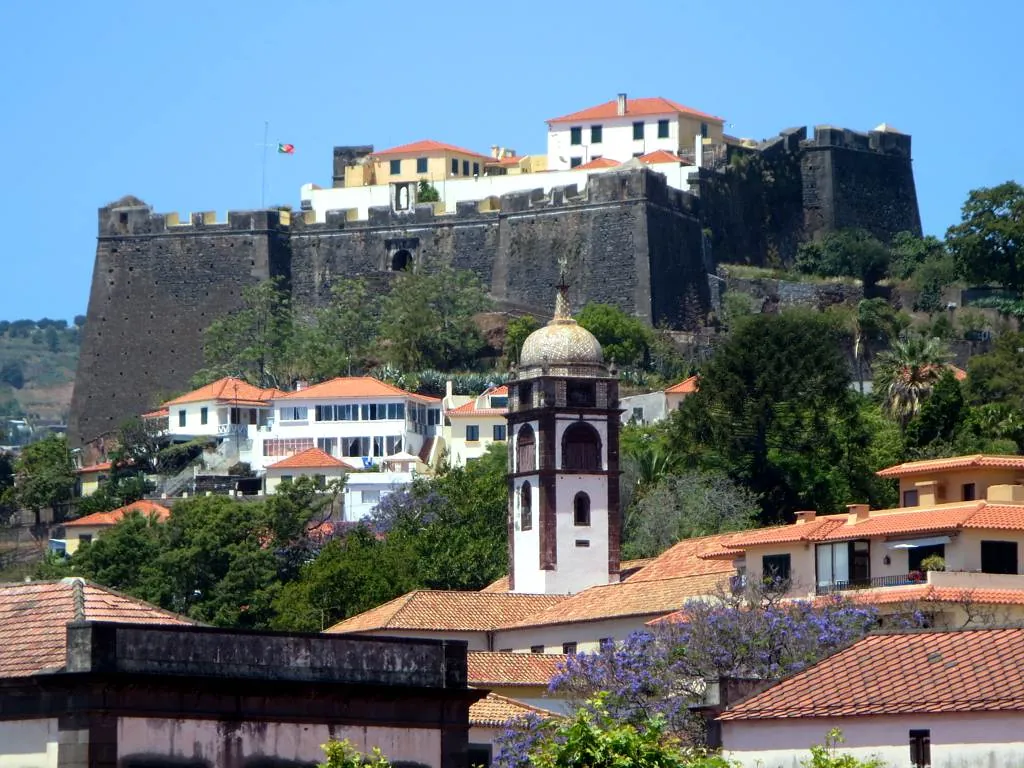
Full article about São Pedro, Funchal: steep lanes where manor silence reigns
Climb 30% cobbled gradients past 1595 Manueline church, salt air turning to loam
Hide article Read full article
The first thing you notice is the camber. Your soles skate on basalt cobbles and your torso tilts forward, as though the city itself is urging you uphill. Somewhere between 100 m and 170 m above the harbour the air changes: salt drops out, chlorophyll rushes in, smelling of damp loam and evergreen. On this steep shelf overlooking the Atlantic, São Pedro spreads across 149 hectares of hair-pin lanes, manor houses and sudden hush—home to 7,204 souls crammed in at 4,835 per km², yet somehow still audible as silence.
A parish that died twice
São Pedro has been born three times. The first delivery came in 1566 when Cardinal-Infante Dom Henrique signed the royal charter that prised it away from Funchal Sé. The new parish centred itself on the little chapel João Gonçalves Zarco—Madeira’s first captain-donee—had raised in 1454 to Saints Paul and Peter. Thirteen years later the bishops changed their minds: in 1579 São Pedro was abolished and re-absorbed. The climb to Sunday mass was evidently penance enough. Finally, in 1587, Philip I of Portugal reinstated the parish for good. The on-off-on again story is textbook Madeiran bureaucracy, but it also records the brute geography of a population scattered up a 30-percent gradient.
For centuries São Pedro remained the island’s most crowded parish, the address of choice for merchants who had grown rich on sugar, then wine. They built high on the ridge, safely above dockside contagion but with proprietary sight-lines over the entire bay.
Stone that speaks, stone that weeps
The mother church, finished in 1595 under royal master-builder Mateus Fernandes III, is the district’s pulse. From the street the façade is plain white lime that rebounds Atlantic light so hard you squint. Inside, the high altar is pure Mannerist theatre: gilded carving flickering between shadow and gold leaf, columns and niches where apostles hover between turf and heaven. Side windows cut diagonal shafts of dust-flecked sun; the quiet feels viscous, the accumulated hush of four centuries.
Five minutes away on Rua João de Deus, the Chapel of São Paulo tells a different tale. Zarco’s tiny 1454 chapel doubled as Funchal’s first hospital—few passers-by realise it. Since 2014 the building has been sealed, its basalt blocks fretted by damp, moss advancing like a second skin. Nineteen properties in the parish enjoy listed status (three national monuments, fifteen of public interest); the plaque, however, is no umbrella. Facing the chapel is to measure the gap between what is valued and what is maintained.
Merchant façades
Walk Rua da Carreira or the alleys that braid off it and you flick through an accidental pattern-book of seventeenth- and eighteenth-century Madeiran town houses: basalt corners, iron balconies, carriage gates half ajar onto secret patios. Some have turned into dentists’ surgeries or architects’ studios; others still keep a discreet residential polish. Scale is the giveaway: these are declarations of status, built by men who wanted the slope’s best angle on the bay.
Where the laurel forest exhales
It startles newcomers to learn that São Pedro lies inside the Madeira Natural Park and within the Unesco-listed Laurissilva. Keep climbing past the last pastel wall and asphalt gives way to red earth; the air cools under louro, til, vinhático—trees that have occupied these ridges since the Tertiary. One moment you are between whitewashed houses, the next you are under an emerald vault echoing with chaffinch song. Viticulture sneaks in even here: low dry-stone terraces once trained Moscatel and now support the last stubborn rows of American root-stock, reminders that urban pressure has not quite erased the parish’s farming chromosome.
Growing old standing up
Census 2021 reads like an elegy: 866 children under 14, 1,711 residents over 65. Sit on the blue-slatted bench outside the Junta de Freguesia at 11 a.m. and you feel the ratio. Blinds lift fractionally in eighteenth-century windows; conversation proceeds at the speed of a drip-filter coffee. Yet São Pedro has not hollowed itself into a set. Every Wednesday the street market on Rua Fernão Ornelas turns plastic crates into shouting matches over the price of red peppers. Bars still pull an espresso for 70 cents, and the corner butcher ties your chouriços with white string, not a paper band.
The echo you take away
Start the descent at golden hour and, somewhere between altitude 170 and sea level, two soundtracks overlap: the city’s distant traffic and, behind you, the drip-green silence of laurel. São Pedro lives in that overlap—a parish caught between the forest at its shoulders and the city tugging its ankles, while Zarco’s chapel quietly dissolves between the two, a question nobody quite answers.