Full article about Funchal’s pocket parish where levadas pulse through balconie
Imaculado Coração de Maria packs 5,627 souls into 136 ha of azulejo-clad modernism and 18th-century
Hide article Read full article
Imaculado Coração de Maria: Funchal’s breath between concrete and laurel
The water arrives before the sound does. A finger-thin ribbon slips along a stone aqueduct wedged between back walls and dripping maidenhair ferns: the Levada do Bom Sucesso, still delivering 19th-century snow-melt to the old Campo de São Martinho fields. Between the liceu Jaime Moniz and the Pilar quarter its murmur mingles with diesel gear-changes and the click-clack of commuters’ heels, an audible palimpsest of pre- and post-war Funchal. That overlay—Victorian engineering under 1960s apartment blocks—defines a parish that was invented by urban sprawl yet refuses to surrender its older pulses.
The youngest, the tightest
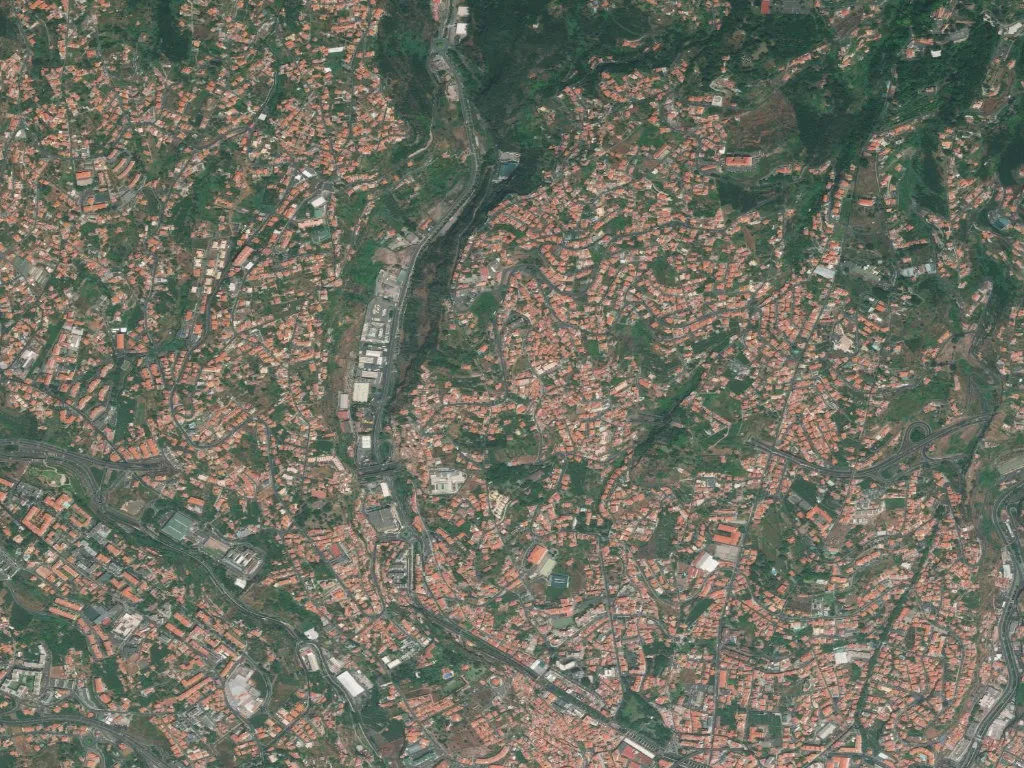
Imaculado Coração de Maria was carved out of São Pedro on 28 April 1954 by a one-page decree printed in Lisbon’s Diário do Governo. The name honours the island-wide consecration of 1942, when Bishop António Manuel Ribeiro entrusted Madeira to the Immaculate Heart of Mary; streets were still cobbled when the first “ICM” letterboxes appeared. At barely 136 hectares it is Funchal’s smallest civil parish, but the 2021 census squeezes 5,627 residents into that pocket—4,137 people per km², denser than Porto’s medieval centre. Houses grew vertically, balconies almost kissing across alleyways, and life spills into the gaps: staircases pitched at 35 degrees, shirts drying in subtropical sun, elderly parishioners occupying stone benches while 600-odd teenagers file past at 4 p.m.
A 1969 church and an 18th-century manor
The parish church, opened on 7 December 1969, is a rare Portuguese specimen of late-modernist sacred architecture: Chorão Ramalho’s rectilinear volume is softened by 156 m² of narrative azulejos painted by Joaquim Alves de Sousa. As Atlantic clouds thicken or thin, the blue-and-white glaze shimmers across the nave like daylight on seawater. Ten minutes’ walk downhill, the Solar de São João survives from 1790—dark basalt corners, carved window-stones, a walled garden now woven into the Rota das Galerias de Arte Aberta, where murals of whales and endemic finches curl around 18th-century stonework. Step from manor to church and you cross 180 years in 300 paces, the pavement changing from hand-laid calçada to brushed concrete.
Where the laurel forest leans over roofs
Average altitude is only 255 m, but the slope tilts sharply enough that, if you climb Rua do Pilar past the satellite dishes, Victorian terraces give way to allotments, then to a moss-coated gate that leaks mist. Here the parish grazes the Madeira Natural Park; fragments of laurissilva—UNESCO laurel forest—still cling to the ridge. Twisted til and bay trunks push through garden walls, their bark jewelled with lichen. Within half an hour the lane narrows to a footpath under a green filter of leaves; Funchal’s bay flickers below, cruise ships reduced to white confetti. You have reached the city’s attic, an arboreal mezzanine few visitors suspect exists.
A levada as timeline
Follow the Levada do Bom Sucesso upstream and you read Funchal in stratigraphy: first the school precinct, then 1970s social housing with painted concrete brises-soleil, finally terraced plots where horta-holders still grow winter cabbage and cherry tomatoes. The watercourse dictated building lines long before planners did, hugging contours like a cartographer’s pencil. Vineyards once scalloped these slopes; now only a handful of pergolas remain, their malvasia grapes destined for domestic vinho de casa rather than the fortified Madeira that built island fortunes. Yet the wine’s ghost is everywhere—on menus, in the cinnamon-scented steam of espetada grills, in parish-hall notices for mid-week tastings.
The blue reflection you carry away
Descend towards the sea and two souvenirs travel with you, whether you notice or not. One is the levada’s hushed continuo, water older than any surrounding masonry. The other is the church’s ceramic shimmer, a square of rippling cobalt projected onto white plaster—sky captured indoors. In a parish where every resident is allocated 24 m² of land, identity is measured in lumens and decibels: a flash of tile-borne light, the whisper of an aqueduct that refuses to be silenced by concrete.