Full article about Santo António: Sunrise Over Funchal’s Laurel-Draped Ridge
Santo António parish, Funchal: swim in cloud-polished pools, walk 16th-century vineyards, greet dawn inside Unesco laurel forest.
Hide article Read full article
Santo António: where the laurel forest meets the rajão
At 07:00 the Atlantic cloud-base is still welded to the ridge, but down in the gorge the Ribeira de Santo António has already clocked on for another millennium’s shift – polishing basalt into swimming holes slick as glazed pottery. From the Lombo de Santo António viewpoint the roofs of Funchal pour downhill in rust-coloured cascades until they slip into the sea. The air carries the damp nip of 559 m altitude, laced with eucalyptus and something older, greener, almost fermented – the breath of the Laurissilva, the Unesco-listed rainforest that wraps the parish in a dark-green cloak. Arrive before the sun with a wool jumper pulled to your chin and you’ll catch the moment the horizon ignites and the laurel canopy bursts into flame-coloured light. This is not sunrise; it’s combustion.
Vineyards, floods and British merchants
Created as a parish in the sixteenth century to serve settlers who landed after 1419, Santo António is one of Funchal’s earliest administrative wards. The first terraces were planted with subsistence crops; by the 1700s the slopes had been flipped to vine and the names on the stone porticos – Blandy, Leacock, Cossart – announced a new, British-accented economy. Their quintas still stand: sober manor houses with private chapels of honey-coloured basalt that have shrugged off Atlantic salt for two hundred years. Earthquakes (1803) and nineteenth-century floods rearranged the street pattern, pushing the settlement uphill and sealing the layout you walk today. Elevated to a civil parish in 1850, Santo António is now home to 25,940 residents squeezed into 22 km² that tilt from city suburb to protected natural park.
Baroque blue, black-grape DNA and a fountain that won’t quit
The parish church, finished in 1810, shelters a Manueline altarpiece and eighteenth-century azulejos whose cobalt seems to drink the high windows’ light. Five minutes away, the Chapel of São Martinho – tacked onto a seventeenth-century quinta – keeps a gilded Baroque altar that glints even when the lights are off. Touchable history waits at Quinta da Rochinha, where the stone lagares of 1750 now form the Wine Interpretation Centre. Inside grows a Tinta Negra vine, trunk as thick as a navvy’s thigh, planted 150-odd years ago and still producing. Taste the volcanic soil in a flight of Madeira: Boal’s dried-orange nose, Sercial’s razor finish, Malvasia’s dark-honey glide. Below the quinta the seven-arched Ponte dos Sete Arcos steps across the stream in dry-stone silence; upstream the 1789 fountain in Largo de Santo António still gushes, fed by a levada tunnelled through basalt before Wellington was born.
A staircase of fire and a levada that hums
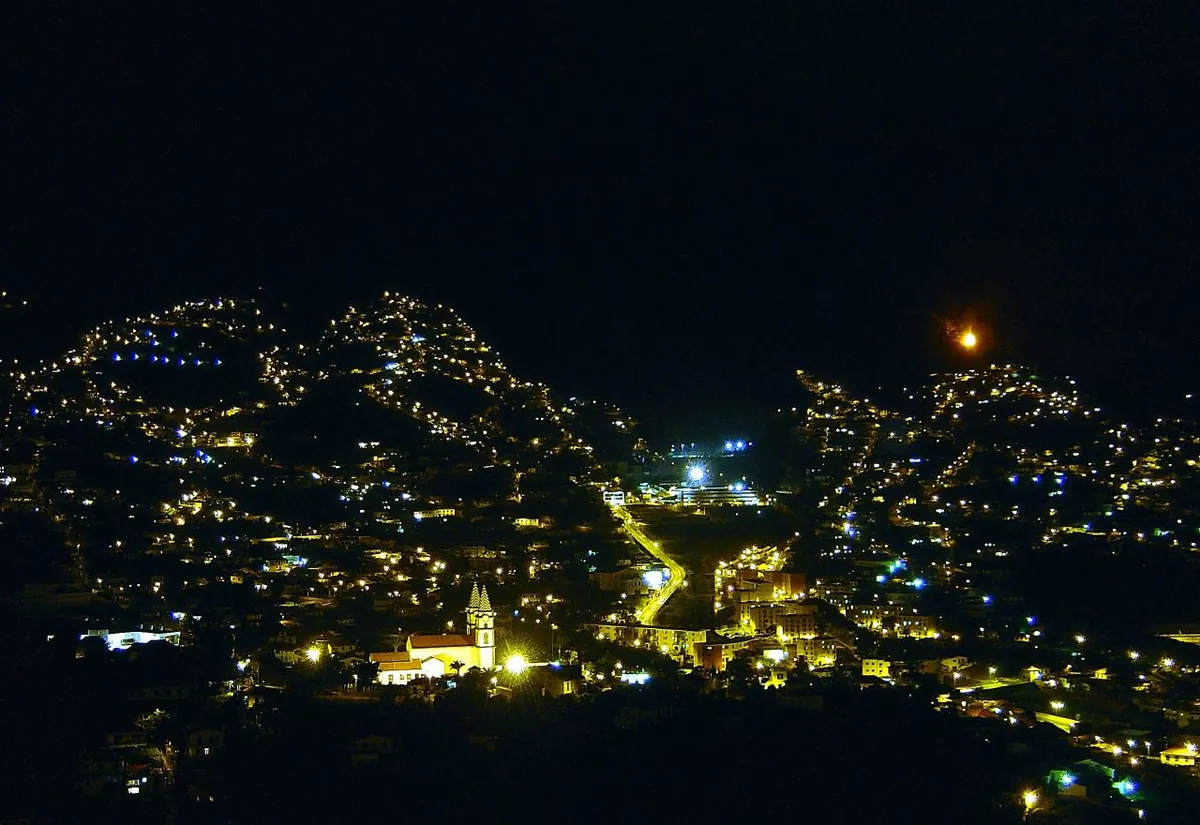
On the night of 13 June the church procession turns mountain guide: candles are lit every few metres along the path to Pico do Areeiro, 1,818 m above sea level. Seen from downtown Funchal the ridge becomes a golden ladder leaned against the sky. By daylight the same trail is the opening stretch of the PR1 ridge walk to Pico Ruivo, where Madeiran firecrests and chaffinches flicker through moss-draped laurel. If vertiginous arêtes aren’t your style, follow the Levada do Santo António: two-and-a-half hours of level riverside walking under eucalyptus and bay, ending at the Miradouro dos Frades where the only soundtrack is water drip-dripping onto stone. Sign up for a new-moon session at the Funchal Ecological Park and the darkness is so complete you’ll feel the Milky Way settle on your shoulders.
Chestnuts on the brazier and meringues that snap
Santo António’s cuisine is governed by flame. Beef espetada – cubed rump threaded on bay sticks, rolled in garlic and coarse salt – is grilled over laurel wood, then brought to table with fried maize squares and bolo do caco, a disk of soft flatbread peeled off a basalt slab. November’s Chestnut Festival fills the lanes with charcoal braziers, roasted nuts popping their shells, and jeropiga, the sweet fortified wine served in thimble glasses. Folk groups rattle the brinquinho, a Madeiran percussion puppet that sounds like someone tap-dancing on a tin roof. For dessert order Suspiros de Santo António, feather-weight meringues that crackle then dissolve on the tongue, and chase them with a poncha made from sugar-cane rum, honey and lime – it burns first, then radiates.
Friday market, clay under fingernails and the small guitar that never left
Every Friday the Largo becomes a low-rise souk: custard-apples, bird-eye chillies, passionfruit stacked like cricket balls. Inside the Casa das Artes potter Carlos Jorge Rodrigues sells bowls the colour of wet laurel and table-runners embroidered with the parish coat of arms – conversation is part of the purchase. At Carnival the masked ranchos march to the rajão, the small four-string guitar that travelled to Hawaii in 1879 and came home renamed the ukulele. December’s Night of the Nativities swings open church doors and quinta gates for candle-lit crib scenes while wooden-ceiled chapels echo with eighteenth-century villancicos.
The final image of Santo António is not the grand view – it’s microscopic. A filament of water slips from the eighteenth-century fountain, landing on black stone with a click almost drowned by Friday’s market chatter, powered by a levada no one sees but which has never once stopped running since the first settler struck basalt on this steep green edge of Europe.