Full article about São Martinho: Chestnut Smoke & Secret Quintas Above Funchal
Medieval wine nights, hidden manor parks and azulejo-clad lanes in Funchal’s mountain-pressed parish
Hide article Read full article
São Martinho: where Funchal presses itself against the mountain
The scent of wood-oven salt cod arrives before the church comes into view. On the night of 10 November, smoke drifts lazily above the terraces that cram the churchyard of São Martinho, braiding with the steam from chestnuts splitting on open braziers and the caramel note of this year’s Madeira wine being poured from unlabelled bottles. Some drinkers have held position since mid-afternoon; others drift in after dark, lured by the sulphur-yellow bulbs strung between balconies and the muffled brass of a village band rehearsing behind the sacristy. The scene is medieval in its cadence – parish records from 1758 already mention the ‘prova do vinho novo’ – and the same verdict is printed on every apron and chalkboard tonight: “São Martinho, castanha e vinho.”
A parish that swallowed manor houses
Created in 1557, when Funchal still hugged the waterfront, São Martinho was carved out of the Sé cathedral parish to serve the farmers settling the basalt slopes 200 m above sea level. It took its name from the fourth-century Roman cavalryman who sliced his cloak for a beggar, but the patron saint had empire-building instincts: over three centuries the parish annexed quintas whole – Barcelos (seventeenth-century), Virtudes, São Paulo, Fundoa – and vineyard terraces that climbed to 400 m. Today 26,929 residents occupy 7.95 km², a density of 3,387 people per km², the highest in Madeira and one of the stiffest in Portugal. Apartment blocks rise like climbing plants yet the nineteenth-century townhouses survive: Quinta da Rochinha (1863) now operates as a small hotel, its basalt gateway still bearing the original owners’ crest; Quinta Magnólia, bought by the town hall in 1982, is public parkland, but the 1878 fountain and cobbled paths of biscuit-coloured calçada remain untouched.
Azulejo, gilt and a princess who refuses to leave
Rebuilt between 1728 and 1740 to a scheme attributed to Lisbon court architect João Antunes, the parish church was granted protected status in 2012. Inside, light falls from high windows on to cobalt eighteenth-century tiles and a 1762 high altar carved by José da Silva, gilded by José de Oliveira – a tableau of such excess that even the side chapels blush. On Corpus Christi the paving stones outside are covered with flower arches, a custom begun in 1912 when parishioners decided the baroque façade needed a horticultural halo.
Five minutes uphill, in the hamlet of Virtudes, the 1780 Chapel of Santa Ana clings to a ruined manor. Its interior is a catalogue of what the Atlantic does to art: gold leaf curls like orange peel, humidity blooms across the face of the infant Mary. Catalogued by the heritage service in 1997, it has waited ever since for a saviour with deep pockets.
From Pico dos Barcelos to black-sand Praia Formosa
The parish climbs from 138 m to the 580 m summit of Pico dos Barcelos, where an ecological park opened in 2003 gives simultaneous views of the Curral das Freiras crater and the full sweep of Funchal’s bay – terracotta roofs pinned between volcanic ramparts and 2,000 m of deep Atlantic blue. Eastwards the boundary touches the laurel forest Unesco listed in 1999; the air here is cool enough for moss to colonise street signs. The Levada do Bom Sucesso, hacked out in 1889 to feed the city’s reservoirs, now serves as a 3.7 km walking trail through eucalyptus and laurel, ending at the Poço Barral lookout where kestrels ride the thermals.
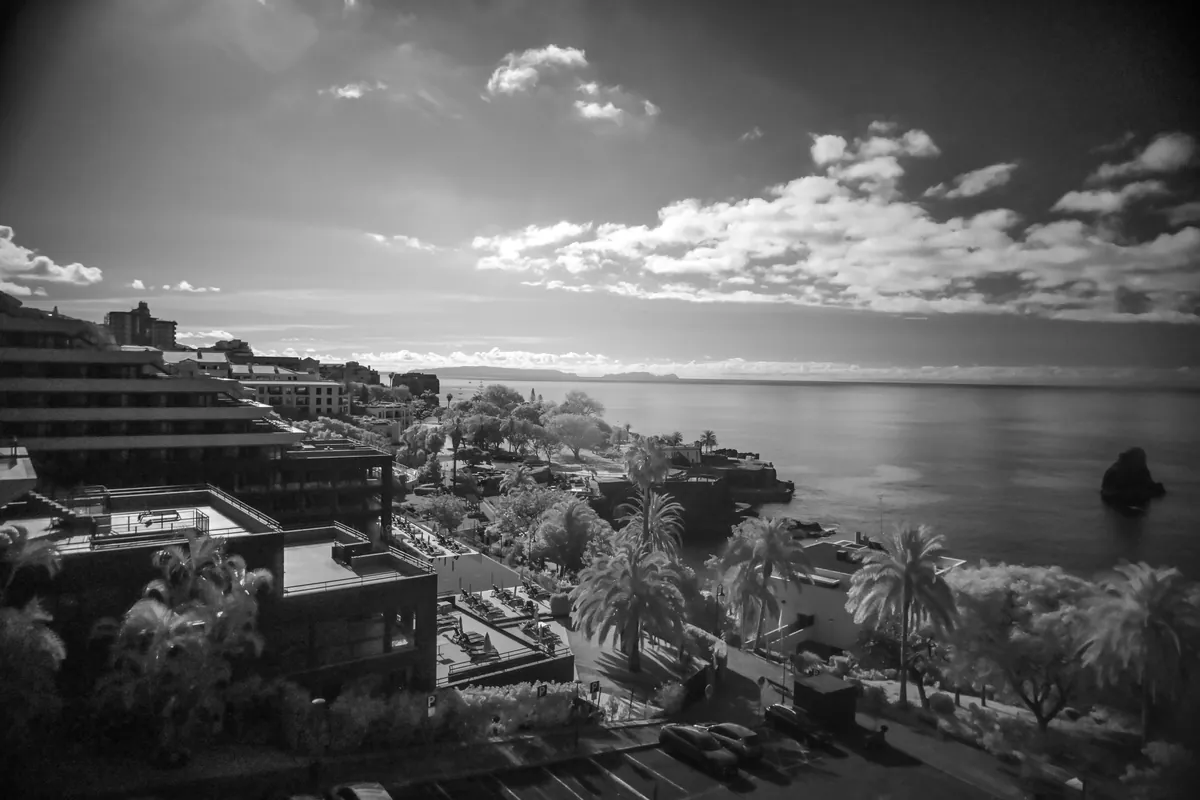
Below, the parish unfurls to a 3 km seafront. Praia Formosa – the city’s largest black-sand beach, flying a Blue Flag since 1986 – delivers the Madeiran version of hot-stone therapy: midday temperatures of the dark sand can nudge 40 °C even when the Atlantic hitting your shins is 19 °C. A pedestrian promenade completed in 2008 links Praia do Gorgulho, creating a continuous ocean walk lined with tascas serving coral-pink prawns and iced coral beer.
Dancilhas, poncha and bolo do caco
Every October since 2012 the parish council and the folk-association Rodopio Pitoresco turn Quinta Magnólia’s garden into an open-air ballroom for Festival Dancilhas – three days of European folk dance that began with 500 participants and by 2023 had tripled. Violas from the Ajuda cultural band duel with the rustle of palm fronds; couples from Toulouse dance cheek-to-cheek with Madeiran grandmothers who learnt the schottische in 1954.
There are no protected designations here, yet São Martinho’s kitchens hold their own. Restaurant O Portão has been threading beef on to bay-laurel skewers since 1978; the scent drifts across the car park like incense. At Padaria do Lido, bakers slide bolo do caco – disk-shaped sweet-potato bread – from the stone oven at 07:00, still blistered and pliant. Cais Velho sends out limpets that hiss in their own juices, sharpened with Calheta lemon and a side of fried maize. In the pastry shop Vilaça, broas de mel follow an 1898 receipt and almond custards arrive with a shot of tangerine poncha made from fruit grown 40 km away in Santana’s terraces.
The Botanical Garden, within parish limits since 1960, shelters 2,500 species; a cable-car installed in 2003 glides 15 minutes down to Monte, launching riders into the wicker-toboggan run – two kilometres, 100 m drop, two carreiros in straw boaters steering by the soles of their boots.
The last glass of the eve
By midnight on the 10th the churchyard empties. The Confraria do Vinho Novo – founded 1996 – has dispensed its annual 3,000 litres; someone sweeps ton-loads of chestnut shells into piles for the municipal lorries. A single dry bell stroke drops down the slope, dissolving among rooftops on its way to the sea, leaving only the composite perfume of charcoal, cod brine and young Madeira wine lingering in the narrow air of São Martinho – a scent you will not find anywhere else on the 11th day of the 11th month.