Full article about Caniçal: Sunrise, Whale-Smoke & Sausage Bolo
Dawn over Madeira’s eastern tip, where whalers once lived and bakers now flame bolo do caco.
Hide article Read full article
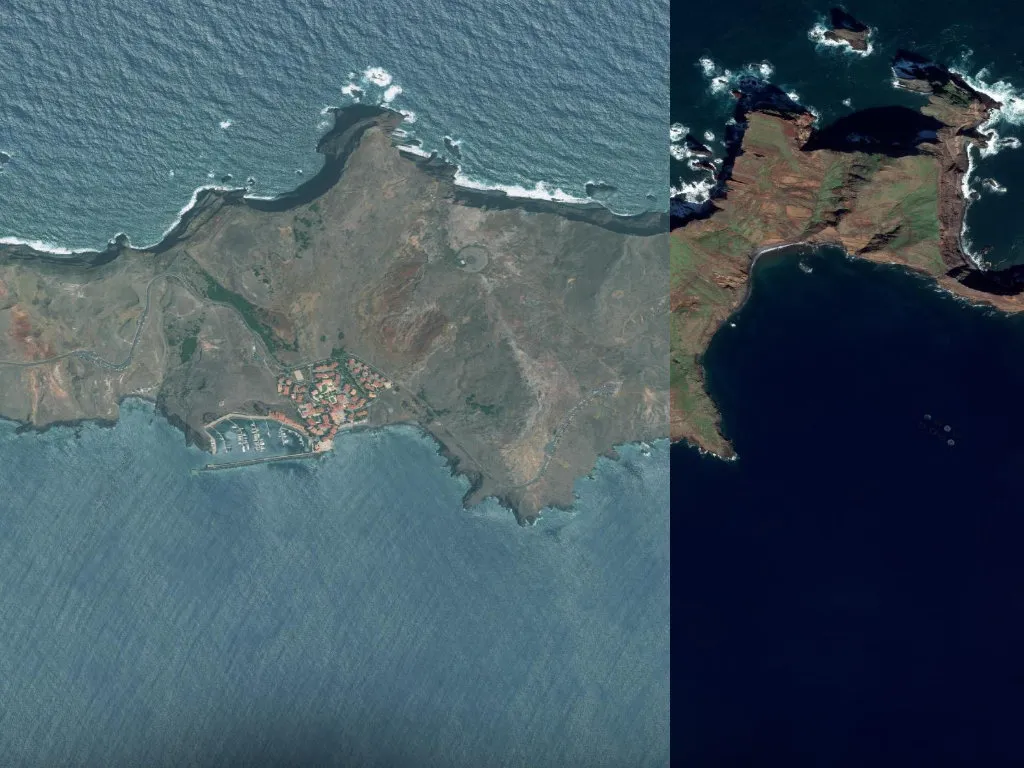
Dawn hits the São Lourenço peninsula first
The sun’s opening ray lands here before anywhere else on Madeira. At 05:52 the sky above Caniçal is already bruised pink; by 06:05 the bakery lights are on. Padaria do Caldeira, wedged above the shuttered Cine-Teatro, slides its first bolo do caco into wooden trays that still smell of last night’s eucalyptus smoke. The village amphitheatre of terraced houses faces due east, so the light pours in over the crane-dotted container port and the east wind lifts the hems of the women setting out chairs on Rua da Praia.
A coastline that learned to look outward
Garcia Moniz’s 1490 chapel of São Sebastião is gone, replaced by a football pitch whose touch-line exactly follows the original nave; locals swear you can hear the saints grind their teeth every time the referee whistles. A five-minute stroll north, the stub of Forte do Pesqueiro is now a dry-stone playground where children hunt Madeiran wall lizards, but until 1958 a rusting 19th-century Krupp gun still pointed seaward, a warning to English privateers who once raided this side of the island. The present church, dated 1749, is the third on the site: Barbary corsairs burnt the first, the 1748 earthquake tumbled the second, this one stayed. On hot days its cedar ceiling still leaks the scent of beeswax.
Water arrived in 1955 via a stone aqueduct, and with it came bricklayers from Minho who married into fishing families. Their grandchildren speak a hybrid accent—continental vowels salted by maritime slang—and invented the now-ubiquitous bolo do caco stuffed with alheira sausage, something no Caniçal grandmother had imagined before. When the Companhia da Balela opened its whaling station in 1944 the men returned home stinking of whale oil, women braided oakum on the courtyard stones, and children used cetacean vertebrae as footballs on Praia de Santana.
When the sea joins the procession
Every September the parish carries Nossa Senhora da Piedade down what the street sign calls Dr Horácio Bento de Gouveia but everyone still refers to as “the lower road”. Chico do Barco coaxes the fishing boat San Miguel into line, engine misfiring on cue, while a crocheted towel protects the statue’s feet from Atlantic spray. At the corner of the old olive press the widows roll up their tights and wade ankle-deep, a gesture nobody can quite explain—some say it remembers the days when laundry was beaten on the same basalt slabs.
The cemetery’s small Capela da Piedade holds three headstones carved only with dates: sailors lost within sight of land. Beyond it, the white tower of the 1874 lighthouse was paid for by a Liverpool ship-owner who eloped with the customs officer’s daughter and insisted the paint be “bright enough to show a ship’s blood if she grazes the reef”.
Trails between levada and lava
The irrigation walk begins behind the former slaughterhouse—now Zé Moleiro’s garage—where the first 50 m always smell of burnt eucalyptus. At 09:00 sharp, Sr António releases the iron valve; water clatters through the gal pipes and he shouts “Mind you get wet!” to anyone wearing clean trainers. A side path leads to João Cabeça de Ouro’s 1944 cache: dented Wehrmacht ration tins, still stamped with eagles, slowly rusting under agapanthus.
Low tide in Baía da Abra reveals granite pools where parents teach children to prize percebes off the rock, always with the warning that a monk seal was seen here yesterday. The miradouro above Estreito is where teenagers bring their dates to watch the runway lights of Cristiano Ronaldo International Airport flick on, and where the retired priest counts returning trawlers like rosary beads.
By 20:45 the San Miguel is back at the jetty, engine coughing dry. Chico revs once, twice, so the crochet towel flaps in the wind and the statue’s skirts are salt-spotted but safe. Inside Bar dos Pescadores, Filipe has already pulled seven espressos; the men compare the day’s sword-fish prices and agree the sea is warmer than it ought to be for late September. Outside, the lighthouse keeps its white vigil and the peninsula waits for the next dawn that will, as always, arrive here first.