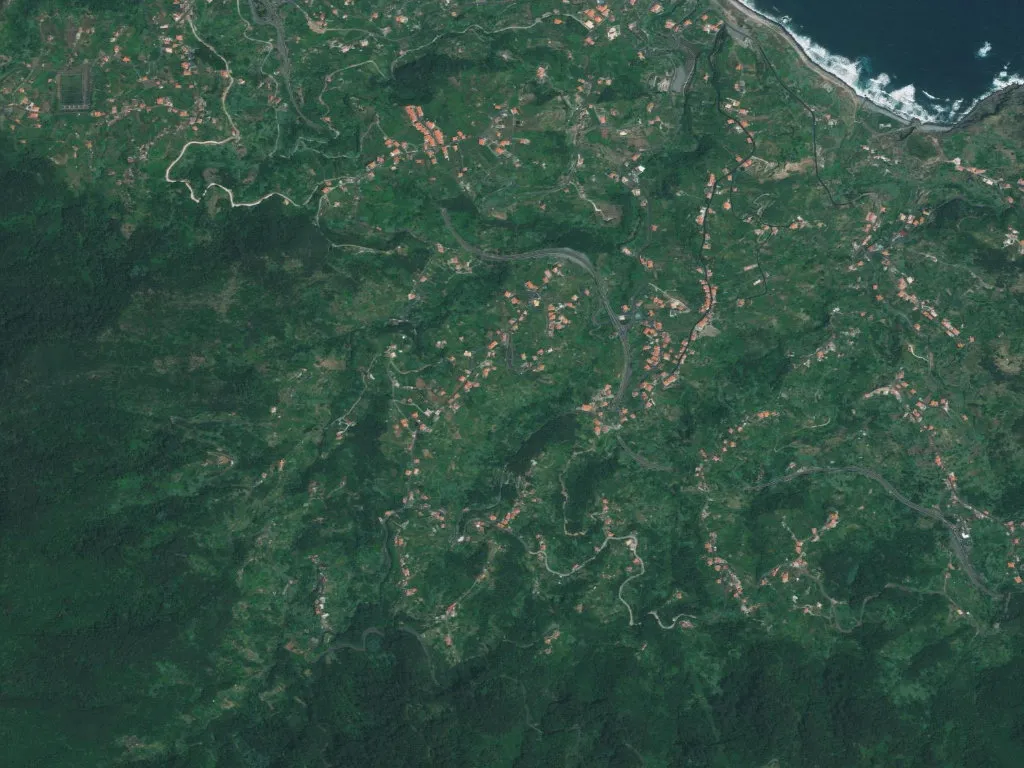
Full article about Porto da Cruz: where cane smoke meets Atlantic brine
Penha de Águia looms over cane fields, seawater vines and 1927 stills in Machico’s northern corner
Hide article Read full article
Steam, salt and basalt
Copper cauldrons exhale a thick, sweet breath above Engenho do Norte while Atlantic air, freighted with brine, rolls in from the bay. The two scents braid together and settle on shirt cuffs like invisible tar. This is how Porto da Cruz announces morning: a fusion of cane spirit and seaweed, watched over by Penha de Águia, a 580-metre blade of basalt that slices the horizon.
Crosses and cane
Elderly residents still point to the spot where a wooden cross once guided fifteenth-century boats onto the shingle. The tiny Capela de Santa Cruz, whitewashed and sea-battered, huddles beside the original mooring. Uphill, the parish church of the Holy Trinity, paid for by nineteenth-century British wine merchants, presides over a square where men debate football under jacarandas. Inside the distillery, itself a relic of 1927, João carries on the family craft: three consecutive days of stripping, crushing and single-pot distillation. The first measure of aguardente is declared “for friends”; the rest is wheeled away in demijohns to Rosa’s bar where it becomes poncha, beaten to a pale froth with honey and lemon.
Terraces that spill to the ocean
Vines are trained low here, almost crawling between banana clumps, because the wind off the North African swell tolerates no vanity. Zé do Carmo’s grandfather planted five terraced rows and bequeathed him the constant task of rebuilding dry-stone walls after winter storms. Yet the grapes survive, thick-skinned and salt-dusted, yielding a red that islanders call “American wine” – an earthy, almost savoury pour that pairs with the local tuna. Higher up the slope, prickly-pear paddles sprout from fissures; children slice them open on the walk home from school, staining fingers magenta.
Waterways and rock
The Levada do Castelejo begins behind the distillery, its opening stretch still cobbled by hand. Hens scatter as you step onto the stone, then laurel and lily-of-the-valley trees close overhead, moss swallowing every sound except the faint lisp of water slipping along stone. For the bold, Penha de Águia offers no levada comfort: a near-vertical three-hour scramble on crumbling scoria, completely exposed. From the crest you can sight the distant outline of Porto Santo on clear days and watch cargo ships inch along the shipping lanes, toy-like beneath you.
Breakfast fire, lunch smoke
César’s wood oven is lit before first light. While the dough for bolo do caco rises, he fetches wheat loaves from the bakery next door. By seven the coals are white; steaks of mature highland beef, marinated for forty-eight hours in house red, garlic and home-grown paprika, are lowered onto bay-laurel skewers. Fish depends on Zeca’s dawn haul: when the sea allows it’s black scabbard or grouper, otherwise espadarte from the deep-freeze. Rosa’s poncha arrives unbidden: three fingers of cane spirit, one of wild honey, lemon juice to taste, whisked with a stick of strawberry-tree wood until it foams.
September gold
During the Feast of the Exaltation of the Holy Cross the seafront bandstand fills with folding chairs and the alleys are canopied with tissue-paper garlands. What began as a sailors’ procession is now a home-coming: emigrants return from Caracas, Paris and New Jersey, their Portuguese rusty but their appetites exact. The parish hall hosts open-house dinners; tables extend into the lane, weighted down by fried moray, yam and the obligatory vinho americano. On the final evening the brass band strikes up, fireworks arc over Penha de Águia, and for a moment the village feels its old population again.
The black-pebble beach remains, reshaped weekly by Atlantic surges. Surfers wax boards beside the old fish-drying racks; at dusk only the stones are audible, clicking softly as the tide rearranges them. Behind, the engenho’s chimney still sends up a lazy plume, dissolving into the hill fog that drifts down after sunset, blurring the boundary between land, sea and cane spirit.