Full article about Seixal: Madeira’s Vertical Parish Above the Clouds
Black-terrace vineyards plunge 340 m to the Atlantic inside 15-million-year-old laurel forest.
Hide article Read full article
Where the Forest Meets the Atlantic
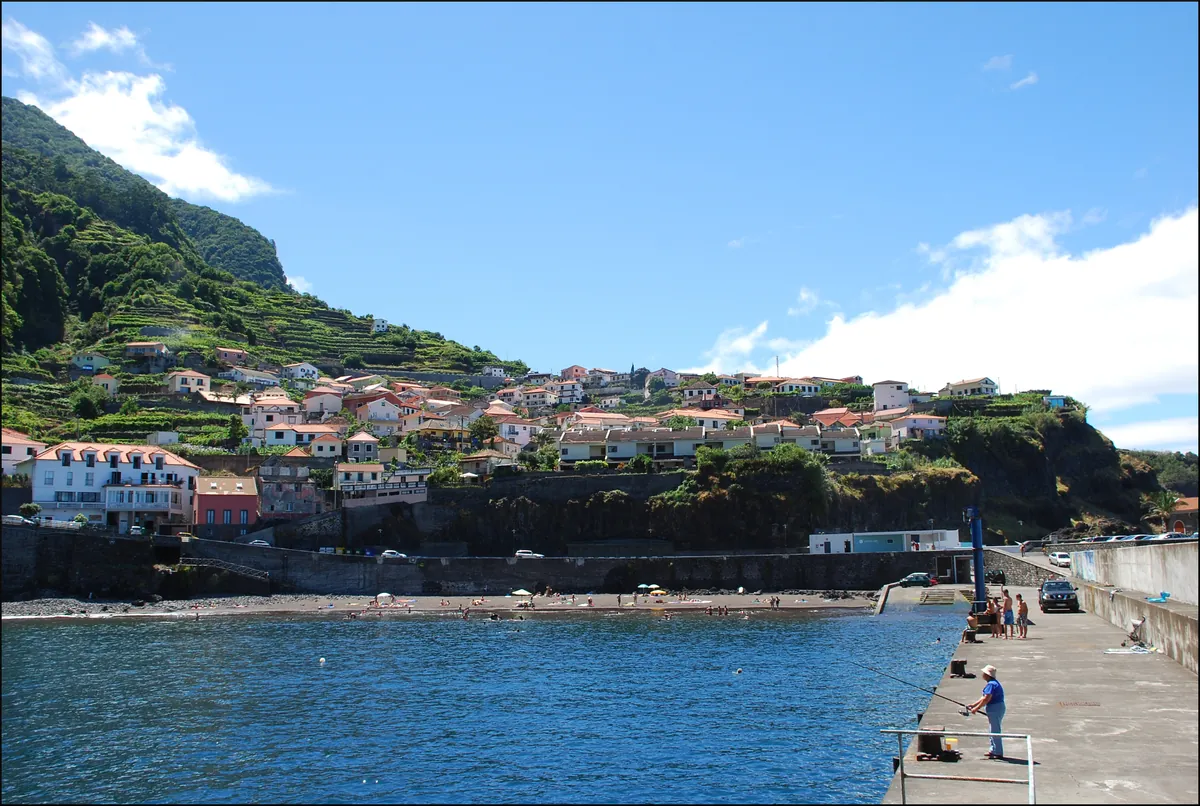
The slope drops 340 metres in a single gesture, heaving black basalt terraces towards the sea. From the ER-101 you count them—vineyard ledges, banana plots, a patchwork of rye—each held in place by dry-stone walls no thicker than a forearm. Six hundred and twelve people share this vertical parish; scatter them across 36 km² and you arrive at sixteen souls per square kilometre, a ratio more Highland Scotland than subtropical island.
Laurel Country
Most of Seixal lies inside Madeira Natural Park, and therefore inside the 15-million-year-old laurel forest that UNESCO lists as a World Heritage Site. Til, vinhático, barbusano—evergreen hardwoods that once girdled the Mediterranean—now survive only here and in the Canaries. At ground level the air is saturated; water condenses on leaves, drips, keeps the moss an almost artificial emerald. Sound behaves oddly: the Atlantic is a mile away but you hear only your own pulse and, somewhere overhead, the thin whistle of a Madeiran firecrest.
The forest ends as suddenly as it begins. One bend in the footpath and you’re staring at a basalt shore where waves detonate in white petals. Seixal gives you both atmospheres within a ten-minute walk—cloud-forest twilight and oceanic glare.
Living Above the Inversion
An average altitude of 341 m means the sea is always visible yet not always reachable. Farmers work in fleece; the thermometer can be six degrees cooler than Funchal on any given morning. Vines are trained low, pegged to chest-high trellises so the wind doesn’t snap them, and the harvest comes three weeks later than in the south. The resulting wine—made from hybrid varieties like Bastardo and Tinta Negra—carries a sharper, greener acidity, closer to a cool-climate Jura red than to the fortified classics shipped from Funchal in the nineteenth century.
Demography is equally bracing. One in four residents is over sixty-five; only sixty-six children are enrolled in the primary school. The parish council scores the logistical difficulty of daily life at 55/100—anything above 50 on Madeira’s rural index flags unreliable bus connections, a 45-minute drive to the nearest A&E, and groceries that arrive by lorry twice a week.
Vertical Territory
The PR 14 ‘Levada dos Cedros’ begins just above the village and immediately reminds you that contour lines here are decorative fiction. The path narrows to a cobbled shelf cut into the cliff; guardrails are intermittent, and winter moisture turns basalt into wet glass. Within a kilometre you’ve gained 200 m of elevation and lost any phone signal. Continue and you reach the 100-metre Véu da Noiva waterfall that simply steps off the lip of the escarpment into the ocean—a sight that looks computer-generated until the spray hits your face.
Walk more gently along the coast road and you’ll find the Piscinas Naturais do Seixal—lava pools refilled by every high tide. They’re free, unsupervised and edged by a single café whose espresso machine dates from 1992. The black-sand beach beside them is one of the few on Madeira where the sand is genuinely natural rather than imported from Western Sahara.
What the Land Gives
Gastronomy scores 35/100 on the regional index, a number that translates as “what you eat is what you can carry uphill”. Yet simplicity has its own grammar. At O Pastel, Friday’s fish stew arrives in a pot sealed with bread; the catch is whatever Porto Moniz boats landed the previous afternoon, usually black scabbard or grouper. Padaria do Seixal still fires its wood oven at 4 a.m.; by nine the corn and rye broa is sold out, mostly to farmers who’ve already worked two hours.
Evening brings the northerly fog back up the valley, erasing first the sea, then the terraces, then your own hand in front of your face. Sound narrows to water trickling in the levadas and the soft percussion of dripping leaves. Seixal doesn’t court you; it withholds, then yields just enough to make the next climb, the next bend, the next weather front feel like a negotiation you might win tomorrow.