Full article about Tábua: Where Madeira’s River Sings Above the Clouds
Laurel mist, basalt terraces and candle-smoked chapels cling to Ribeira Brava’s tiniest parish.
Hide article Read full article
The river that named a parish
Water talks in Tábua. Not the ocean – that’s 500 m below – but the Ribeira de Tábua itself, tumbling seven kilometres from Pico das Pedras to the Atlantic, audible in every lane. At 521 m above sea-level the air is soaked in laurel-forest breath; vapour drifts across stone terraces stitched with Madeira wine vines, sugar-cane and banana fronds. Barely 1 200 souls occupy these 11 precipitous square kilometres, the smallest parish in Ribeira Brava municipality, yet the sound-track makes it feel crowded: constant water, wind in Laurissilva leaves, the odd church bell.
What “Tábua” really means
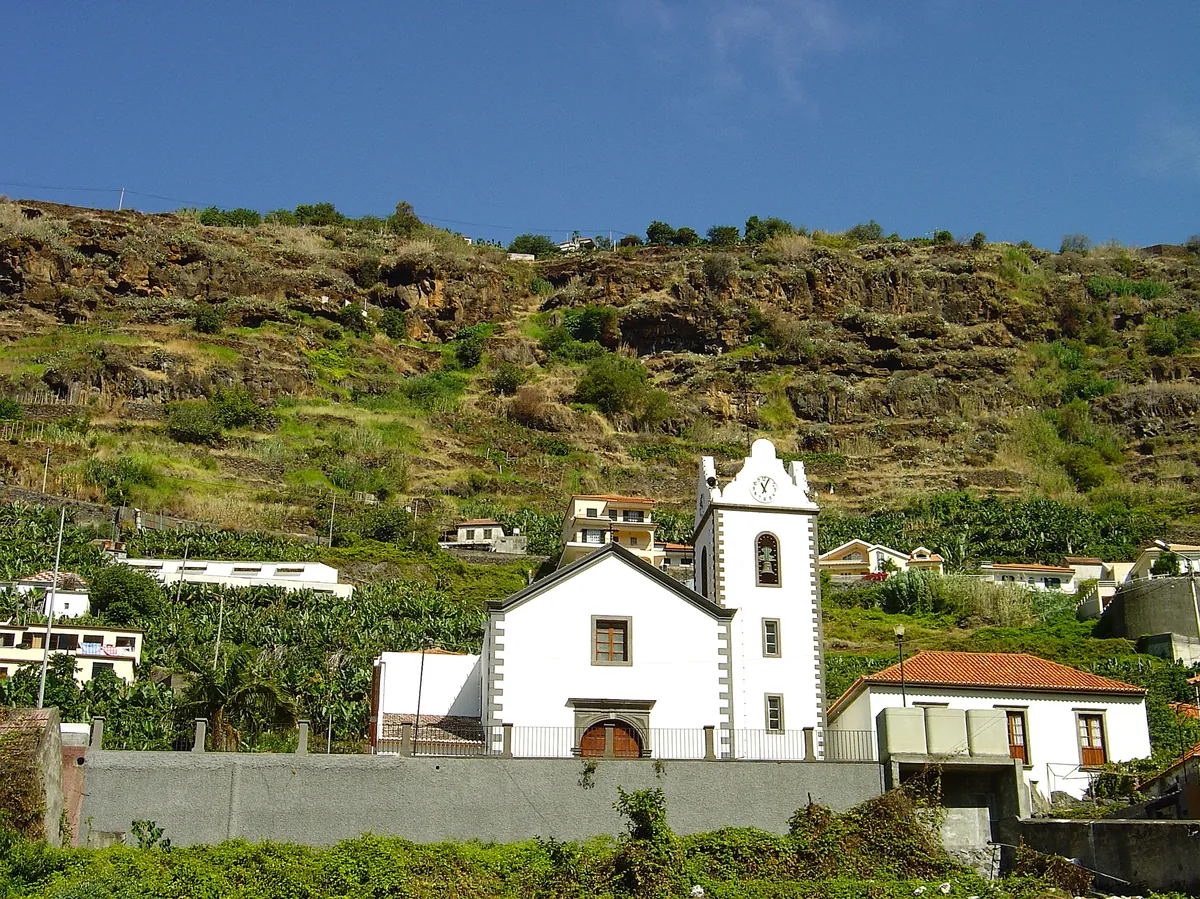
Older parishioners still say “Atábua”, the pre-1838 form, recalling a reed-like sedge whose fibres once became chair seats and straw-coloured mats. The plant has vanished but its name clings to the valley. A chapel to the Holy Trinity first drew settlers around 1588; the present parish church, Nossa Senhora da Conceição, rose after an 18th-century flood demolished the original. Administratively Tábua has shuttled: annexed to Ponta do Sol in 1881, returned to Ribeira Brava in 1914 – bureaucratic tides as regular as the Atlantic swells below.
Faith carved in basalt and lime
Seventeenth-century whitewash glows against schist irrigation channels and the dark granite walls that keep the poios (terraces) from sliding downhill. Side-chapels – Candelária in dignified ruin, Mãe de Deus tucked into a crook of the road – punctuate footpaths once paced by monks bearing the Host to outlying hamlets. The ensemble is classed Monument of National Importance, yet protection is simple: daily use, candle smoke, the tread of processional sandals twice a year.
A calendar you can dance to
Christmas Eve sees torch-lit pilgrimages zig-zagging between houses; January brings the Cantar dos Reis, a door-to-door Epiphany carol whose melodic line predates printed hymnals. On 2 February the tiny Candelaria chapel fills for Nossa Senhora das Candeias, candles blazing against winter drizzle. The detail that stops folklorists in their tracks? At the nine dawn Masses before Christmas, elders accompany hymns with castanholas – paired wooden clappers whose brittle click has vanished from every other parish in Madeira.
Between forest and furrow
Tábua sits wholly inside Madeira Natural Park, wrapped by 15 000 ha of UNESCO-listed laurel forest dripping with Vaccinium, Heberdenia and the island’s own Laurus novocanariensis. Below the canopy the same water that irrigates the wild forest feeds levadas that spill onto smallholdings no wider than a London bus. Vineyards authorised for DOP Madeira wine share terraces with sugar-cane once distilled into aguardente; bananas destined for Funchal market sprout below cane tops that whisper in the upslope breeze. Population density hovers at 100 per km² – silence with a pulse.
Memory rehearsed, not museumised
In April 2025 villagers restaged early-20th-century coastal trading for Ribeira Brava’s maritime festival: fish salted in Tábua sailed westward by wooden xavega, returning with salt from Porto Moniz, the whole exchange paced by tides and muscle. Of the 156 under-25s still here, most know the route their grandparents walked to deliver baskets of tomatoes to the old pier at Campanário. The past is not a plaque; it is the angle of a hoe, the timing of a feast, the metallic snap of castanets in a December dawn.
The river keeps talking, unconcerned by municipal borders or republics. Walk the cobbled shortcut from the church to the forest track and you will hear it – water that remembers a plant no one can identify any more, and a valley that refuses to hurry.