Full article about Gaula’s Cradle: Laurissilva Mist to Banana-Scented Terraces
Gaula, Madeira: banana perfume, levada mills, Laurissilva trails and farmhouse wine minutes from the airport.
Hide article Read full article
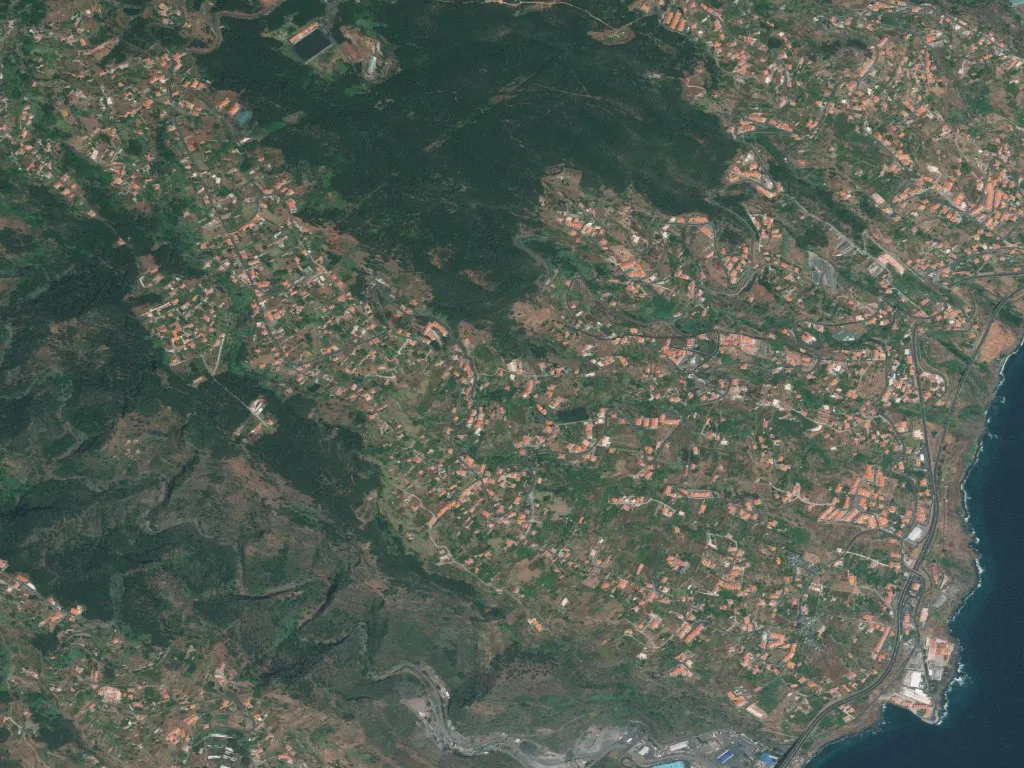
The ER-102 wriggles uphill like a black ribbon; one moment you taste salt on the wind, the next you’re brushing the hem of primeval forest. Gaula slips into view between 230 m and 450 m: crimson roofs scattered over basalt, vines stitched into tiny terraces the older growers still call poios, and the Laurissilva pressing its moss-coloured ceiling against the sky. Atlantic humidity fuses with the ammoniac sweetness of banana fertiliser – not a smell, a signature perfume. Ten minutes beyond the airport’s perimeter fence, the parish registers 535 inhabitants per square kilometre, yet the only traffic jam is a neighbour easing a wheelbarrow between dry-stone walls that have been holding back the mountain since the 1800s.
Between Laurel and Ocean
Gaula straddles the boundary of Madeira Natural Park. Walk north and the levada do Poço das Neves ushers you straight into UNESCO-listed Laurissilva; climb south-east and the 1948 earthquake-rebuilt Igreja de São João Baptista frames the Desertas Islands on the horizon. That tight sandwich of altitude and exposure dictates the table: yams for boiling, squat banana-da-terra for frying, African spinach brought home by Cape-Verdean sailors, and grapes that never aspired beyond the farmhouse demijohn. Ask for wine in a restaurant and you’ll be directed to Funchal; here, the only label that matters is the one scribbled on the carboy in your cousin’s cellar.
The Only Listed Monument
The Mannerist altarpiece in the Capela de Nossa Senhora do Livramento arrived from Lisbon after the 1759 Jesuit expulsion; the rest of Gaula’s heritage is living infrastructure. Five water-mills on the Levada do Lajeado still stand—two restored in 2018 by the Madeira Mountaineering Club—while stone threshing circles dot Lombo Galego and 1894 wooden conduits called lambas feed the public wash-house at Fonte da Senhora, now the favoured Christmas-barbecue pitch.
Grapes and Groundwork
Phylloxera reached Madeira in 1909; by 1912 the island’s vines were charcoal. Replanting favoured Tinta Negra, today the parish’s 11.3 ha of registered vineyard (IVBAM, 2022). None carries the Madeira DOC—growers either sell grapes to the Santo da Serra co-op or distil a fiery house brandy. The rest of the land behaves like an over-achieving back garden: custard apples ripen for December markets, snake-skin passionfruit becomes breakfast jam, and 80 tonnes of yams a year travel to São Pedro market in Funchal, the island’s wholesale heart.
Generations on a Tightrope
Census 2021 counted 590 children and 724 seniors within Gaula’s 7 km². Primary-school rolls fell from 160 to 137 between 2015 and 2023; the day-centre that opened in 2019 already has a waiting list. Yet Café “O Canto” fills at 07:30 with airport-free-shop staff and gardeners heading to Quinta Splendida’s botanical estate, both a twelve-minute commute. On Friday nights the flood-lit sand pitch at Lombo de Gaula hosts SC Gaulense veterans who have been sliding tackles and cracking jokes in the same strip since 1998.
The soundtrack is hydraulic: the Levada do Lajeado, channelled in 1886, runs beneath my bedroom window 24/7. When the flow falters, someone telephones the chefe de levada; he appears with the stainless-steel mattock the council issued in 2020, hacking away until the water remembers its course. That thin silver thread reminds us the island is still volcanically alive, that allotments belong to whoever wakes early enough to irrigate, and that—citizen card and satellite postcode notwithstanding—Gaula remains a village that just happens to lie inside a city called Santa Cruz.