Full article about Ilha: Madeira’s Amphitheatre of Fog & Forgotten Laurel
A 1989-born parish where 189 souls share 14.7 km² of UNESCO laurel and basalt silence.
Hide article Read full article
A village that arrived late
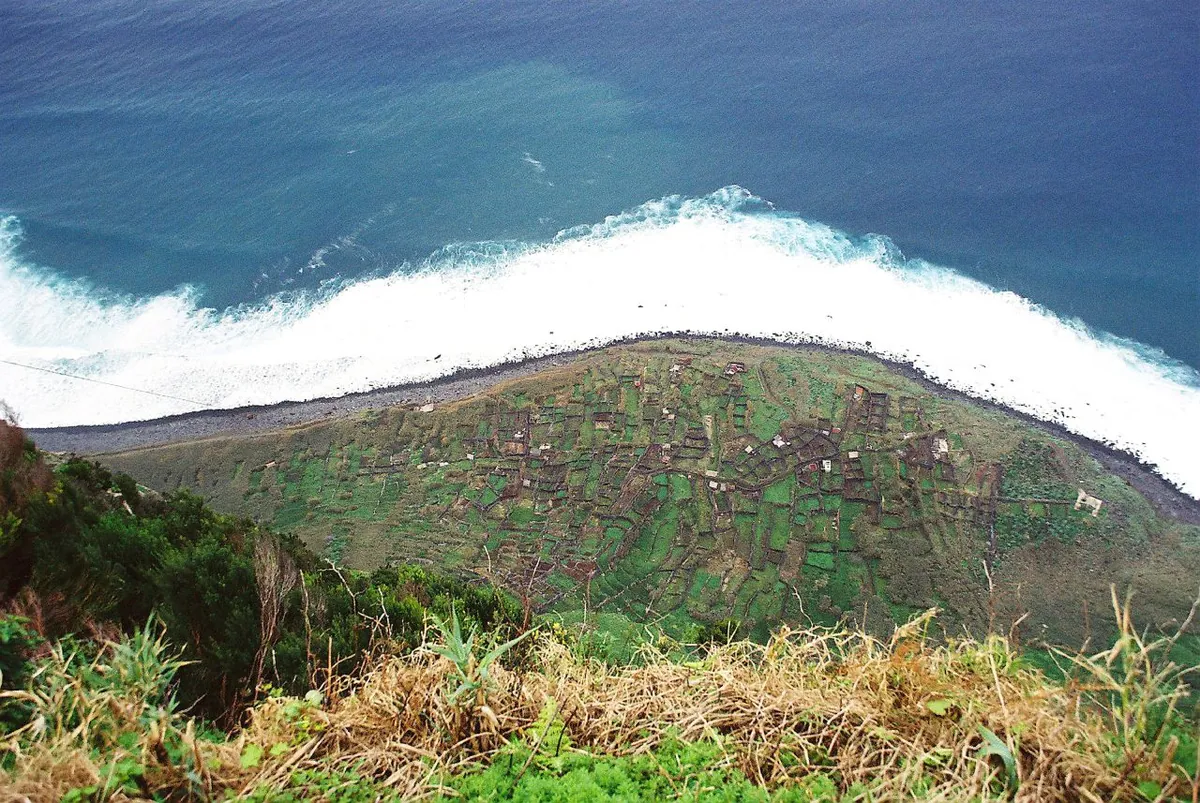
Fog pours down the valley like cold milk, wrapping itself around moss-slick laurel trunks. At 715 m the only sounds are a distant water channel muttering to itself and a bird you will never see. This is Ilha, the island’s newest parish, carved out of Santana in 1989 when cartographers finally admitted the place was just too far away to govern from anywhere else. Geography here is a deep basalt amphitheatre; isolation is not a mood, it is the daily commute.
One hundred and eighty-nine people (2021 census) share 14.7 km² of UNESCO-listed laurel forest – a human density lower than the red deer of Dartmoor. Most of the scatter of houses among the avocado trees went up between 1981 and 1990, regional-government social housing that swapped basalt for breeze-block yet still shelters the same families who know every shortcut to their potato plots.
Chapel and concrete: the architecture of 1983
São João’s chapel keeps its seventeenth-century footing but wears a 1980s concrete coat; it is listed, like 190 other parish buildings, in the “popular” grade – code for “no architect was harmed in the making of this place”. The raw grey stuff dominates because Ilha’s brief population boom coincided with subsidies designed to stop young Madeirans fleeing to Caracas.
August’s only diary date
Forget processions. The year turns on three evenings in August when the parish hall lays long tables for wheat-and-kale soup, someone’s cousin plays accordion, and the home-baked loaf contest is judged by women who have never bought yeast. Turn-out is 65 per cent – 123 names on the roll, every vote audible across the dance floor.
Inside the green that swallows lenses
Ilha sits squarely within Madeira Natural Park. The paths are working levadas: PR 14 drops to Ribeiro Frio’s trout ponds, PR 15 climbs towards Pico do Areeiro’s knife-edge, yet there are no ticket booths, no branded waymarks. Tree ferns unfurl two-metre fronds above your head; Madeiran blueberry heath powders the air with lilac pollen in June. Humidity condenses on camera glass; boots darken in minutes. The scent is of damp loam and slowly turning leaves. Carry water and a wind-shell – the weather can flip in the time it takes to eat an orange, and the only espresso is back at sea level. The constant water-noise is not ambience; it is the 400-year-old channel still rationing every drop to the terraces of Serra de Água.