Full article about São Roque do Faial: misted laurel & levada breath
São Roque do Faial hides a 15-million-year-old Laurissilva levada, 16th-century timber ruins and flood-scarred bridges above Santana, Madeira.
Hide article Read full article
Water moves beneath the moss like a withheld breath.
At 670 m above the Atlantic, the levada that threads São Roque do Faial is carpeted with ferns so thick you never see the channel itself—only hear it, a low metallic whisper that keeps time with your boots. Til and vinhático trunks rise out of the mist like columns in a drowned cathedral; then the fog withdraws and sudden sun sparks the laurel leaves with the wet sheen of pewter. This is the fringe of the Laurissilva, the 15-million-year-old forest that once covered all Madeira and is now a UNESCO World Heritage site. The parish still inhales through it.
Roots and ruins
The name Faial is a botanical memory: early settlers found the slopes upholstered with Myrica faya, the “Madeira beech” they called faia-da-terra. One of the first to profit from its timber was Lançarote Teixeira, son of Machico’s captain-major, granted this rugged sesmaria in the 16th-century scramble for altitude land. Their chapel to São Roque—patron against plague—went up beside the stream, was swept away by a winter torrent in 1744, rebuilt, then incinerated in 1960. The present church is diaspora work: emigrants in Toronto, Caracas and Rio sent home money and photographs while Father António Martinho spent seven years supervising every sack of cement and hand-cut block.
Stone, water, half-finished arches
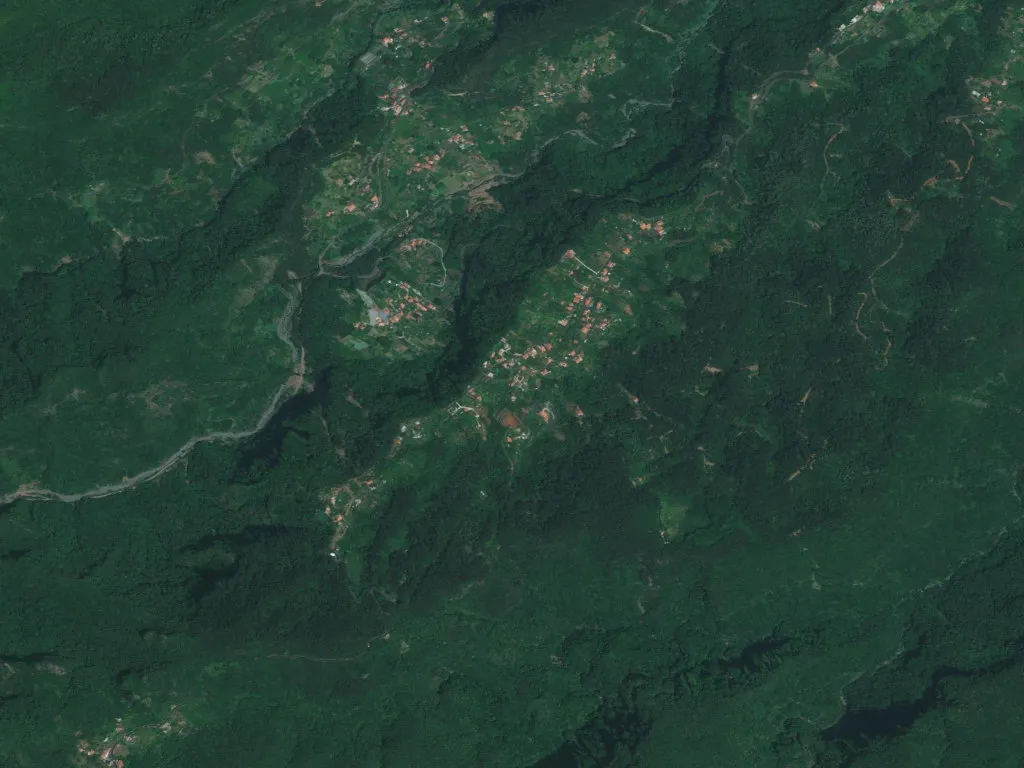
The parish arranges itself in vertical stripes: riverbed, terraced plots, then forest. Half-way up, at Fazenda, a chapel has been chiselled straight into a basalt outcrop—Nossa Senhora da Penha de França, 1685, its interior still smelling of damp stone and candle smoke. Below, only three arches of a seven-arch bridge survive the 1984 flood that took the rest. They stand in the coat of arms now, flanked by a beech leaf and an eagle, emblems of an equilibrium that never quite settles. A five-minute scramble above the village, the Fortim do Tojal is nothing more than a stone balcony, but from it 18th-century look-outs once scanned for Barbary corsairs that never reappeared.
Cider, chestnuts and slow orchards
Population 680, median age 66. Yet even here tradition ferments: Geraldo Dória presses old-field apples and pears in a granite trough, bottles the must with nothing but wild yeasts, and ages it for nine months until the cider carries the IGP seal of Madeirense identity. Acidity climbs with altitude; sweetness lengthens the lower the orchard. When the mist closes in, wood-smoke drifts from sheds where chestnuts roast on eucalyptus logs or stew with kid in winter broths. Bio-vegetable terraces—kale, potato, pumpkin—follow the lunar calendar, and a glass of 10-year-old Madeira is poured by neighbours who still distinguish festa days by what is ready to pick.
Green trails, blue Atlantic
From the Guindaste platform the north coast unrolls like a topographic map: Faial’s ravine stitching the slope, the peninsula of São Lourenço floating far to the east, breakers exploding black basalt into slow-motion geysers. Signed paths dive into the Natural Park, following 16th-century irrigation channels that siphon spring water down to banana fields. In the understorey the Madeiran chaffinch and kinglet rustle before you see them, quick commas among lichen commas. Even when the path veers away, the levada’s murmur threads the silence, a continuo that only stops when dusk fog erases every outline and the forest is reduced to texture: moss soft as felt, the iodine breath of decomposing leaves, the chill that rises from volcanic bedrock. São Roque do Faial does not perform for visitors; it yields itself reluctantly, layer after layer, the way that cliff once gave up its stone for a chapel.