Full article about Fazenda: Where Clouds Graze Basalt Walls
Lajes das Flores' cliff-top parish breathes salt-spray, rye ovens and 261 stubborn souls
Hide article Read full article
A Parish That Wears the Clouds
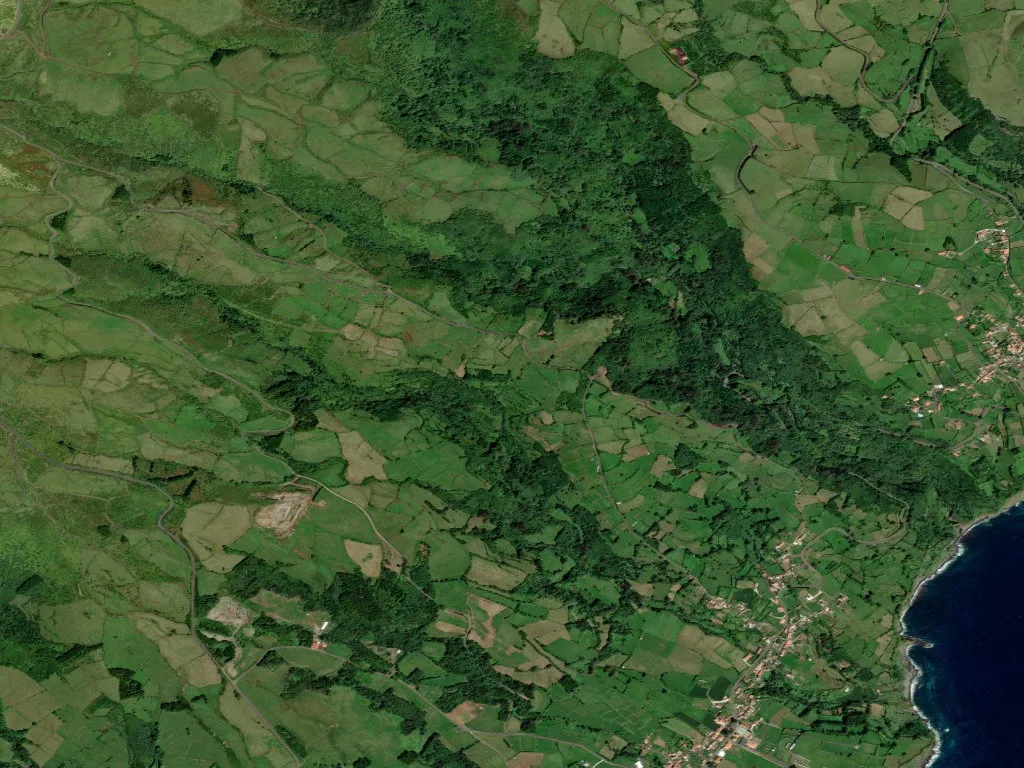
Sea-fog climbs the cliff at Fazenda and settles on the basalt walls like a second skin. Hydrangeas along the lane take on a gun-metal sheen from the salt-spray the Atlantic flings upwards, and every face you meet tastes faintly of brine. At 291 m above the swell, this westernmost parish of Lajes das Flores inhales at the tempo of Azorean isolation – 261 souls spread across almost a thousand hectares where pasture quarrels with sky for breathing space.
Geography for those who stay
Twenty-seven people per square kilometre: the arithmetic explains the hush. Field boundaries are stitched by hand, stone upon black stone; the only punctuation is the low of a Friesian cow or the stammer of a finca tractor that has seen better decades. Thirty-six children still race home on earthen tracks; forty-seven elders remember when the island fed itself without refrigerated ships or government subsidy. Between these generations, time is portioned out in yam harvests, cloth-bound queijo do Pico dripping whey on a slate shelf, and rye loaves baked in communal ovens that have not cooled since 1923.
The name means simply “farm”, yet the altitude shields the settlement from Atlantic storm surges while surrendering to a wind that sculpts every dry-stone wall into a reluctant bow. Basalt outcrops force their way through the sward, black knuckles of a UNESCO Global Geopark still flexing after half a million years.
Life inside the walls
Guidebooks award Fazenda no stars, no way-marked trails. What it offers is a living exhibit of continuity: women stitching white-on-white embroidery in the one patch of winter sun; mending cotton nets they no longer cast, because habit is a kind of ancestry. Logistics here are existential – a replacement hinge for a gate must wait for the fortnightly ferry from Faial, then the island’s only supermarket van. Isolation is not scenery; it is infrastructure.
The kitchen larder follows the same rule. Sweet potatoes roast in the wood stove; wreckfish appears only when the skipper judges the swell charitable; yesterday’s broth becomes tomorrow’s caldeirada, thickened with saffron milk caps picked from the hillside. Vines survive in microscopic quadrangles, trained inside high basalt screens that mimic the currais of Pico. Their grapes – small, thick-skinned, salt-shocked – yield a wine that tastes of struck flint and green apple, poured from unlabelled bottles for anyone who lingers past the second coffee.
The weight of an open sky
To walk the lanes at dusk is to feel the island press gently down on your clavicles. Not through menace, but through the pure physics of space: 360° of horizon, the knowledge that Newfoundland lies 1,900 km to the north-west and nothing at all lies west of here until Canada. Beauty arrives in increments – a shaft of sun on a whitewashed transept, then gone; a rainbow that lasts long enough to be doubted. The parish church bell strikes noon; the note travels unimpeded through damp air, finds every scattered house, then dies, leaving only the wind that never, on Flores, thinks to apologise.