Full article about Cedros
Azorean cedar roofs, hidden groves and August processions in Flores’ smallest parish
Hide article Read full article
Where the cliff road ends
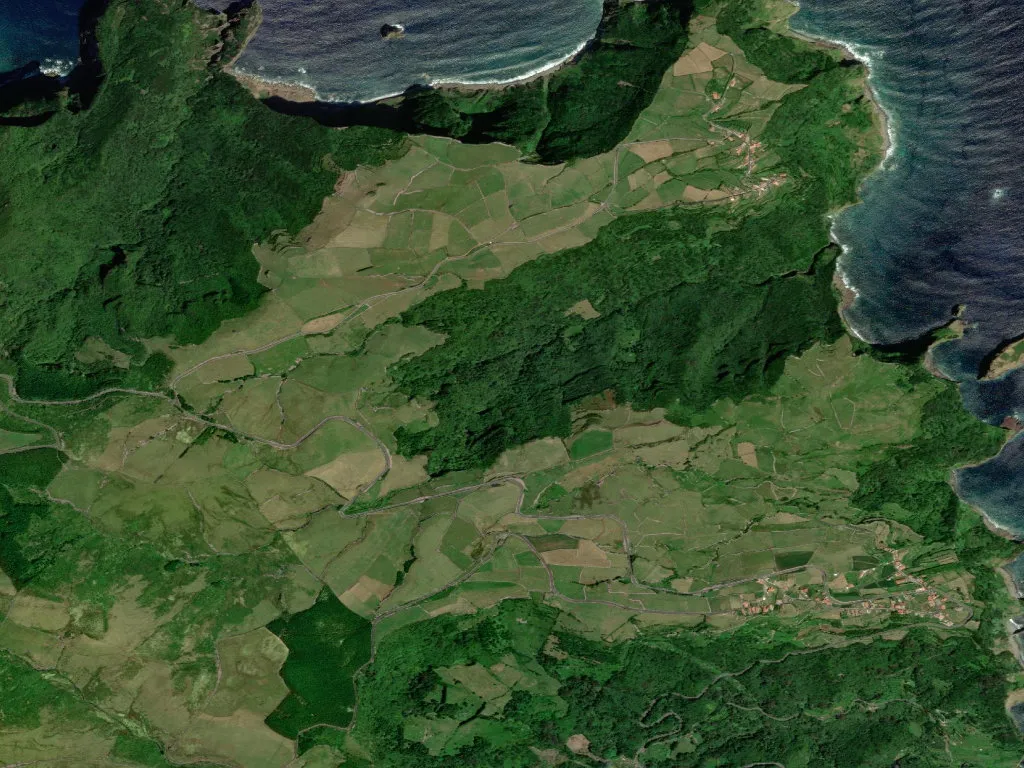
Ribeira da Alagoa hits the Atlantic in a natural amphitheatre of basalt, the south-westerly wind slamming into the eastern rim of Flores without apology. In this green cleft, 112 neighbours occupy a scatter of single-storey houses and the odd orange grove that refuses to give up. Dry-stone walls keep cows from wandering over the edge; the animals graze inches from a 200-metre drop, unbothered.
The cedar that christened the quiet
Early settlers named the parish after Juniperus brevifolia, the Azorean cedar they felled for roof beams and fishing boats. By 1693 the head-count had already peaked: 50 households, 176 people. Today Cedros is the island’s smallest civil parish, its white-plaster Igreja de Nossa Senhora do Pilar (rebuilt in 1954 after the 1712 original was demolished) standing alone at the centre like a single exclamation mark on a horizontal sentence.
When oranges sailed to Falmouth
Between 1890 and 1960 the bay below served as Flores’ only reliable anchorage during south-west gales. Wooden crates of Valencia oranges were lugged down the ravine, loaded onto English schooners and landed, still cool from the Azorean current, in Southampton and Falmouth. The trade died with the introduction of refrigerated container ships; today only hikers on the GR1-FLO long-distance trail descend to the shingle beach, stripping off for a bracing plunge before the return climb.
Procession, triduum and the summer census
On 15 August the village doubles in size. Emigrants flying in from Boston, Toronto and south London squeeze into family houses that have stood empty since the previous summer. The three-day triduum begins with 8 p.m. mass on the 12th; by Sunday afternoon eight local men shoulder the gilt canopy of Nossa Senhora do Pilar through lanes scented with grilled limpets and sweet basil. Folk group Os Cedrenses strike up a chamarrita, and the dancing spills across the churchyard until the wind finally calls time.
Between sea stack and hydro dam
Seven kilometres of narrow lane twist west to Ponta Delgada, hydrangeas spilling over the walls like blue surf. Stop at the Miradouro do Ilhéu Furado and the perforated sea stack lines up with the horizon, a 20-metre basalt arch sculpted by Atlantic storms. Inland, the road climbs to the 1966 hydro-electric dam that gave Flores its first 24-hour electricity; the reservoir sits in pasture so violently green it makes sunglasses useless. Cattle bells echo across the crater, and somewhere below a wave detonates against fresh lava.
When the sun drops at 18:30 and the Ilhéu Furado glows like hot iron, Cedros feels less like a destination than a pause between mountain and ocean, measured out in footfalls on uneven cobbles and the faint slam of a screen door in the wind.