Full article about Almagreira: Where Atlantic Wind Salts the Pasture
Basalt-walled fields, 616 villagers, wine licked by brine—Santa Maria’s quiet crest above the indigo
Hide article Read full article
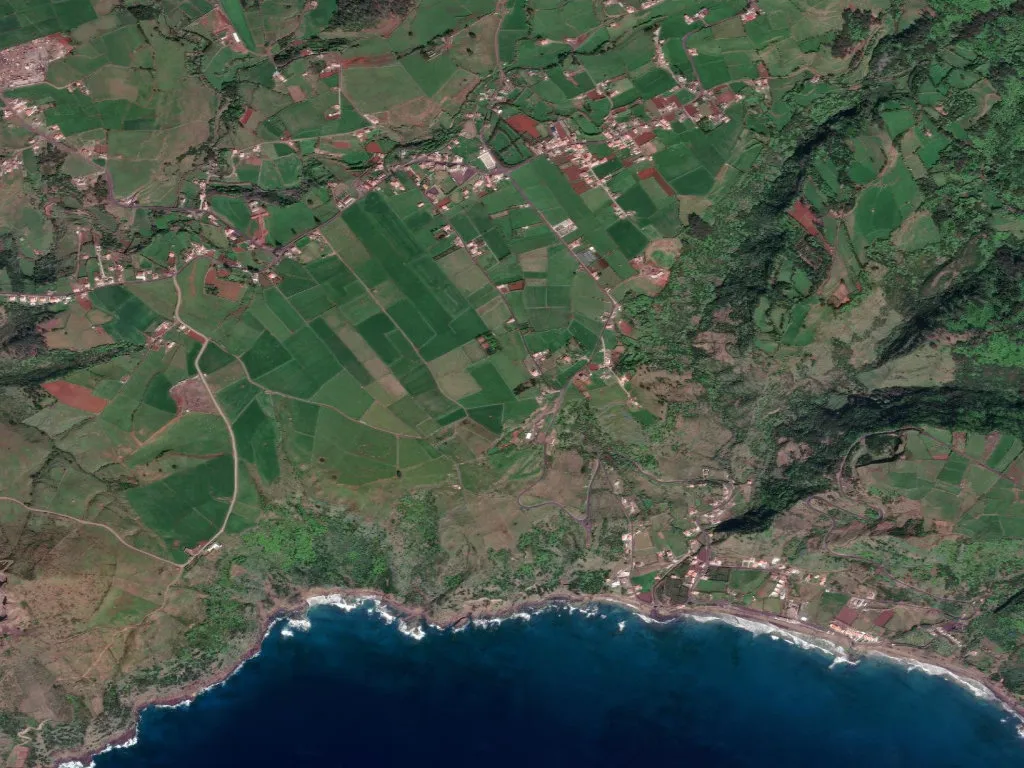
The wind climbs the hill as if it were nipping to the corner shop: no knocking, it simply walks in. It carries sea salt right up to the farmhouse door and, when the afternoon tilts westward, folds in a pinch of dried seaweed to season the breeze. At 182 m above the Atlantic, Almagreira unrolls like a warped carpet: sunshine tears through the cloud and the pasture glows so green it feels like advertising; fog drops and the land turns the colour of under-roasted coffee. Basalt walls, shoulder-high and lichen-mottled, still mark out holdings the way they did before satellites—patient hands, heavier stones.
Six-hundred-and-sixteen, stretched thin
Eleven square kilometres, 616 parishioners: the maths leaves you with near-silence. Cows outnumber cars; a farmer can park his tractor in the middle of the lane for a chat without a single horn sounded. Ninety-three children learn distance in Azorean strides, not metres of tarmac: goalposts are two basalt boulders, the bell is a mother’s whistle from the kitchen door. Old men—76 of them over 65—still recite every plot by name and heir. Meet one on the footpath and he won’t ask where you’re from; he’ll ask, “Where’s the road taking you?”—a courteous way of asking whether you plan to stay for the afternoon or merely drift through.
A balcony over the past
From the crest above Malbusca the ocean looks like indigo tweel stretched seam-to-seam to Brazil. Santa Maria, the archipelago’s eldest island, has watched volcanoes rise and retire; its patience shows in the low, wind-bent vines that hug the ground behind miniature stone parapets. The walls are built from the very clods that were lifted to plant, an agricultural jigsaw that keeps both soil and heat. The resulting wine, bottled under the Azores’ IPG “Vinho de Licor,” tastes of brine and powdered basalt; sip slowly or the finish slaps like a wave that never asked permission.
No queue, no gift-shop, no filter
There are no ticket booths, no laminated viewpoints, no designated selfie spot. Access is easy but not effortless: tarmac exists, but so do potholes that school you into second gear. Risk is minimal; worst-case scenario is meeting a heifer mid-bend, her expression clear: “I told you to take the left fork.” Beauty here doesn’t shout. It asks you to sit on a wall, let the Atlantic wind fill your ears, and notice what needs no filter: a freshly turned field, limewash flaking off a cottage, a mongrel asleep in the sun too polite to bark.
When dusk slips behind Pico Alto the wind stays awake alone, whistling through the narrow windows, rattling shirts on the line, ferrying the clatter of cutlery out across the pastures. Persistent, slightly meddlesome, it is the parish’s night watchman—and the reason Almagreira is still a place where silence itself holds the conversation.