Full article about São Pedro: Where Cannonballs Sleep in Church Walls
Stone corrals, 23 Império chapels and a 1616 corsair’s cannonball mark Santa Maria’s highest parish.
Hide article Read full article
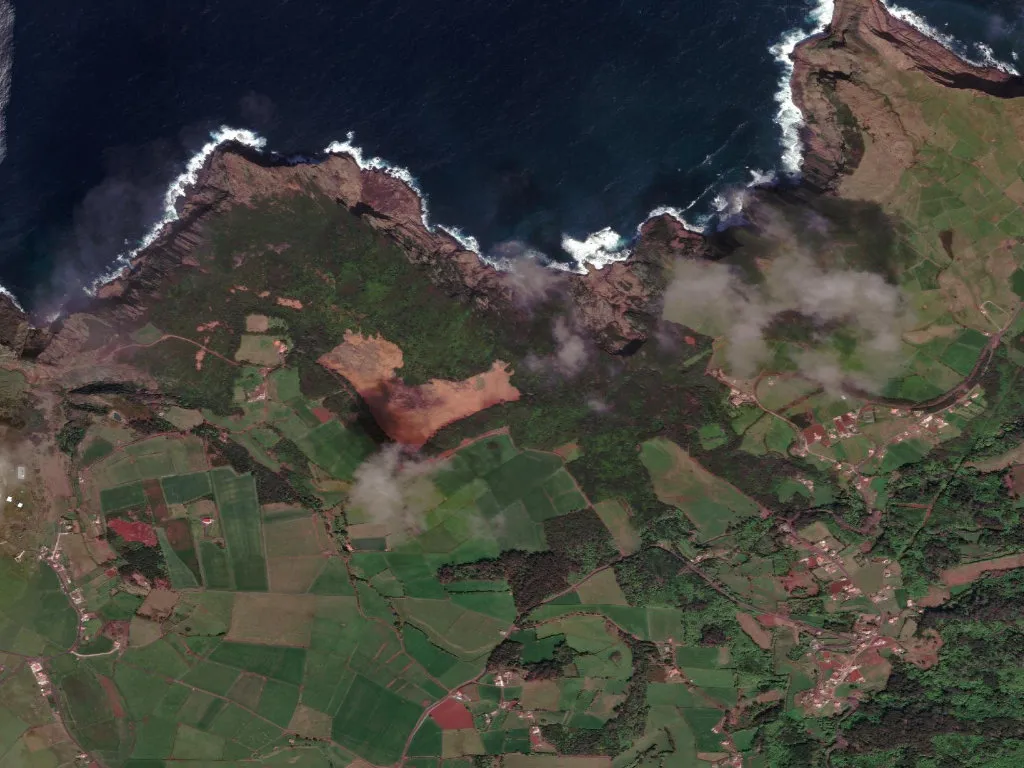
The bell of São Pedro strikes noon before you even see the village. Its bronze note rolls downhill, collides with the murmur of the Ribeira de São Pedro, then dissolves into the cryptomeria shade. At 150 m above sea-level, two miles west of Vila do Porto’s ferry dock, the smallest parish on Santa Maria island arranges itself around 47 listed dry-stone corrals, lime-washed Império chapels and pastures that climb to 300 m before the land tips into the Atlantic.
Stone, faith and a corsair bullet
The single-nave parish church, completed in 1694 on the footprint of a 15th-century hermitage, measures exactly 18 m inside. Its 1734 gilded altarpiece still gleams, but look left into the sacristy: a 24-pounder cannonball fired by the privateer Manuel Pessanha in August 1616 is lodged in the 1.2 m-thick basalt wall. When Pessanha’s squadron appeared, all 120 villagers locked themselves inside for three days, defending the doorway with 17 matchlock muskets. Outside, the black basalt cross was landed from the brig Nossa Senhora da Conceição in 1853; six yoke of oxen and hemp ropes from Faial hauled it uphill.
Twenty-three Impérios do Espírito Santo—more per square kilometre than anywhere else on the island—dot the lanes. The oldest, on Rua de Baixo, dates from 1823. On Pentecost Sunday, the procession leaves the church at 9.30 a.m. and walks exactly 847 m to the principal Império, where the brass crown and dove are lifted above the white-washed walls.
Taste of land, taste of sea
Fish stew here is a precise affair: conger, dusky grouper and white seabream simmer 45 minutes in clay pots from São Miguel with three kilos of malagueta tomatoes and 200 ml of local pimentão. Octopus is braised for two hours in 750 ml of vinho de cheiro drawn from the parish’s 14 terraced vineyards. In January, when the annual pig is killed, torresmos crackle in five litres of lard; they are served with two kilos of yam and a liver sauce sharpened with 200 ml of white wine. Dessert is bolo de panela, its 300 ml of honey sourced from eight registered hives, spiced with Ceylon cinnamon and chased by fig eau-de-vie dripped through three illicit backyard stills.
The “work of sharing” survives. On 17 smallholdings, neighbours still gather to plant maize in April and pick grapes in September. Payment is lunch: 15 kg of cured cow-and-goat cheese, 30 corn loaves and 20 litres of red wine that disappears before the sun hits the yardarm.
Between river and basalt track
The Caminho dos Três Bicas (2.3 km) begins at the church door, drops past three stone troughs where the stream forms mirror-bright pools, then climbs through moss-covered basalt to the 500 m crescent of Praia Formosa. Since 2013, this blond sand and its underlying volcanic tuff have belonged to the Azores Geopark; snorkel 12 m down and you drift over sargo and salema shoals.
From the Pico Alto lookout, eight minutes by car above the village, the island tilts away in every direction—orange light on pasture, ocean welded to sky. On Fridays, six São Pedro farmers unload their harvest at Vila do Porto’s producer market: coriander €1 a bunch, figs €2 a kilo, passion-fruit liqueur €8. The same 17 calloused hands that pass you the change will, before the year is out, raise another 120 m of dry-stone wall, whitewash an Império, and keep the bell tolling at midday.