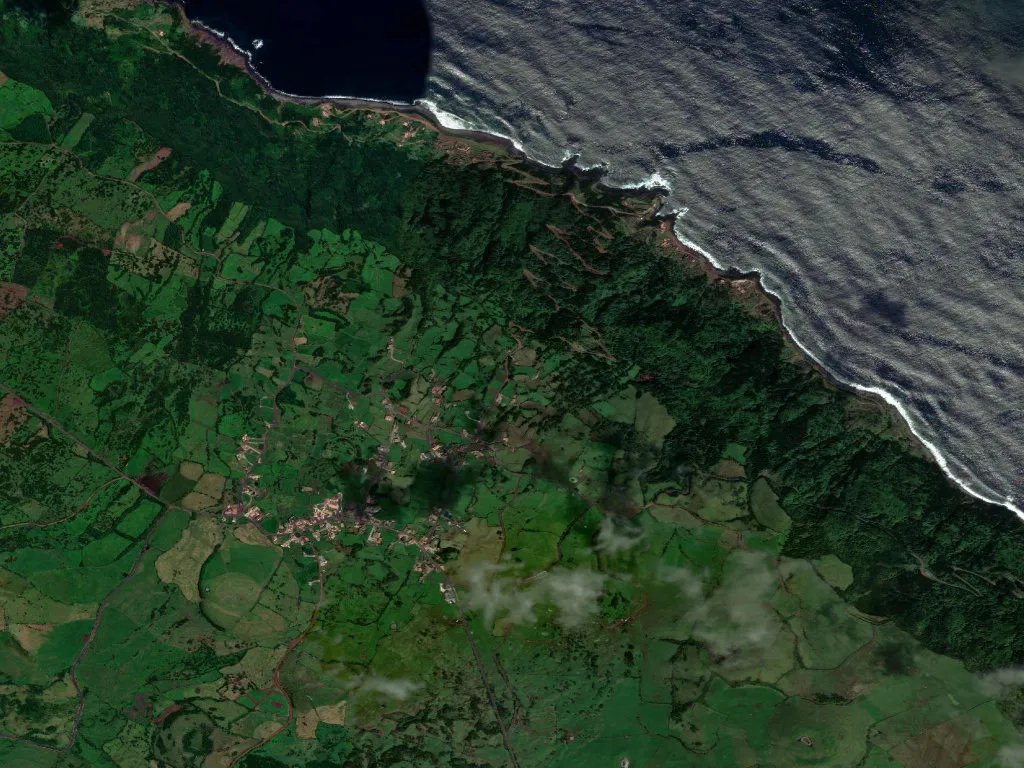
Full article about Norte Pequeno: Where Atlantic Wind Sculps Basalt Walls
Norte Pequeno, Calheta de São Jorge, Azores: tiny basalt village, 196 residents, Holstein cows, howling salt wind and a café that doubles as post office.
Hide article Read full article
The wind never stops at 418 m
It slips through door jambs, rattles hydrangeas on basalt walls, carries salt fused with wet earth. Norte Pequeno is a 10 km² shelf on São Jorge’s north face, home to 196 islanders in 66 households (2021).
The ER3-2 climbs 8 km from Calheta, 12 % gradient, hairpins sharpened by winter storms. Visitors need twenty cautious minutes; locals do it in fifteen, steering by memory around every pothole and crest.
Living here
Houses step down the slope in terraces. Waist-high dry-stone walls—black, vesicular basalt—parcel out fields and block the 40 km/h winter gales. Light shifts three times: dawn fog reduces visibility to three metres; noon sun burns it off, raising the temperature eight degrees in two hours; low evening side-light turns the walls into sculpted relief.
What’s on the ground
- Village shop-café: 07.30-12.00, 14.00-19.00. Frozen rolls, UHT milk, tinned tuna.
- Parking: twelve bays beside the 18th-century chapel.
- Post office: one red box inside the café; collections Monday & Thursday.
- Doctor: twice-monthly surgery in Calheta; público minibus runs twice daily except Sunday.
What grows
Pasture covers seventy percent of the land. A hundred-and-twenty Holstein-Frisian cows graze smallholdings; each averages 18 litres a day, trucked 15 km to the São Jorge dairy co-op. Kitchen plots sit under plastic sheeting, yielding kale, potatoes, yams from October to May.
Who stays
Forty-five residents are over 65; fourteen under-18s catch the 07.10 school bus to Calheta and return at 17.40. Finish secondary school and the choice is university in Angra or Ponta Delgada, or milking shifts for €750 a month. Summer brings the students back to muck out parlours and mend roads. The rest send remittances from Boston or Geneva, funding the next layer of black stone that keeps the Atlantic wind at bay.