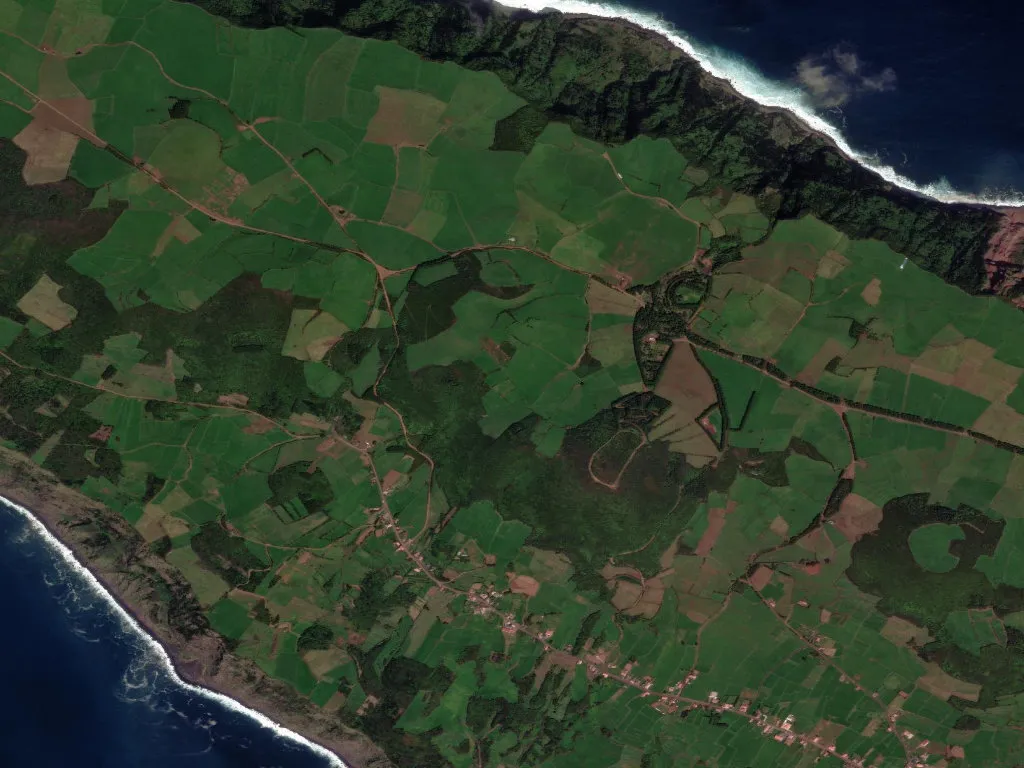
Full article about Rosais: Where the Atlantic Swallowed a Lighthouse
Bleached 1958 tower, violet Baixa dives, cattle blessed in linen-stone church—Rosais lives.
Hide article Read full article
The solar beacon at Ponta dos Rosais flashes every three seconds, a metronome for the Atlantic. Beside it, the lighthouse that once declared Portugal’s engineering future now stands roofless, its 1958 concrete bleached to the colour of weathered bone. On 1 January 1980 the cliffs gave way; the tower cracked, kitchens tilted, and the families were ferried east for good. Two hundred metres below, the sea rifles through sea-caves and the submerged platform called Baixa, where weekend divers drop into fifteen metres of violet water and find shoals of triggerfish circling black basalt.
From roses to granary
When the first settlers arrived in the 1470s the headland was pink with Rosa canina. They shortened the name to Rosal, then Rosais, and by 1568 the parish had its own record book. Prince Henry the Navigator’s 1439 charter had sent sheep across the channel from Terceira; within decades the western plateau was São Jorge’s breadbasket, rippling with wheat and ryegrass that fattened cattle for Velas and Horta. The 1890 census lists 1,605 souls; today there are 661, and the combine harvesters have given way to tractors the size of ride-on mowers.
Inside the parish church – stone walls the shade of old linen – the Feast of Santo Antão turns the nave into a barn. On 24 January farmers lead their Jerseys, chestnut colts and mongrel dogs to the altar rail for blessing while the União Rosalense brass band marches through narrow lanes built for ox-carts. Outside, wood-smoke from open hearths mingles with the scent of estufado simmering in red wine and clove.
Cliffs and cryptomerias
The European Union’s Habitats Directive drew a red line around 979 hectares here. Cory’s shearwaters nest in fissures once scanned for whales; roseate terns trade fish above the swell; and the Azorean forget-me-not, Myosotis azorica, freckles the turf with lapis dots. A red-dust track runs 8.7 km inland from the beacon to the Parque Florestal das Sete Fontes, climbing past the Pico da Velha lookout where, on a clear afternoon, you can see the perfect cone of Pico Island 18 km away and the blue silhouette of Faial beyond.
Drop into the park and the temperature falls five degrees. Japanese cryptomerias filter sunlight into cathedral beams; water trickles over moss-covered weirs; and a stone model of São Jorge, the size of a dining table, floats in a pond meant to represent the ocean. Sunday families fire sardines on communal grills while children chase fallow deer in the adjacent enclosure.
Keeping the past in use
The parish council’s Vivências da Nossa Terra trail refuses to let memory moulder. A thatched hayloft holds wooden sledges for dragging flax; the whale-lookout post keeps its stone bench facing the channel where look-outs once cried “Baleia!” at the spout of a sperm whale; and the communal washing tanks, carved from single blocks of basalt, still carry the scent of lye soap. The Rosais Folklore Group rehearses chamarritas in the old primary school, stamping the floorboards hard enough to rattle the windows, while the village brass band, theatre troupe and scout pack meet in rooms next door, outnumbering the island’s greying demographic by sheer noise.
Dusk pulls a rose filter over the strait. The beacon keeps its three-second pulse, and the Atlantic keeps its own, slower heartbeat – break, withdraw, repeat – as regular as the parish clock that has measured Rosais nights since the days when roses, not concrete, defined the skyline.