Full article about Urzelina: São Jorge’s tower that defied 1808 lava
Walk among basalt cottages to the lone bell-tower, fajã terraces and cave-aged cheese
Hide article Read full article
The tower that refused to fall
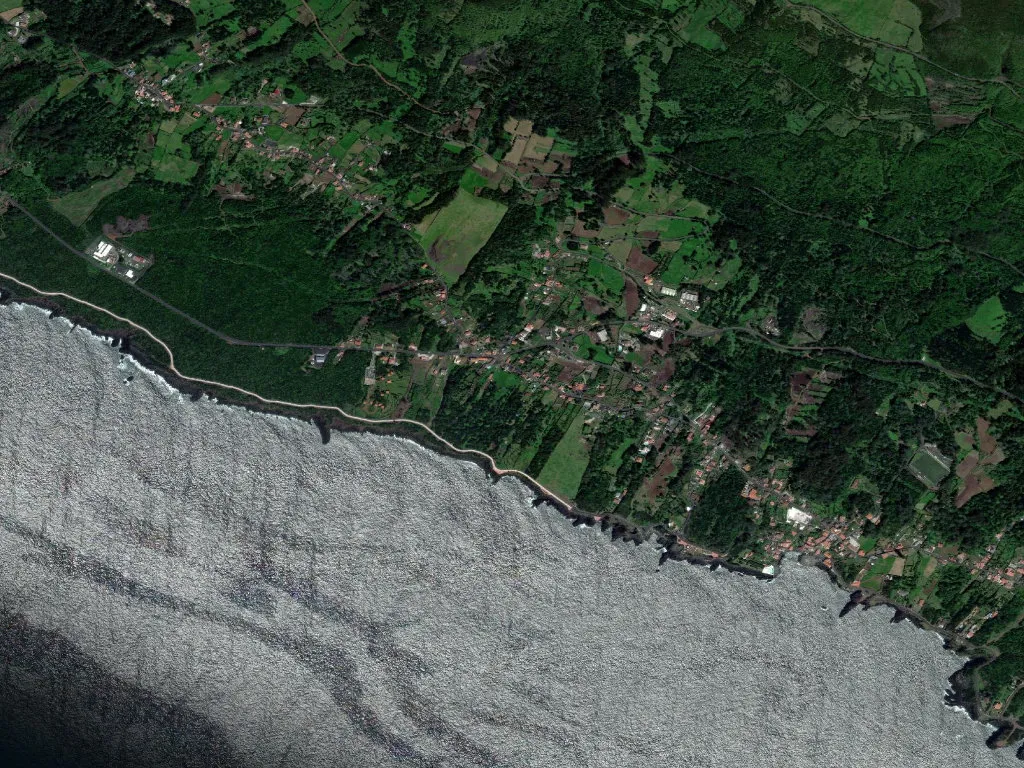
A single basalt steeple stands sentinel in a garden of black lava, its bells still ringing at 18:00 sharp. The lava froze on 1 May 1808, the day the Caldeirinhas craters woke up and sent a molten river down to the sea, burning Urzelina for eight days straight. Everything vanished—except this 17-metre shaft of stone. Around it the village grew back: basalt houses with timber balconies painted the colour of heather, the plant that once carpeted these cliffs and still gives the place its name. On foggy dawns the São Mateus bell carries the same note it sounded in 1807, before the earth cracked open.
The village the lava couldn’t erase
The original parish church, built 1555, was swallowed whole; only the tower survived. Fifty-three houses, eighteen people and 2,500 head of cattle were not so fortunate. When the eruption settled, engineers rebuilt the church (1859-61) and grafted the surviving Manueline doorway onto a new neo-classical body. Inside the tiny parish museum—open Friday 14:00-17:00—an 18-silk brocade vestment warped by heat and a partially-melted silver chalice testify to a community that declined to relocate. Touch the basalt at sunset and you’ll feel yesterday’s fire still radiating back.
Fajãs that ignore gravity
Below the village the Fajã da Urzelina fans out: a slim shelf of collapsed cliff and lava deltas caught between 280 m escarpment and Atlantic surf. Dry-stone terraces, first stacked in 1480, hold white-pulp cherimoyas and perfume-heavy passion fruit that ripen in the salt-sheltered micro-climate. PR05SJO, a 3.8 km footpath, corkscrews down to Ribeira da Areia past recovered water-mills—Galego and Ribeiro—where basalt millstones ground maize until 1965. At sea level the track disappears into cobble-sized aa lava; your boots balance on geology still younger than Trafalgar.
Cheese, caldeiradas and the taste of the island
The pastures above Urzelina supply raw milk for São Jorge DOP, a 90-day cave-aged cow’s-milk cheese documented since 1612. In the 1927 dairy co-op, loaves the size of wagon wheels develop their buttery sharpness at a constant 12 °C. Dona Lurdes simmers yam-and-fish broth in clay crocks; island watercress soup is thickened with grated São Jorge; molho de fíados—four-hour beef stew—scents kitchens with bay and garlic. At Restaurante O Pescador, boca-negra blackspot seabream is landed at 07:00, grilled with coarse salt from Angra’s salt-pans and served with a Pico-Vinho verde that tastes of volcanic basalt and Atlantic spray.
Traditions that outrun tide and time
On 21 September the São Mateus procession follows the 1808 route along Rua da Igreja, halting exactly where the lava stopped 50 m short of the tower. Summer 2024 revives the Festa da Urzela after a three-year pause; 87-year-old Sr António coaxes a 1953 Hohner accordion through chamarrita sets while 121 primary-school pupils mark the steps learned since 1987 from Professora Rosa. At the Empírio do Espírito Santo, 3 May and 24 June draw all 896 residents to the churchyard for sopas do império ladled from copper vats. When LED lamps flicker on heather-green balconies and wood-smoke rises vertical in the still air, the tower’s shadow measures 23 m across the lava plain—proof that, even here, the Azores drift 2.3 mm a year towards the future.