Full article about Velas Runs Five Minutes Fast for Pico’s Cardboard Sunset
Cows outnumber people in Velas, São Jorge, where cheese, fajãs and bent streets outrun clocks.
Hide article Read full article
The Town That Runs Five Minutes Fast
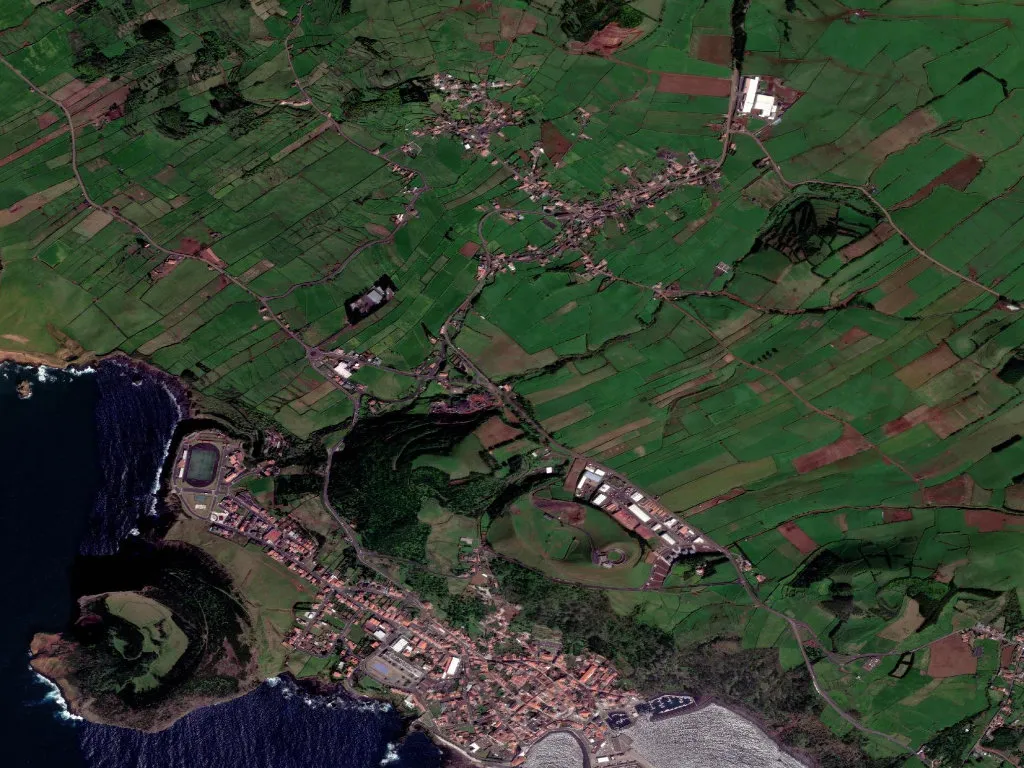
The English clock on the town hall has been five minutes ahead since 1902. Its tick merges with the stream that slips down Rua do Cais and dissolves into the bay. At dusk, Pico Island turns mutable: first a separate landmass, then a cardboard cut-out so sharp you can almost pick out the lava-mouth vineyards. Velas was born of this proximity; anyone who claims the town is named after ship sails has never felt the north wind cannon into the river mouth where fishing skiffs still scrape across black sand.
The Earthquake That Bent the Street
The 1957 shock left only the chapel of Nossa Senhora dos Remédios standing. When the storm that followed loosened the basalt, boulders rolled downhill and buried the old harbour. Rebuilding climbed upwards: thighs burn on Rua da Igreja, but the reward is a square where a bowl of red wine costs €1.50 and the barman asks, “Northbound or south?” as though offering a compass. The old customs house, now the library, keeps its rusted door—push with the right shoulder, just as Nantucket whalers were told when they tied up here two centuries ago.
Fajãs That Cling
Descend to Fajã da Caldeira de Santo Cristo along a path that smells of wet horse. After the hydrangeas, the track narrows between heather and silence, broken only by the whistle of Cory’s shearwaters. In the fajã, the lagoon is deeper than it looks: local divers swear a vent is plugged with kelp below the surface. Mussels grow on frayed lorry tyres; owners mark them with yellow tape—GPS for people who trust foot-memory over maps. Climb out on an empty stomach: at the top, a stall sells lemon-doused limpets and a glass of house red.
Cheese That Wakes at Dawn
São Jorge has 8,000 cows and 4,000 people. By seven on Wednesday morning, wheels of Queijo São Jorge arrive at the market on wooden trays covered in red-checked cloth. The rind is tactical: it fractures under the knife, releasing a scent of chalk and slightly sour butter. The affineur—because that is what he is—scores days into the crust with a hot nail: thirty for semi-cured, ninety for extra. Take it home wrapped in coarse paper that leaves the car smelling of stable for a week.
A Festival You Inherit
On Trinity Sunday, the Império do Espírito Santo in Fajã do Ouvidor opens at six. Copper pans have been on the wood-fire since four, when the women set the cornbread to bake. The soup is dense—kidney beans, yam, purple kale snipped with scissors. It is eaten from cracked clay bowls on benches carved with “José e Maria 1968”. After lunch, the procession descends: the litter sways, the cornet wheezes, and round the bend Pico appears to listen.
A Night That Puts Itself Away
When the last ferry hoots, the quay goes dark. The only light comes from Café O Pescador where the radio is tuned to TSF and the owner pours medronho firewater into thick glass tumblers. Outside, the sea slaps the pier with the regularity of breathing. The town-hall clock strikes eleven-fifteen—still fast—and someone says the squid are in tomorrow. Coats are buttoned, cigarettes pinched out on stone. Velas shuts like a shell: first the noise, then the lights, then even its name.