Full article about Lagoa: basalt cliffs, teal coves & Atlantic breath
Where São Miguel’s lava walls meet salt-sprayed rosary bells and cobalt convent tiles
Hide article Read full article
Lagoa, where basalt meets salt spray
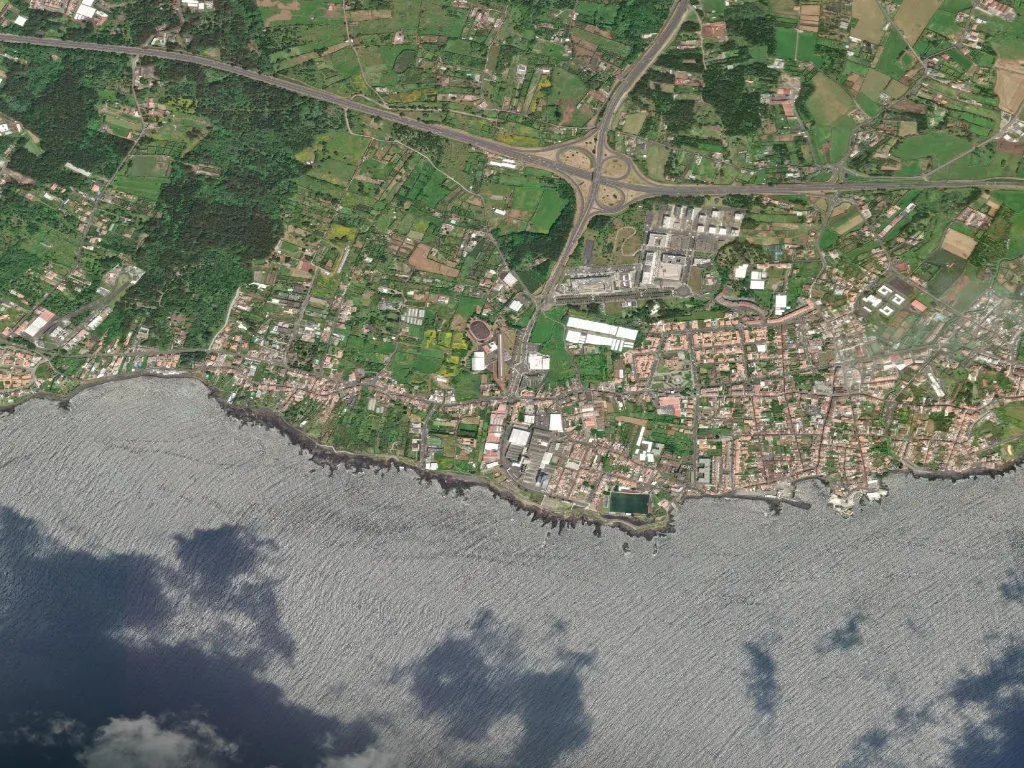
The Atlantic announces itself before you see it. A briny exhalation – seaweed, iodine and something faintly tropical, perhaps passionfruit drifting up from coastal plots – rides the wind that combs the south coast of São Miguel. Then the light arrives: a diffuse, almost white glare that ricochets off basalt cliffs and turns the surf into a neon seam. Lagoa, barely fifteen metres above sea level, is stitched so tightly to the ocean that humidity settles on skin like silk, breakers provide a permanent bass line and even the hand-cut lava-stone walls glitter under a film of salt.
A name that pooled before it spread
Long before “vila” status or town-hall paperwork, this strip was simply a coastal basin that filled with water – a lagoon that christened everything around it. When the 1522 earthquake flattened Vila Franca do Campo and redrew the island’s pecking order, Lagoa inched up the hierarchy. Parish life coalesced around the Igreja Matriz de Nossa Senhora do Rosário, begun in the same century and buttressed over successive remodels. Today its whitewashed facade, razor-sharp against the Azorean sky, is the first landmark that appears as you drop from the high interior and the last to slip from sight when you climb back inland.
Two widows, one papal brief and a cliff-top convent
Follow the lava shelf east to Caloura and you’ll find the Convento de Nossa Senhora da Conceição, one of the archipelago’s earliest nunneries. In 1556 two devout widowers secured a bull from Paul III to build a religious house on this black basalt promontory. Public-interest status since 2008 has preserved the 17th-century azulejos that cloak the chapel walls in cobalt geometry and the gilded baroque retables that flicker in the nave’s cool gloom. Step outside and geography snaps into focus: the Caloura bay forms a natural theatre of dark rock, the water a dense teal that invites a single, effortless dive. Slip beneath the surface and the volcano’s contours bloom with parrotfish and violet sea-urchins; the only soundtrack is the distant crackle of your own exhaled bubbles.
Terraced vines and a wine that smells before it’s poured
Lagoa is the historic heart of the Azores’ “Vinho de Cheiro” – literally, scent-wine. Open a bottle and the room fills with a head-rush of gardenias and bruised citrus before the first sip reaches your lips. Narrow dry-stone terraces, buttressed by hydrangeas and cryptomeria hedges, still shoulder the slopes; harvest day ends with communal sopas do Espírito Santo and singing in the lagares. Walk the rows at six o’clock, when the low sun reheats the basalt and the air is thick with grape perfume, and you’ll understand why locals refuse to waste adjectives on something already eloquent enough.
Grilled limpets and pastries that outrun municipal borders
Caloura’s tiny harbour smells of diesel, kelp and grilling garlic. Fishermen hose down concrete ramps while plates of lapas arrive straight from the coals: butter, parsley and a squeeze of local lime hissing in the shell. The catch-of-the-day caldeirada is thickened only with red pepper and coriander; nothing else is needed when the fish left the water at dawn. Finish with bolo lêvedo – a palm-sized, yeast-risen bun that gives gently under the fingers – or a queijada de Vila Franca, the custard tart that has long since outgrown its neighbouring town. A shot of passion-fruit liqueur, distilled from fruit that ripens outdoors all year in the subtropical micro-climate, provides a final, perfumed full stop.
Holy Ghost soup and salt on every handshake
October’s procession for Nossa Senhora do Rosário is picturesque, but the pulse quickens during the Festas do Divino Espírito Santo: silver crowns paraded through lanes, beef broth ladled out to strangers, the parish council’s loudspeaker reciting centuries-old couplets between hymns. Density here runs at 829 people per square kilometre, yet the village feels neither crowded nor quaint; it simply functions as an extended living room where loaves emerge from communal ovens at dusk and children learn to greet neighbours before they can spell their own names.
What lingers after the road climbs away
Trek the coastal footpath where vineyards terrace above the Atlantic and you’ll carry off an unlikely souvenir: not the ocean’s breadth, nor the church’s lime-white wall, but a low, unhurried murmur – the sound of water coaxing basalt, grain by grain, century after century, as if the entire island exhaled through its southern rim.