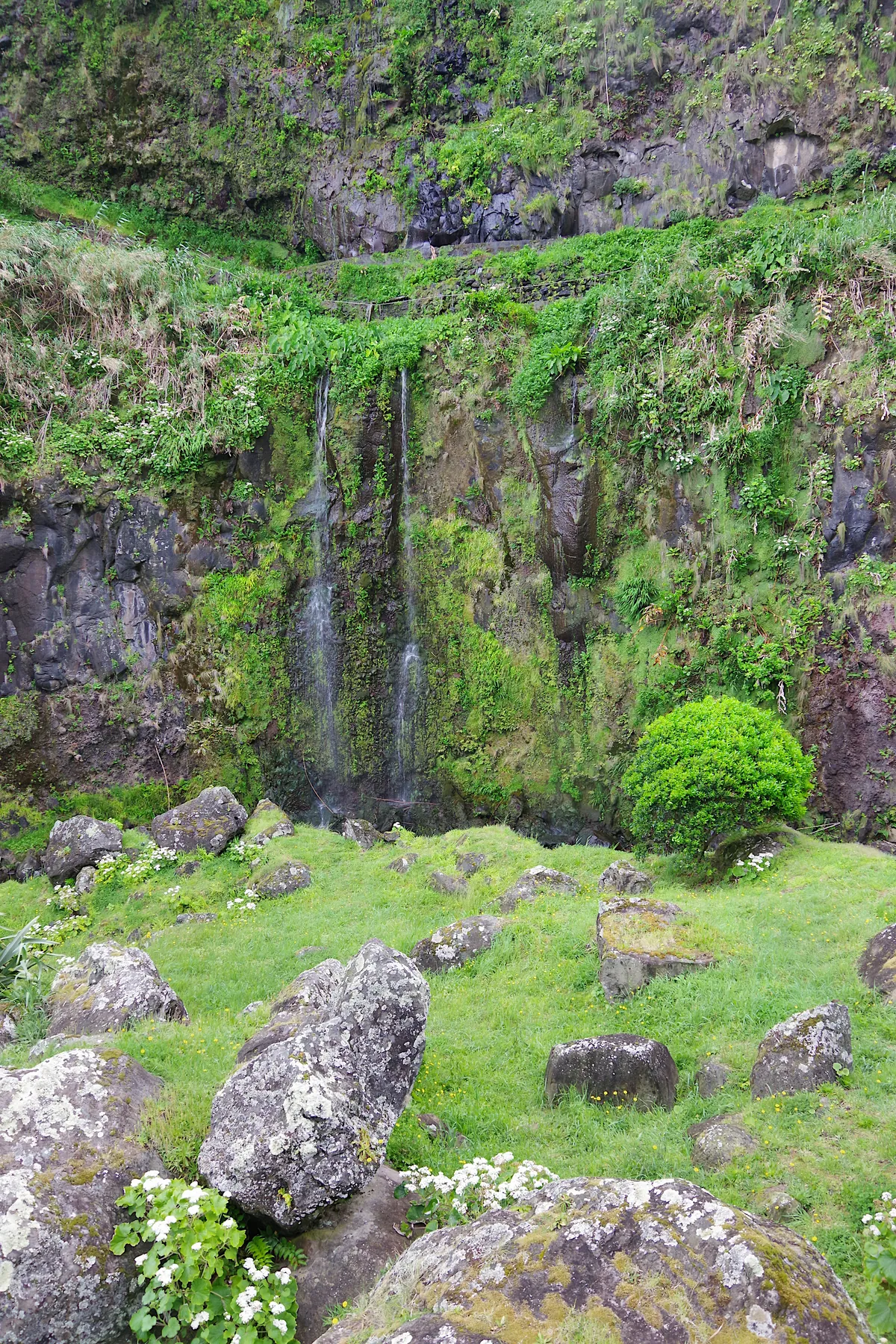
Full article about Salga: Azorean Village Clinging to a Cliff-Edge
Pastures tilt like velvet staircases above the Atlantic, where mist, wood-smoke and brine mingle.
Hide article Read full article
A Road That Winds
The road ascends in tight zigzags, so narrow that foreign cars must pull over before bends to let the milk truck pass. Behind the black stone walls, the pastures are sharp-edged in size — each patch of land was won from heather with a spade and the patience of a saint. At 410 metres, Salga is not suspended: it clings to the summit like someone gripping a balcony rail to watch the procession below. The sea peeks through the cryptomeria, but you smell it before you see it — that Atlantic brininess that rises on easterly winds and mingles with wood-smoke from the hearths.
Up here, the weather is not discussed: it is felt. Mist descends without warning, pushing cold air down your collar, and when it lifts the pastures glint as if upholstered in velvet. The parish register lists 484 souls, but in practice there are fewer — the 78 young people are only here at weekends and holidays, when their mothers wash laundry in plastic bags and still manage to stock the freezer with kale soup and homemade tomato sauce.
Where the Land Shows No Mercy
There is no flat ground in Salga. Even the football pitch is on a slope — local children learn to kick against gravity and score from one goal to the other with a single, ingenious touch. Cows graze on terraces that look like a giant’s staircase, and when it rains the water races down the cobbled lanes like a child on a slide. The visitors who find their way here are either lost en route to Lagoa do Fogo or Germans in hiking boots unfolding paper maps. They stop, photograph the Maronesa cattle with the Atlantic behind, and drive off shaking their heads — “Schön, aber steil”.
On winter mornings the men descend to the common land to cut acacia for the fire. The logs are as black as the basalt walls, and when they burn they crackle like living things. In the old kitchens the smoke-cured sausages still hang above the hearth, maturing slowly to the rhythm of days that are never in a hurry. In January, when the weather closes in, the smell of wood-smoke and rendered fat seeps into the laundry on the wooden drying racks — the scent that tells returning children they are home.
Wine That Comes from Below
The vineyards are tucked into hidden clearings — small plots that grandparents cleared by hand among the gorse. The vines grow low, protected by drystone walls that face away from the sea but trap the afternoon sun. The wine made here has no supermarket name: it is a rough red that burns the throat and leaves the mouth tasting of stone and fire. It is drunk from small glasses at the wooden table where yam soup with a poached egg is still served, and carried off the island in plastic flagons so that children in Lisbon “won’t forget the taste”.
At dusk, when the sun drops behind Pico da Vara, the light turns the colour of heather honey. That is the hour when the shadows of the cryptomeria stretch across the pastures and the cows begin their slow walk to the byre, bells tinkling like distant church bells. The high wind starts up — first a whisper, then a steady blow — carrying the smell of the sea, the bleat of sheep and the promise of a cold night. Windows slam shut, and inside there is only the creak of timber and the muffled sound of the television in the front room where the father has fallen asleep on the sofa, mouth half open, bare feet resting on the crochet rug his grandmother made thirty years ago.