Full article about Feteiras: Azorean fog, cows and lava-stitched pasture
São Miguel’s overlooked parish breathes between crater rim and Atlantic swell
Hide article Read full article
Where the mist forgets the sea
At 340 metres the fog lifts straight from the pasture, erasing every hedge and wall until only sound remains: a cow calling somewhere beyond the veil, wind combing the long grasses, the hush that exists only at this middling height. Feteiras inhales and exhales on its own slow metronome, suspended between an invisible Atlantic and the crater rims that fence the horizon. Its 1,557 souls are scattered across 23 square kilometres where the calendar is still divided by silage, slaughter and the first yellow blossoms of citrus.
The in-between land
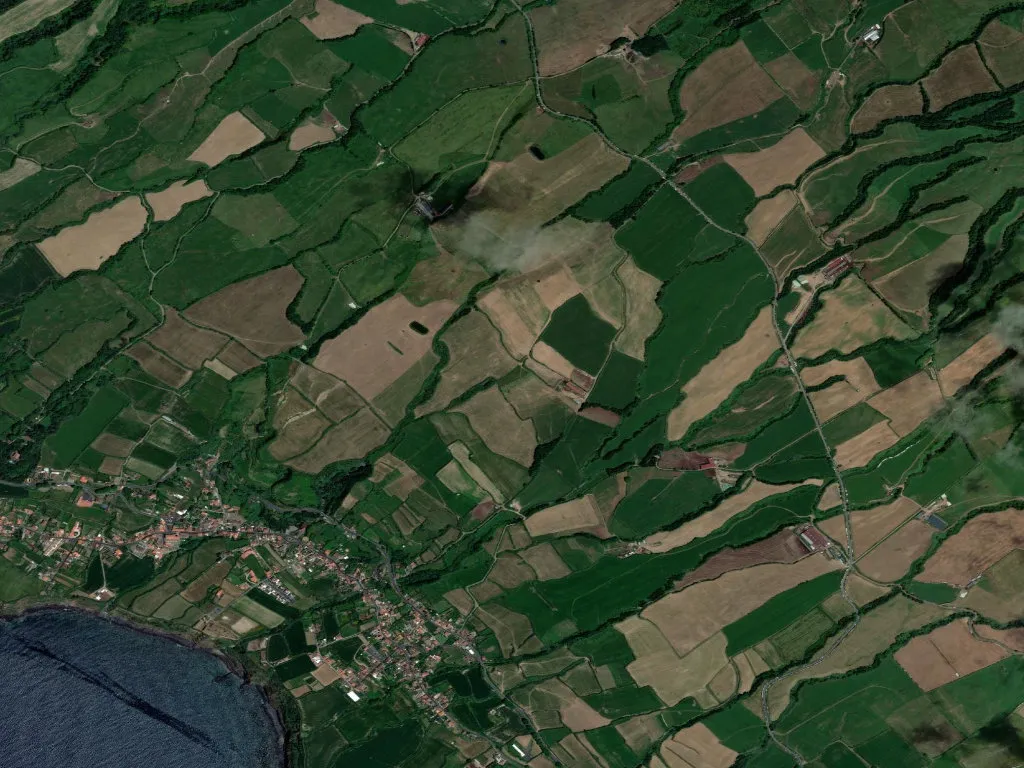
The parish sits on a geological landing-strip that eases the island from coastal lava platforms to the mountainous interior. There are no sapphire lakes here, no caldera drama; instead you get an almost flawless record of how São Miguel has fed itself for five centuries. Population density hovers at 66 people per km² – low enough that a walker can study the lay of the land without a single roofline intruding. Volcanic basalt walls, the colour of wet slate, stitch together small, irregular paddocks whose green is less aesthetic than fiduciary: every blade is mortgage, schoolbook, Friday-night queijo fresco.
Unlikely as it sounds, Feteiras lies inside the Azores Geopark. The designation isn’t marketing gloss but geomorphological fact; the “boring” pasture is underlain by deep pyroclastic deposits that drain fast and warm early, letting farmers keep cattle outdoors year-round. The cows, mostly Holstein-Friesian with the odd brown-eyed Jersey, outnumber people two to one and supply the milk that ends up on Ponta Delgada breakfast tables 14 km away.
Daily life without a script
TripAdvisor has nothing to say about the place. The primary school still has 268 pupils, enough to keep the playground shrill and the future from feeling purely archival. Older residents – 168 of them over 65 – remember when land was measured by how many rows of sweet potatoes a man could tend before breakfast, and when emigration to New England left entire dwellings swallow-haunted.
Walk the lanes and you meet tractors ferrying plastic-wrapped silage, milk tankers on their afternoon rounds, men in flat caps who lift a hand without breaking stride. The parish church anchors the settlement symbolically, yet the real nucleus is diffused: a cheese-shed where morning curds drain in muslin, a citrus grove wind-proofed by Japanese cedar, a café that has no name on the door but pours the island’s most reliable bica. Everyone knows where it is; no one needs a sign.
Cooking with altitude and damp
Forget the subterranean cozido of Furnas; up here the vapour comes from soup pots, not fumaroles. Caldo verde is thickened with local kidney beans, leeks are braised in their own fat, and beef is simmered until the collagen sighs. The obligatory cheese arrives unannounced, still dewy, beside a disc of massa sovada that scorches your fingertips.
Technically the Azores’ minuscule DOC vines reach this high, yet Feteiras’ wine culture is kitchen-table rather than cellar-door. What you drink is garage-blend from coastal plots further west, served in heavy tumblers whose opacity hides the sediment – terroir translated as honesty rather than label.
Unposted paths
There are no laminated viewpoints, no QR-coded trails. Footpaths are simply the shortest route between hamlets, compacted by cattle hooves and the weekly pilgrimage to the bread van. The air smells of wet basalt and vegetal manure – not city-side offensive, just the neutral perfume of agriculture working as it should.
Even in July dusk arrives jacket-cold. Lights click on early, small amber rectangles in a darkness that smells of bruised grass and wood-smoke. Feteiras offers no epiphanies, no sunset to break the internet. It gives instead the granular texture of island life lived at the pace of a 40-year-old tractor – and, for those willing to adjust their tempo, that is riches enough.