Full article about Mosteiros: where lava stacks echo with shearwaters
Black Atlantic stacks, tarred nets and 15th-century basalt bells in Ponta Delgada’s western cradle
Hide article Read full article
The first thing that strikes you in Mosteiros is the soundscape: a low, percussive thud of Atlantic swell cannoning into lava walls, then the cataract cry of Cory’s shearwaters homing in on the same islets where their grandmothers nested. Finally, the light chime of aluminium rings knocking against basalt as nets dry in the wind. The village – all 1,021 souls – sits in a natural amphitheatre tipped west, white houses welded to a green slope that ends abruptly in black rock. Out front, four sea stacks rise 72 m from the foam, the broken teeth of a submarine volcano that punched through 20,000 years ago and now serves as a crèche for wheeling seabirds.
Stone, whitewash and saltwater
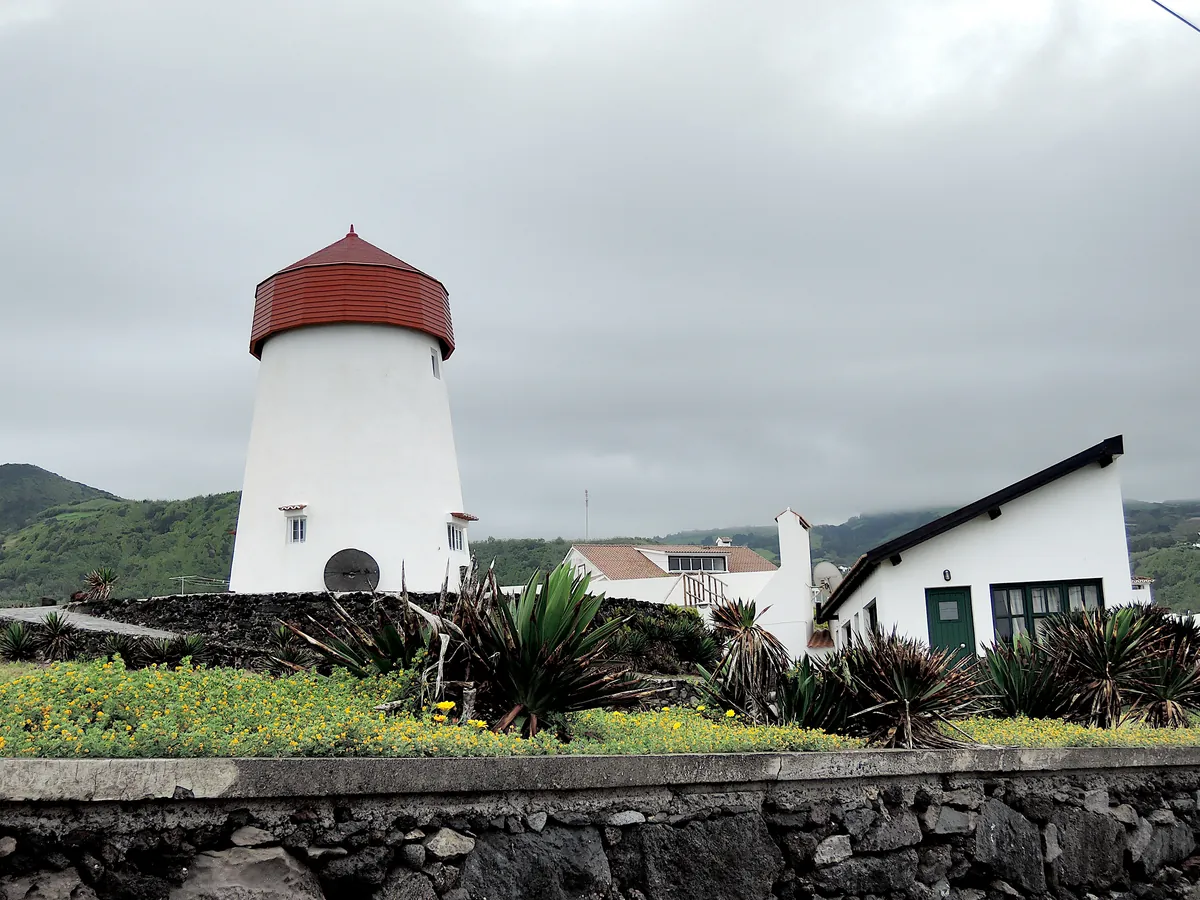
The Igreja de Nossa Senhora da Conceição commands the square with a stocky, basalt bell-tower dating from the first settlement in the late 1400s. Inside, a 19-pipe organ fills the nave with a reedy echo that lingers under dark cedar beams. In the porch a granite font has baptised every local since the 1800s; its lip is thumbed smooth by godparents who still smell of brine and wood-smoke. Around the church, single-storey cottages glow with limewash, basalt doorframes carved to a shadow-sharp geometry by the 4 p.m. sun.
That black door on the right? Sr Carlos has kept his nets there since 1973. He no longer sails – a bad hip ended that ten years ago – but he refuses to sell. “These are the last cords that still taste of the sea,” he says, fingers running over tarred hemp like rosary beads.
Casa do Pescador, opposite, is built from the planking of beached whalers. Inside, miniature lance boats and iron harpoons recall Captain Henrique “Quinca” Silva, born Rua da Igreja 1875, who introduced toggled iron guns to Azorean whaleboats after seasons in the South Atlantic. Scales still glint in the floorboards – the building itself seems to have grown them. On the church’s north wall a grey tide-mark remains from the 1957 Capelinhos ash cloud that drifted 250 km west; locals left it as a quiet memo of the archipelago’s restless geology.
Fish broth and crackling corn bread
Order caldo de peixe before you do anything else. The day’s catch – dusky grouper, black seabream – is simmered with sweet potato, onion, tomato and bell pepper, then brought to table with corn bread baked in wood-ash and hot enough to scorch fingerprints. At Café O Pescador the bowl arrives as the sun slips behind the islets, firing the sky into an ember gradient of orange and mauve. Octopus follows, stewed in local Verdelho with bay leaf and stream-mint, yams absorbing the liquor like coral.
Turn up at 3 p.m. and the soup is gone; they cook only what the morning boat landed. Cross the street to Dona Lurdes for honey-cake instead – it makes the wait taste of caramelised sugar-cane and Christmas spice.
Finish with queijadas da Ribeira, condensed-milk tarts capped with toasted coconut, paired with tea made from algae gathered in the lava pools at low tide. The parish white, grown on sea-facing terraces buttressed by dry-stone walls, carries a salt-lick, volcanic finish that makes you think of surf shattering on obsidian.
Black sand and sculpted lava
Praia dos Mosteiros is a 500 m sickle of charcoal sand that absorbs heat like a battery; barefoot sprints to the tide-line are performed with the urgency of a fire-walk. North of the beach, Caneiros natural pools are lava basins refilled by every high tide; parrotfish and salema shoal between sargasso fronds iodine-rich enough to stain your fingertips ochre. A coastal footpath threads banana fajãs and old whaling lookouts to Ponta do Escalvado, ending on a cliff where the island’s edge feels surgically removed from the map.
Locals’ tip: between 2 p.m. and 4 p.m. the pools resemble a brimming bath. Before or after, you’ll find only barnacle-encrusted rock and the risk of a wave-induced bloody nose.
Inland, Lagoa do Pão de Manteiga hides between tree ferns, a seasonal mirror where grey herons and Azorean blackbirds nest while thermals rise off the valley like exhaled breath.
August lights and Easter immersions
From 13–17 August the village combusts with phosphorescent rockets for the Festa da Nossa Senhora da Conceição. Processions shoulder the Marian statue beneath floral arches while skewered chouriça drips fat onto open coals. On Easter Sunday the Banho da Ribeira sees fishermen and teenagers sprint into 17 °C breakers – a saltwater baptism believed to rinse away the previous season’s ill luck and guarantee full nets. At Carnival, caretos de cabaça – men wearing grotesque gourd masks – bang drums and blast whistles in a ceremony no one has dated, only repeated.
Dusk ends with the islets turned burnt-honey by the lowering sun and tripods lined along the promenade like artillery. Old hands still measure distance to the horizon in “sail-hands”: the time it takes a candle to burn down to the first knuckle – roughly the moment a west-bound launch disappears from sight. It is not nostalgia; it is a portable clock, passed father to son, accurate only here where molten rock met ocean and decided to stay.