Full article about Atlantic Breath of Ponta Delgada’s São Pedro
Salt-lashed basalt lanes, pewter horizons and 18th-century azulejos in São Miguel’s densest parish
Hide article Read full article
São Pedro: where Ponta Delgada inhales the Atlantic
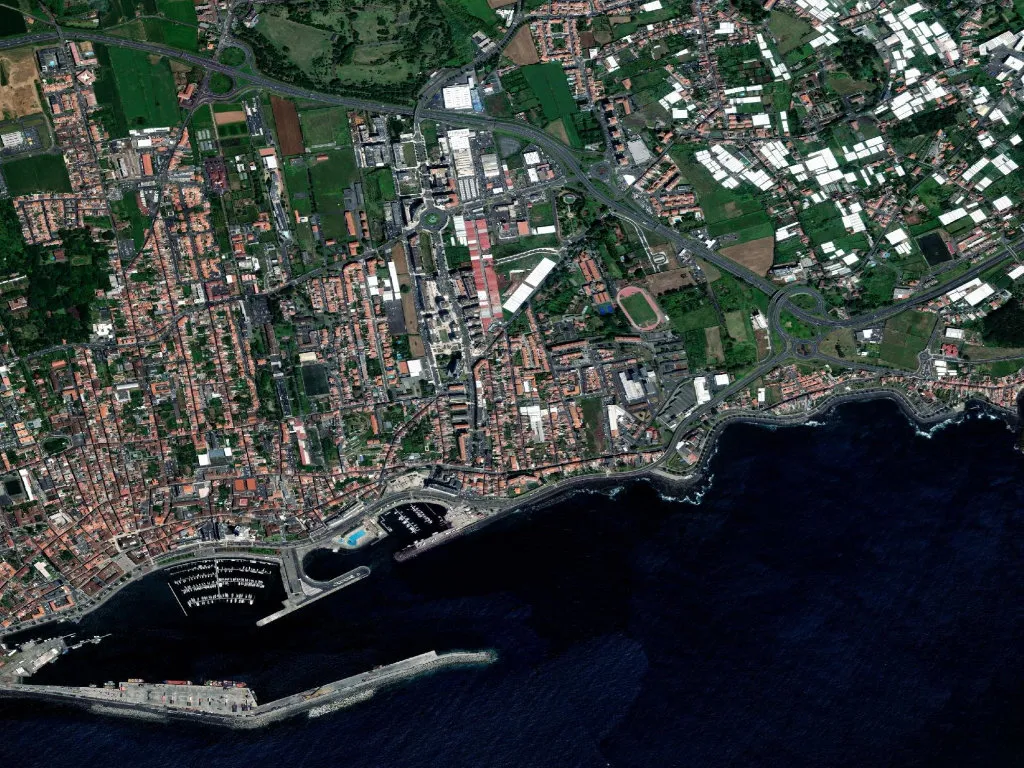
The smell hits first—salt sharpened by wet basalt that climbs the alleys and clings to cotton, hair, skin. At barely 25 m above sea level, São Pedro is the pocket of Ponta Delgada that refuses to look away from the water. The ocean isn’t scenery here; it is weather, mood, tempo. Low clouds skid in on gusts that rattle the sash windows of terraced houses turned side-on to the sea, as if the whole parish were bracing itself against the next wave.
A weave of dark stone and white render
Squeezed into 2.8 km², São Pedro packs 7 495 souls—over 2 500 per km², the densest parish on São Miguel. Volcanic walls almost graze one another across lanes just wide enough for a single Renault Clio; whitewash is applied like correction fluid over the black stone, only for the basalt to re-appear in doorframes and cornerstones. Footsteps echo, gulls wheel overhead, and the air carries a metallic note of drying seaweed from the nearby slipways.
Unlike the island’s cliff-flung parishes, São Pedro meets the Atlantic on level terms. There is no precipice, only a low sea wall and a horizon that dissolves into pewter on foggy mornings, leaving eye and instinct to guess where water ends and sky begins. Moisture hangs thick enough to taste; laundry takes an extra half-day to dry; ironwork rusts with enthusiasm.
Three monuments in black stone
You bump into history here rather than hunt for it. The parish church, Igreja de São Pedro, lifts its 18th-century façade off a square the size of a London tennis court—stone benches warm all afternoon in the low sun. Two minutes away, the former Jesuit college—now the University of the Azores—lets students eat chouriço sandwiches in arcaded cloisters that once echoed with Latin. Face the harbour and you meet Igreja da Conceição, its 18th-century azulejos narrating shipwrecks and storms in cobalt blue. When the light slants, the basalt absorbs it and glows a soft umber, as though the stone itself were remembering lava.
A geopark beneath the pavement
UNESCO lists the Azores as a Global Geopark, but residents feel the pedigree under their soles every day. Soil is rust-red and flecked with pumice; garden walls are literally chunks of cooled magma. São Miguel is geologically adolescent—its last onshore eruption was only 1652—and the earth’s restlessness expresses itself in the virulence of weeds that split tarmac and the glossy monster leaves of elephant ears leaning out of backyards. Even in this urban parish, hortensias balloon over gateposts and tree ferns colonise the shady side of cashpoints.
Vineyards shaped like black-stone amphitheatres sit 40 km east on the Pico-facing coast, but their influence reaches São Pedro’s tables. Order a glass of Arinto dos Açores at a harbour tavern and you’ll taste diesel-mineral salinity, the liquid equivalent of licking a battery—perfect foil for black scabbardfish landed that dawn.
Saturday before sunrise
Demography tilts gently older—1 300 residents are over 65—yet the streets never feel becalmed. Saturdays begin in darkness: by 5 a.m. women in housecoats descend slate steps with wicker baskets on forearms, heading to the parish market. By 7 a.m. the fish is gone—espadarte, sarda, cherne—sold to cooks who know the week’s menu before the rest of Portugal is awake. Cornbread from Furnas arrives at eight, still steaming in brown paper, and queues curl down Rua do Melo like a parish procession.
The salt you can’t shower off
Evening light arrives sideways, gilding the white façades so they appear back-lit. Against that glare the basalt trim becomes graphic, almost Art-Deco. The wind drops—or perhaps skin has simply agreed to the terms—and the soundtrack narrows to shutting shutters, a distant television, one last gull note. Hours later, on the flight home, you scratch your forearm and feel it again: the finest salt film, invisible, stubborn, São Pedro’s calling card that no hotel soap can fully dissolve.