Full article about Furnas: stewed in a volcano’s breath
On São Miguel, the earth slow-cooks lunch while you swim in rust-red springs
Hide article Read full article
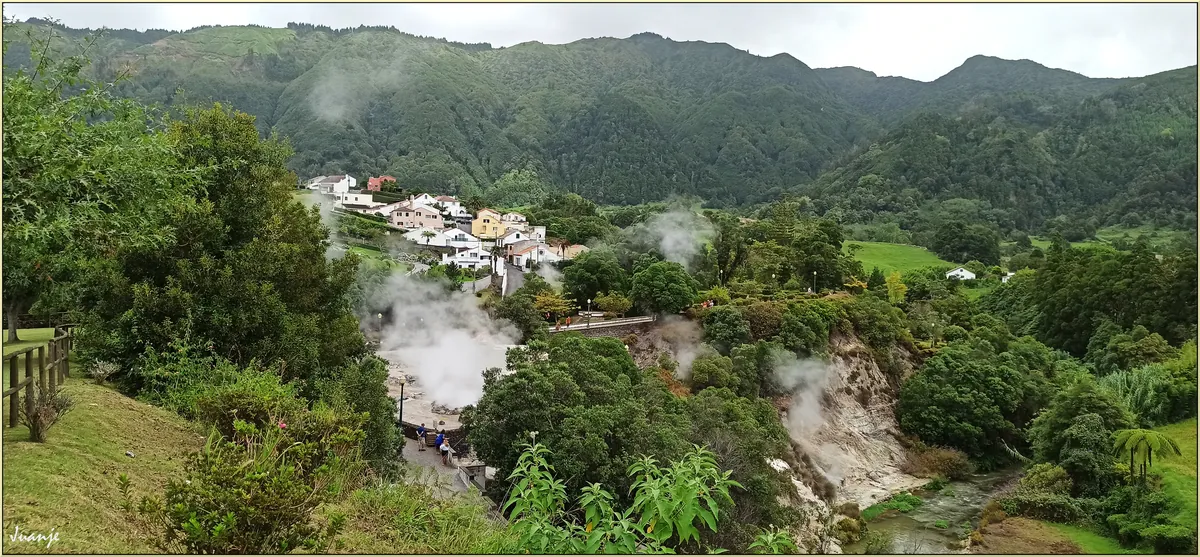
The smell hits first: sulphur dissolved in the Atlantic dawn, a metallic tang that clings to the back of the throat. Only then do you see the plumes – ghost-white columns rising from fissures around Lagoa das Furnas as if the lake itself were exhaling. This is Portugal’s most civilised apocalypse: a parish built inside the crater of a sleeping volcano, where the ground keeps the cookers on.
Earth as oven
Every morning, before the tour coaches rumble down from Ponta Delgada, two dozen cast-iron pots arrive at the caldeiras. Cooks lower them into geothermal vents, pack soil on top and leave the planet to do the rest. Six hours at a constant 95 °C turns pork shank, blood sausage, yam and collard greens into Cozido das Furnas – a stew that tastes faintly of rock and iron, served at precisely 12:30 in dining rooms that still insist on linen napkins. No flame, no electricity: just subterranean steam doing what it has done since 1630, when the last eruption here drove villagers briefly into the sea.
Gothic stone among tree ferns
José do Canto, the Azores’ 19th-century botanical obsessive, married science with devotion by the shoreline. His neo-Gothic chapel – Nossa Senhora das Vitórias, 1886 – rises like a slate-grey exclamation mark among banana leaves and giant rhododendrons. A three-minute shuffle east brings you to Parque Terra Nostra, where camellias planted in 1775 still drop petals onto a thermal pool the colour of oxidised iron. Swim for ten minutes and your costume emerges the shade of a Madeira label; locals call it the “Furnas tan”.
Darwin’s footnotes
Charles Darwin spent 24 hours here in 1836, cataloguing fumaroles between bouts of seasickness. The 9.5-kilometre PRC6 trail circles the lake at crater level, passing mudpots that gurgle like badly-tuned kettles. By late afternoon the water shifts from pewter to jade, depending on cloud cover and your own altitude. Inside the 18th-century church of Sant’Ana, the only sound is the tick of votive candles and, if you listen hard, the faint hiss of the valley breathing beneath the floorboards.