Full article about Ribeira Grande: river-roar & baroque bells echo
Trace basalt bridges, gilded angels and a gorge trail to Lagoa do Fogo’s crater lake.
Hide article Read full article
A murmur before you see it
The river arrives before the town does. Long before the white façades of Ribeira Grande come into view, you hear water scouring basalt, a liquid drum-roll that has been playing since the fifteenth century. On Atlantic mornings, when the air feels almost thick enough to chew, that sound folds around baroque doorways and settles in the stairwells of the parish church like a second liturgy.
Stone by stone, quake by quake
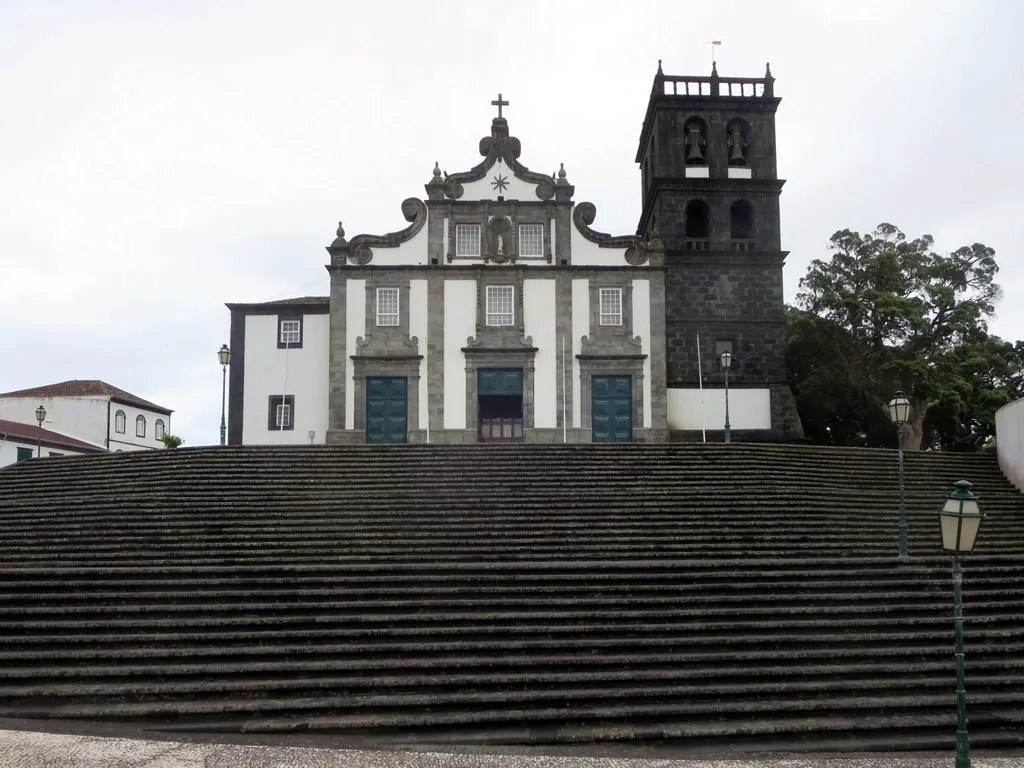
Igreja Matriz de Nossa Senhora da Estrela was first dedicated in 1517, flattened by the 1522 earthquake, then rebuilt in a hybrid of Manueline rigour and baroque swagger. Inside, candle-light picks out gilded angels; outside, the basalt bell tower keeps watch over Largo da Matriz. A few strides away the Pelourinho – a sixteenth-century stone pillory shaped like a twisted rope – marks the spot where wheat and citrus once changed hands and the town’s economy turned. Cross the adjacent Ponte de Oito Arcos (1883-93) and you feel the engineer’s confidence: nine-metre arches, barely a mortar joint out of place, freighted against winter spates that can lift entire cobbles. Below, the Ribeira Grande river slides seaward under cafés smelling of espresso and briny air.
Follow the water
Pick up the Rota da Água just behind the theatre and the gorge narrows to a green tunnel. Tree ferns lean over basalt walls; the scent of wet moss follows you even on cloudless days. At 220 m above sea level you are already halfway to the central plateau: turn uphill and within two hours you are on the crater rim of Lagoa do Fogo, the island’s wildest caldera lake, where wind replaces running water and the only colour is the petrol-blue of the lagoon far below. The trail doubles as an open page of the Azores Geopark: each layer of ash, lapilli and pumice is a dated receipt for 50,000 years of volcanic housekeeping.
Festivals you can set your watch by
On the last Sunday of August the parish carries Nossa Senhora da Estrela through streets carpeted with sawdust mosaics. Processional brass bands slow to a shuffle as fireworks arc overhead; the air tastes of myrrh and grilled black pudding. Three weeks earlier the town’s Philharmonic Society occupies the Art-Deco Teatro Ribeiragrandense for the Festas Juninas, turning the auditorium into a whirl of accordion and twelve-string guitar. December belongs to the bulbous, violet-skinned turnip – nabos – simmered into a restorative broth that appears on every lunch table once the temperature drops below 17 °C.
Breakfast before the market closes
Be at the Mercado Municipal before nine. Buy a bolo lêvedo still steaming, split it, and let a slice of aged São Miguel cheese melt into the dough. From the river wall you can watch the tide fight the current: Atlantic salt water nosing inland while fresh snow-melt pushes the other way. Somewhere in that collision is the reason 3,767 people still live in this parish, and why the Azores’ most convincing urban soundtrack is not Fado but water negotiating stone.