Full article about Santa Bárbara: black-sand surf under crater rim
Santa Bárbara, Ribeira Grande, offers Azores surfing on volcanic black-sand, crater-rim pastures, and a 10,000-year-old lava shoreline.
Hide article Read full article
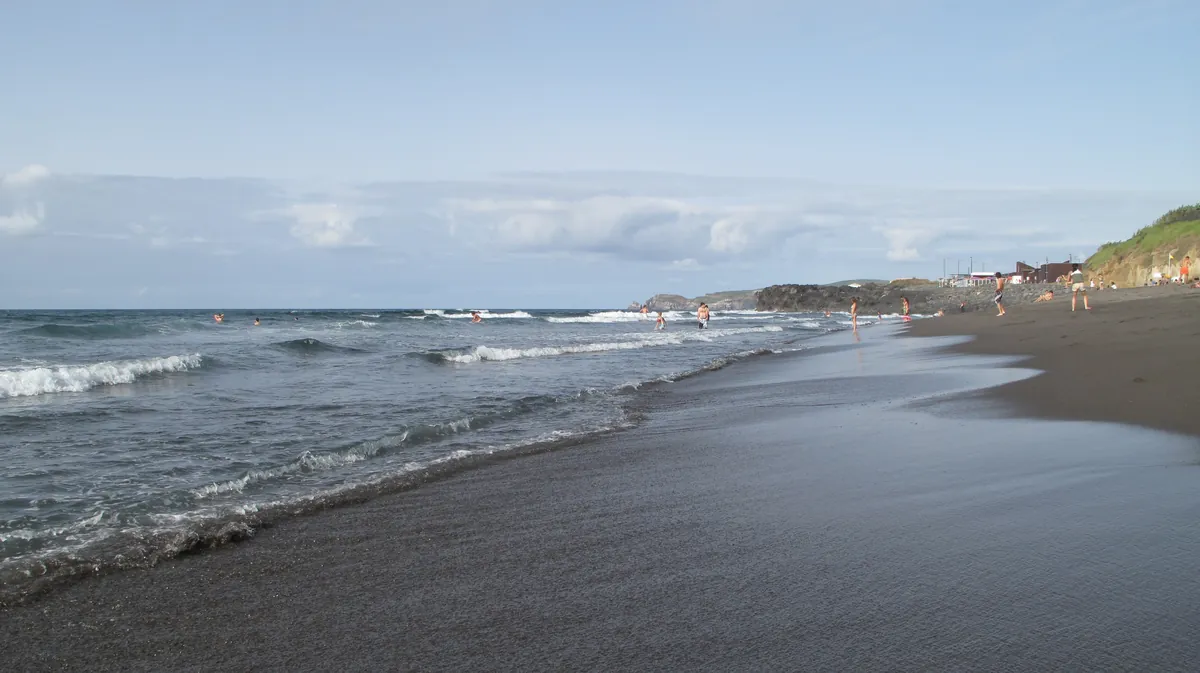
Black volcanic grit squeaks underfoot, dampened by the same Atlantic air that keeps the pasture behind you improbably green. At Areal de Santa Bárbara the surf unrolls for almost a kilometre—an anomaly on São Miguel, where basalt cliffs usually slam the door on sand. Northern squalls carry the reedy call of Cory’s shearwaters and the metallic scent of salt spray mixed with cow-silage drifting down-slope. Stand still and you feel the parish’s split personality: 322 m above sea level on the crater rim, yet the tide draws your gaze outward until horizon and sky weld together.
From ridge to parish
Until the late 1700s the place was simply Lomba da Ribeira Seca—“ridge of the dry stream”—a topographic label for scatterings of stone cottages above an unreliable watercourse. Everything changed when villagers erected a chapel to Santa Bárbara, patron of lightning and sudden storms, a prudent insurance policy on an island that conducts weather like copper wire. The settlement was promoted to full parish only in 1971; its church, rebuilt in 1998, still keeps the older temple as a side-hall where bingo replaces vespers on Friday nights. There are no Unesco plaques, no procession that clogs the lanes once a year—just the low murmur of daily life beyond the reach of cruise-bus timetables.
The surf break that put the parish on the map
Areal de Santa Bárbara is now the Azores’ most consistent surf stage: a blue-flag beach-break where Atlantic swells fan into long, waist-high rights perfect for learners and, when the angle shifts, punchy barrels that draw the QS circuit every October. Part of the Azores Geopark, the sand is ringed by signboards explaining pillow-lava tides and the half-submerged root of a 10,000-year-old spatter cone. Walk east at low water and the basalt starts to bite; you’ll reach Praia dos Moinhos in 25 minutes, a pocket cove where fishermen still winch boats up the cobbles on rusted cables.
Tukátulá, the lone beach bar, parks its sun-bleached boards against the railing like horses at a hitching post. Order bife à açoreana—rump steak flash-fried, topped with a runny egg and sweet-pepper wine sauce—then follow it with a slice of São Miguel’s acid-bright pineapple while the sun drops into the Atlantic and the sky performs its nightly colour inversion.
Inland: caldera and cloud forest
Fifteen minutes inland, the tarmac corkscrews to the Lagoa do Fogo trailhead, where a 6 km out-and-back climbs through Japanese cedar to a mirror-crater lake ringed by endemic heather. Closer still, the partial nature reserve of Serra de Santa Bárbara and the Mistérios Negros climbs to the island’s roof at 1,105 m. The last 300 m of ascent lie inside Ponta Delgada’s council boundary, but the view belongs to everyone: a chequerboard of allotments, hydrangea hedges and the metallic glint of irrigation tanks suspended between ocean and cloud.
Beds, boards and breakfast
Tukátulá opens at 10, serves breakfast until 11.30, closes when the last surfer gives up (usually 22 h). Burgers €7, bife €12, craft lager from mainland breweries.
Sleep either at the Santa Bárbara Eco-Beach Resort—116 low-slung suites that step down the dune, pool, yoga shala, doubles from €180—or in the simpler Apartamentos do Areal, 50 m from the tide line, from €85. Book ahead June-September; the car park fills by 11 a.m. at weekends—leave the hire car on the verge and walk the last 200 m.
When the tide turns, the ocean erases footprints, tyre tracks and the geometry of children’s moats. Santa Bárbara starts each morning with a fresh black page: damp, cool and waiting for whatever story the next swell decides to write.