Full article about Água de Alto: Atlantic winds & basalt terraces
Sweet-potato plots cling to São Miguel’s fossilised cliffs above Vila Franca’s islet
Hide article Read full article
The Breath of the Atlantic
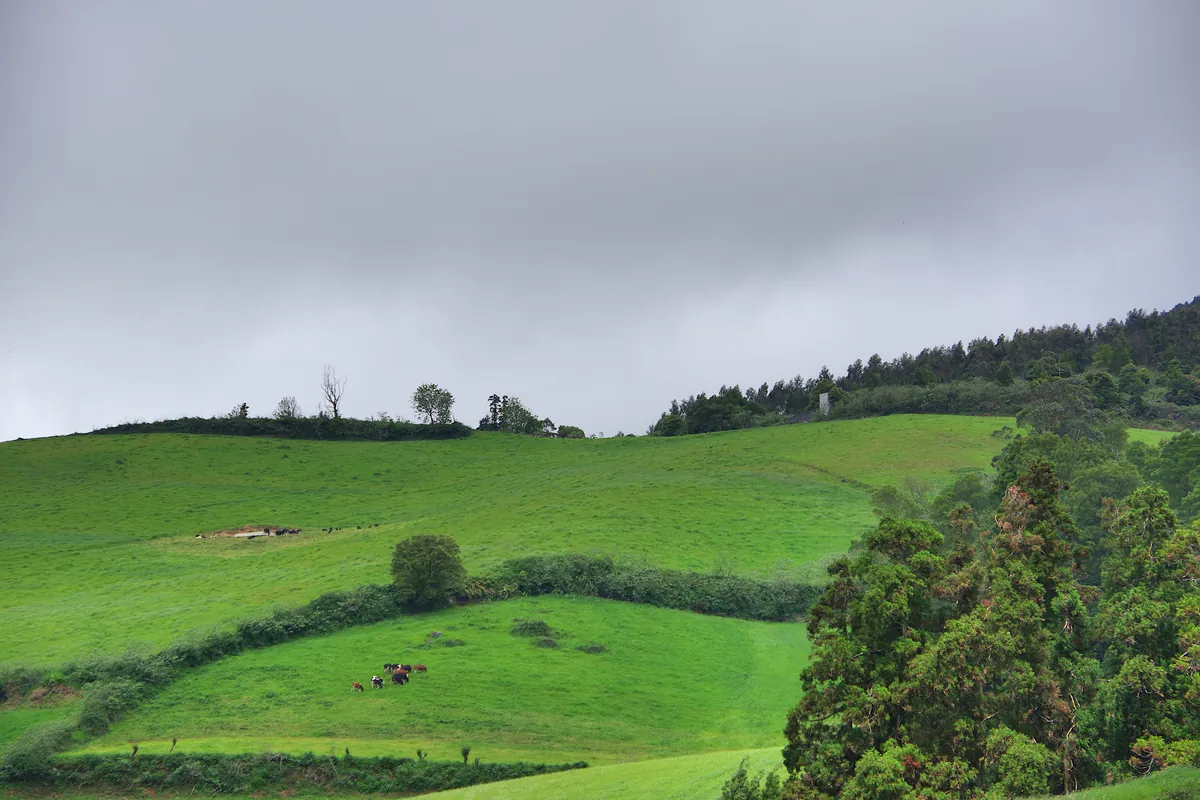
The south wind slaps the basalt cliffs and drags the smell of brine uphill until it mingles with the scent of freshly turned soil. Água de Alto lies pinned between ocean and slope at 346 m, its mosaic of sweet-potato terraces armoured by waist-high walls of charcoal-coloured slate. No cement binds them: each stone is countersunk by eye, stacked so the Atlantic gales can rattle but never topple them. Beyond the last wall the fossilised cliffs drop sheer, and the islet of Vila Franca do Campo hovers on the horizon like a full stop punched into the Atlantic sentence. Five centuries ago caravels used to fill their barrels from the cold, constant springs that give the parish its name—literally “High Water”—before beating south to the African coast.
The spring that christened the village
The earthquake of 1522 levelled Vila Franca do Campo, then capital of São Miguel, and forced the island’s administrative re-ordering. When the dust settled, this upland hamlet was officially promoted to parish because a single spring, set high above the contamination of the shore, never ran dry. Ships’ masters would anchor below and send men up the zig-zag path with casks; the water was said to stay sweet for an entire Atlantic crossing. The rebuilt Igreja Matriz de Nossa Senhora da Conceição still anchors the village square: basalt walls the colour of wet slate, Manueline portals softened by Baroque excess. On storm days the stone darkens minutes before the first drop falls—an augury older than any barometer. Inside, the nave smells of beeswax and cedar; footsteps echo like slow heartbeats.
A smaller chapel, São José, keeps vigil among the fields. Around it the manor houses—thick-walled, their sash windows trimmed with white paint the colour of wave foam—record the money that once came from oranges and sweet potatoes sent to London and Madeira.
August in the streets
On the second weekend of August the village doubles in size. The feast of Nossa Senhora da Conceição begins with a dawn rocket and ends when the last accordion collapses. Procession bearers sway under gilt canopies, incense competing with the sharper perfume of sardines crackling over laurel twigs. Inside every kitchen the “eve cake” rises: a cinnamon-and-fennel loaf neighbours slice and score like a ballot. Two weeks later the Holy Ghost circuit reaches Água de Alto: an imperial crown is paraded, then clay bowls of meat-and-kale soup pass from stranger to stranger in a ritual older than the parish records. Until the 1960s the soup was stirred in a copper cauldron so wide two women had to stand opposite each other, trading jokes to keep the rhythm.
Tastes of lava and tide
Fish stew here is reduced from heads and bones, whisked for an hour until the broth blushes coral. Limpets prised off the same basalt are flash-grilled, returned to their shells with a cube of garlic butter that liquefies on contact. The signature dish, though, is cozido das Furnas: beef shin, pork belly, blood sausage, yam and potato lowered into volcanic vents at dawn, exhumed at lunch steam-baked by the earth itself. Acidity comes from vinho de curral, grown inside tiny walled plots that keep the salt wind at grape height; first-time drinkers pucker, then reach for the jug again. Breakfast tables offer levedos—plate-sized English-muffin cousins—alongside massa sovada and the custard-yellow queijadas da Vila, their pastry stamped with the town’s coat of arms.
Tracks of water and stone
The Água de Alto trailhead begins between two potato walls and immediately dives into laurel shadow. Streams cross the path every few hundred metres; after rain the clay grips like toffee. Halfway up, the canopy parts to reveal the islet framed perfectly in a V-shaped valley, a sight that once convinced a visiting geologist he had stumbled onto a still-functioning caldera. Higher still, fossil layers—grey, ochre, rust—read like a flip-book of Atlantic eruptions. Birders come for the Monteiro’s storm-petrel; anglers come for the invisible ledge where barracuda rise.
Parallel runs the old barefoot pilgrimage: a slate track that once linked the hillside chapel to the mother church in town. Walk it on a weekday and you meet no one—only the Atlantic breathing through the gorse and, somewhere below, the perpetual slur of water against rock.