Full article about Ribeira Seca: Where Watermills Whisper Above Tsunami Ruins
Hear basalt axles creak, trace 1522 survivors’ stone rebirth on São Miguel’s clifftop parish
Hide article Read full article
The Sound Before the Sight
The sound arrives first: a metallic echo as water strikes a wooden wheel, the slow groan of basalt axles that once ground corn for two centuries. Along the Ribeira Seca – the “Dry Stream” – summer shrinks the river to a silver filament between moss-covered stones. On either side, watermills stand like forgotten sentries: some still wearing their sun-split oak paddles, others reduced to rubble in the dry bed. The name is accurate; the stream only sings after heavy rain, yet it was enough to earn the valley its label when fifteenth-century settlers first mapped the island.
A Village Re-written by Earthquake
On 20 October 1522 the ground juddered for two terrifying minutes. Vila Franca do Campo – then São Miguel’s capital – slipped into the sea in a roar of masonry and tsunami. Survivors fled uphill, clutching children and relics, and camped on the plateau above the landslide. What had been a scatter of cabbage plots and cow sheds became Ribeira Seca, a refugee settlement that grew fast enough to demand its own parish council in 1836. The 2013 nationwide redrawing of boundaries swallowed the parish into a larger “União de Freguesias”, yet 1,005 people still write Ribeira Seca on envelopes and birth certificates. Their houses sit 368 m above sea-level, cradled between Pico da Cruz and the Atlantic.
Stone, Carving and a Little Latin
The parish church dominates the small square with eighteenth-century baroque confidence. Inside, gilt carved wood catches the low light and throws it across lime-washed walls in liquid gold. St James the Greater, sword in hand, keeps watch from the high altar. Outside, the sixteenth-century Capela de Nossa Senhora da Boa Morte – Chapel of Our Lady of the Good Death – is quieter, its mannerist stone trimmed to Puritan severity. Beside it, the 1787 cross still carries a Latin inscription you can run your fingers over, wind-blasted but legible. Opposite, the former manor of the Carvalho family – all dressed-stone corners and sash windows – now houses the parish office; clerks open the shutters each morning to the view of maize terraces stitched together by black basalt walls.
The Climb to Pico da Cruz
Trail PR15 begins between two hydrangeas and climbs 4.2 km through dark basalt cobbles. Dry-stone walls hem the path, their zig-zag patterns older than any ordinance survey. Incense plants perfume the air; pennyroyal releases a sharp mint note under boot. At 536 m the Atlantic suddenly appears, framed by the islet of Vila Franca’s perfect crater and, on very clear days, the distant double-lake caldera of Sete Cidades. Up here the wind is curator: it tugs your jacket, forces a step back, delivers a cocktail of brine and iron-rich soil straight from the mid-Atlantic ridge.
Water that Heals, Soil that Feeds
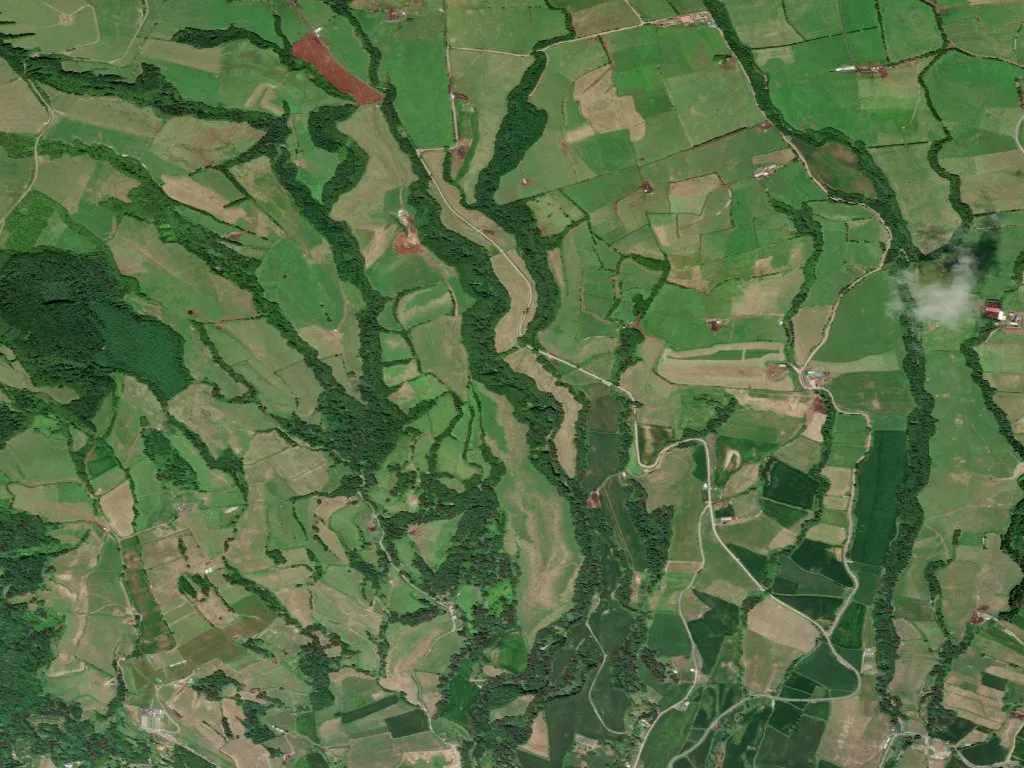
Below the summit, a footpath detours to Ribeira Funda’s mineral spring, classified a National Monument in 1974. Ferruginous water seeps from lava, painting the rock rust-orange and tasting faintly of old pennies. Farmers still fill plastic demijohns for household remedies. Further down, gravity-fed terraces grow maize, potatoes and yam; the soil drains so fast that roots never rot, rewarding hand labour better than any tractor. Visit between March and May and the valley looks like a patchwork quilt flung across a hillside – every green or brown square worked by someone you can wave to.
Basalt Shoreline
The coastal strip, now administered with neighbouring villages, is five minutes by car but a geological world away. Black-sand beaches and lava-sculpted pools appear at Praia da Ribeira Quente; the Atlantic is glass-clear and, even in August, cold enough to make you yelp. Each basalt layer is a dated ledger of eruptions; some flows are only 3,000 years old, fresh by island standards. Bring a towel and a thick jumper – locals enter at a run, scream, and exit just as fast.
Where to Eat
Ribeira Seca itself has one café where the cook presses boca de caco (Madeiran sweet-potato bread) around tinned tuna, and a backyard grill that brushes chicken with house-blended piri-piri. Better, drive 200 m up the regional road and stop halfway on the hill at the unnamed white bungalow: order arroz de lapas (limpets cooked like paella) and, if the owner is in the mood, he’ll fetch the original millstone his father used in the valley below and tell you why the water stopped turning it in 1982.
Dusk
When the sun drops behind Pico da Cruz the stone houses glow briefly bronze and the church bell counts out the Ave Maria. Even in high summer you can still hear the stream – not flowing, but remembered in the grooved wood of the mills, a low metallic echo that never quite fades.