Full article about Vila Franca do Campo (São Miguel)
Stone terraces, 348 children and 452 grandparents breathe Atlantic silence at 645 m
Hide article Read full article
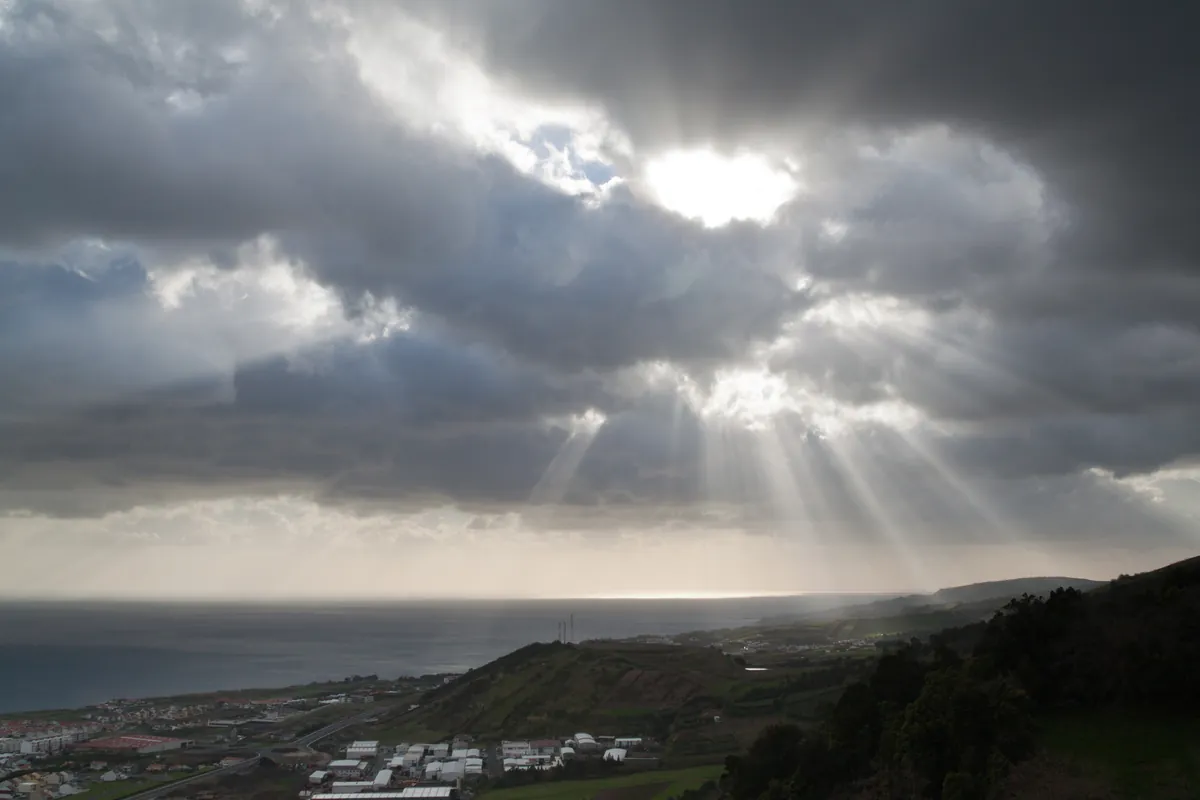
The clouds that live at 645 metres
Mist rolls off the Serra de Água de Pau and settles along the ridge above 600 m, bleaching pasture into wool. Even in August the air feels cider-sharp; Atlantic fronts shove the hydrangeas sideways against basalt walls and force every holly into a permanent bow. Vila Franca do Campo’s inland parish—often confused with the coastal town of the same name—occupies this bruised backbone of São Miguel, where the land remembers it is still volcanic and the nearest water is either falling from the sky or running down a black-stone levada.
Up in the island’s attic
Dry-stone terraces stitch the slope, just wide enough for a cow, a row of kale and a single Japanese cedar. Roads have numbers here—ER1-2, R1-2a—but no advertising; gradients touch 14 % and the tarmac is polished to obsidian by winter rain. Since the parish lost its municipal seat in 1981 the population has hovered around 2,500, giving a human density lower than that of the Icelandic interior. Geography does the filtering: coaches turn back, satellite signals vanish, and the silence gains mass.
A census of 348 children and 452 grandparents
Demography is audible at 17:30 when the school bus drops off eight pupils and the church loudspeaker still plays the Angelus to a square of empty benches. The Cooperative Dairy of Vale Verde, founded the year the parish was demoted, collects milk twice daily; its refrigerated lorry is the louthing that disturbs the dusk. Smallholdings keep the old stone corrals, but vines have retreated to wind-scarred pockets at 250 m—any higher and the saline wind taints the must. What grows up here is grass, cryptomeria and a single DOC-level terroir for the mineral whites that sommeliers in Lisbon now list simply as “Água de Pau”.
The entire parish lies inside the Azores Geopark; every footstep is on the flank of a 3-km-wide caldera last stirred 5,000 years ago. Follow the Ribeira da Mãe d’Água downhill and you tread through layers of pumice, lapilli and compacted ash until the basalt bed finally shows its tooth-black grin.
Night closes the volume
When the sun slips behind the ridge the temperature drops nine degrees in half an hour; wood smoke threads out of chimneys, carrying the resinous note of long-felled cedar. No streetlights, no bar playlist, no Instagram sunset—only the slow breathing of cattle and the intermittent clink of a cowbell. Visibility shrinks to the width of a torch beam; beyond it the mountain turns the colour of closed eyes and the world becomes a private affair between you, the crater you are standing on and the cloud that has decided to spend the night.