Full article about Flamengos
Ruined chapels, pastel impérios and cows among cabbages at 392 m on Horta’s green rooftop.
Hide article Read full article
The plateau where water talks to stone
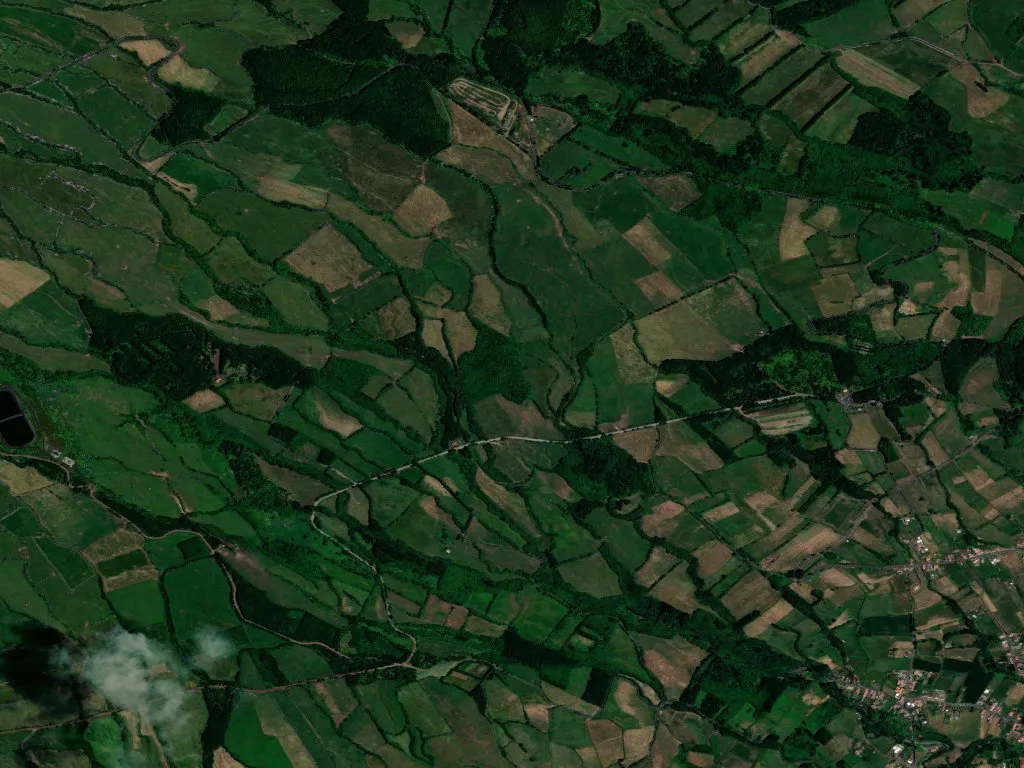
The Flamengos stream never raises its voice. It simply threads its way between basalt boulders and cushions of emerald moss, a low, steady commentary that fills the high plateau at 392 m. Up here the air is cooler than in Horta’s marina, freighted with Atlantic moisture that settles first on cabbages, then on the slow-motion cows that graze beyond them. White houses interrupt the green geometry like full stops, and beyond every dry-stone wall the island’s perfect caldera keeps watch—an extinct volcano pretending to nap.
When stone forgets its purpose
Time in Flamengos is measured in seismic cracks. The parish church of Nossa Senhora da Luz, built in the seventeenth century, was first looted by English privateers in 1597, then shaken to its knees by earthquakes in 1926 and again in 1998. No one has patched it up. Roof beams have vanished, ivy barges through rose windows, and swallows nest where the altar once stood. Azorean law normally obliges councils to maintain consecrated buildings; the exception is written here, in basalt and neglect.
Faith, however, migrated rather than died. Flamengos holds the highest density of Espírito Santo “impérios” on Faial—six miniature chapels painted the colours of gelato: salmon, turquoise, egg-yolk yellow. On Pentecost Sunday each one becomes the stage for a procession that begins with the rosary and ends with sweet bread and carne de vinha d’alhos handed out to anyone who queues. The hamlet’s other chapel, São João (1944), is an architectural hallucination: a central tower and crenellations give it the air of a keepsake castle dropped by mistake among the potato rows.
What remains of the Flemish
The first settlers were Flemish wheat farmers—flamengos—enticed by the island’s fertile basalt soils. Their language and surnames dissolved within two generations, leaving only the label on the map. Traces of their water-mills still surface after heavy rain: a granite runner stone here, a chiselled race there, moss-coated and silent since the 1950s. Electricity arrived as late as 1967; the subsequent eruption of Capelinhos (1957) and the call of New England emptied the parish. Today 1,561 souls are registered, but only 237 are under fourteen and 243 are over sixty-five. The school bus departs half-full; the dairy tanker still comes daily.
Between crater and valley
Until running water reached kitchens in the late 1970s, women carried laundry to the Flamengos stream in wicker baskets, exchanging gossip while sheets slapped against the basalt. The public fountain of Bicas still flows—icy, iron-tinged, collected in plastic jerry cans by octogenarians who trust it more than the tap. A five-minute walk away, the privately run Quinta de São Lourenço botanical garden keeps a living archive of Azorean endemics: glossy Azorean holly, tiny forget-me-nots that grow nowhere else on earth, and the improbably named “mother-of-thousands” succulents that colonise lava walls.
Drive the narrow lane that zig-zags toward the caldera rim and the vale unfurls below—an agricultural chessboard of hedged meadows, hydrangea plumes and terracotta roofs. The Atlantic glints on the horizon, but the eye returns to the valley floor, a pattern first surveyed in the 1500s and redrawn after every earthquake, stubbornly green.
Festivals that refuse to end
On 24 June the parish throws the island’s liveliest São João party. After mass under a marquee—because the church is still roofless—processions, brass bands and a makeshift grill zone fill Largo Jaime Melo. Children race supermarket-trolley go-carts down the slope while grandfathers play sueca at card tables balanced on beer crates. On the third Sunday of September the cycle repeats for Nossa Senhora da Luz, patron of the ruined church; the icon is carried from the império da Praça to a temporary altar on the church steps. Cord-bullfights—Portuguese-style, with the animal on a long rope—were last held in 1983, yet every bar still contains an António who will show you the scar on his ankle “where the farrobo bull caught me outside the bakery”.
Leave at dusk and the only sound is the stream working its patient geology, smoothing basalt grain by grain while cracked walls remember the last tremor and wait, composed, for the next.