Full article about Horta’s Angústias Bay: where paint, brine and whales echo
In Faial’s marina quarter, stone crosses, whale-steam and sailors’ frescoes layer 500 years
Hide article Read full article
The Sound of the Sea
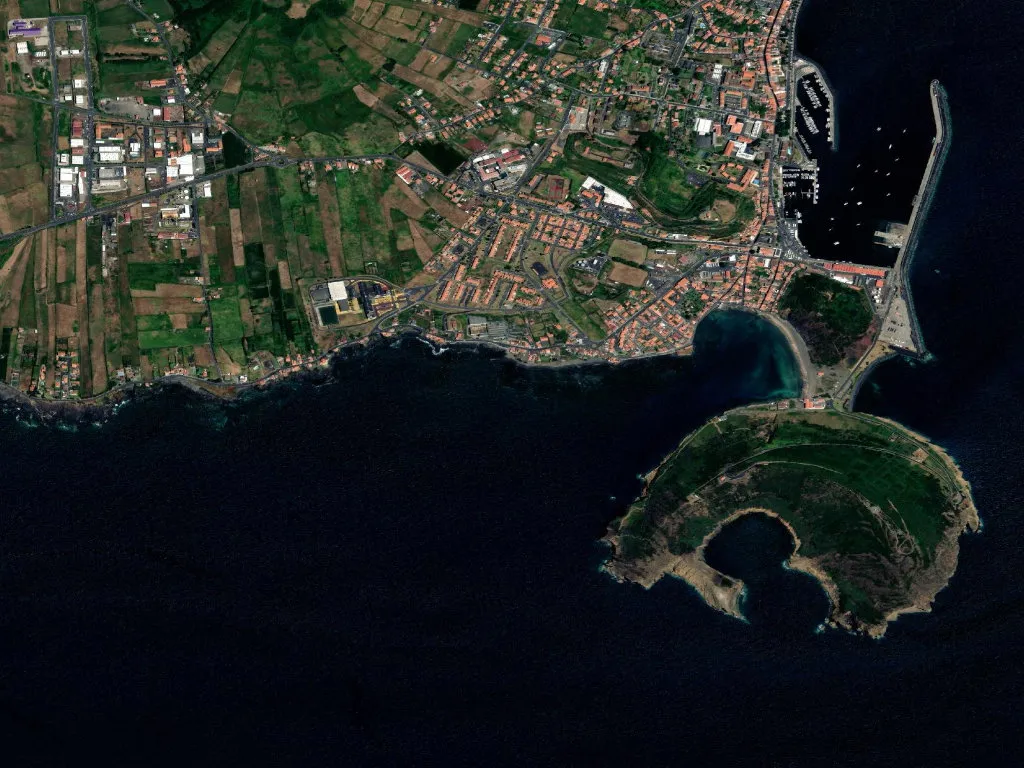
The first thing you hear in Angústias is metal kissing stone. Hawsers rasp against cleats, rubber fenders sigh as hulls nudge the quay, and a loose sail slaps the mast like a slack drum. The air tastes of brine and wet varnish; every centimetre of the marina breakwater is tattooed with crew-made frescoes—yacht names, dates, national flags—painted in the certainty that no skipper passes Horta without leaving pigment. Across the natural amphitheatre of the bay, Monte da Guia closes the southern arc while Pico rises 2,351 m on the far side of the channel, a navy-blue pyramid glued to the horizon. Here the Atlantic is not scenery; it is the house next door.
An Oceanic Petrol Station
From the fifteenth century onward, every captain crossing the Atlantic knew Porto Pim was the last reliable fill-up before the unknown. Vasco da Gama watered here; Magellan logged the bay. A half-submerged crater shelters the cove, giving flawless anchorage and a freshwater spring. Survivors of a 1684 storm kept their vow by building the parish church—Nossa Senhora das Angústias—whose gilded carved altarpiece and 18th-century azulejo panels still read like a thank-you note from the drowned who made it home. The stone cross erected in 1720 stands at the entrance like a mast set in granite. Even the 1926 earthquake, which shook chimneys into the streets and tilted half the town, could not cancel the port’s vocation.
When Whales Were Factory Work
At the bay’s tip, the former Porto Pim Whale Factory dozes against a crescent of white sand. Closed in 1957, it was one of the Azores’ last industrial flensing stations; rusting boilers, oil tanks and narrow-gauge rails are now an interpretation centre where the ghost odours of blubber and steam still cling. Next door, the sixteenth-century Forte de Santa Cruz—built to see off privateers—has become a pousada, its gun embrasures converted to bedroom windows that scan the horizon for sails which never come.
Tide-Set Cooking
Lunch at Canto da Doca arrives as a copper pot of caldeirada: black-tail comber, yam and fennel fronds thickened with pimenta-da-terra, the broth iodine-sweet. Around the corner, Genuíno serves just-grilled Atlantic tuna that still crackles, matched with molho de vilão—“villain sauce”—a rough escabeche of raw onion, sweet pepper and vinegar descended from cannery workers’ lunchboxes. For something to hold in the hand, Café David’s pastel de Horta—laminated pastry stuffed with fig or yam jam—shatters into buttery shards. Night drinks happen at Peter Café Sport, where house-distilled Faial gin aromatised with island botanicals slips down while crews trade trans-Atlantic war stories and the barman decodes fresh graffiti just unloaded on the quay.
The Crater That Guards the Channel
A spiral footpath climbs the 271 m volcanic cone of Monte da Guia, through low-grade scrub into lava tubes and abandoned lookouts where whalers once scanned for spouts. At the summit the wind arrives unfiltered, the Faial-Pico channel stretched below like a dark corridor between two landmasses. The Caldeirinhas Nature Reserve cups seawater inside its secondary crater; shearwaters wheel overhead, calling like unoiled hinges. Descent to Porto Pim tunnels through camellia and hydrangea, then opens onto a salt pond where herons breed and the sky is repeated in jagged silver.
The writer Maria Ondina Braga, born a street away from the fish market, recalled childhood “between the smell of dried cod and the creak of ox-carts on the pier.” Today, when the thirty-minute ferry blows its departure for Madalena on Pico and the siren ricochets across the bay, a freshly docked yacht is already unrolling masking tape and tins of paint. The echo fades, but the certainty lingers: some places remain compulsory waypoints simply because the ocean says so.