Full article about Horta Matriz: cobalt bay & basalt lanes
Faial’s parish climbs 91 m from 16C fortress to coffee-scented Rua Vasco da Gama
Hide article Read full article
Cobalt and coffee: the opening act
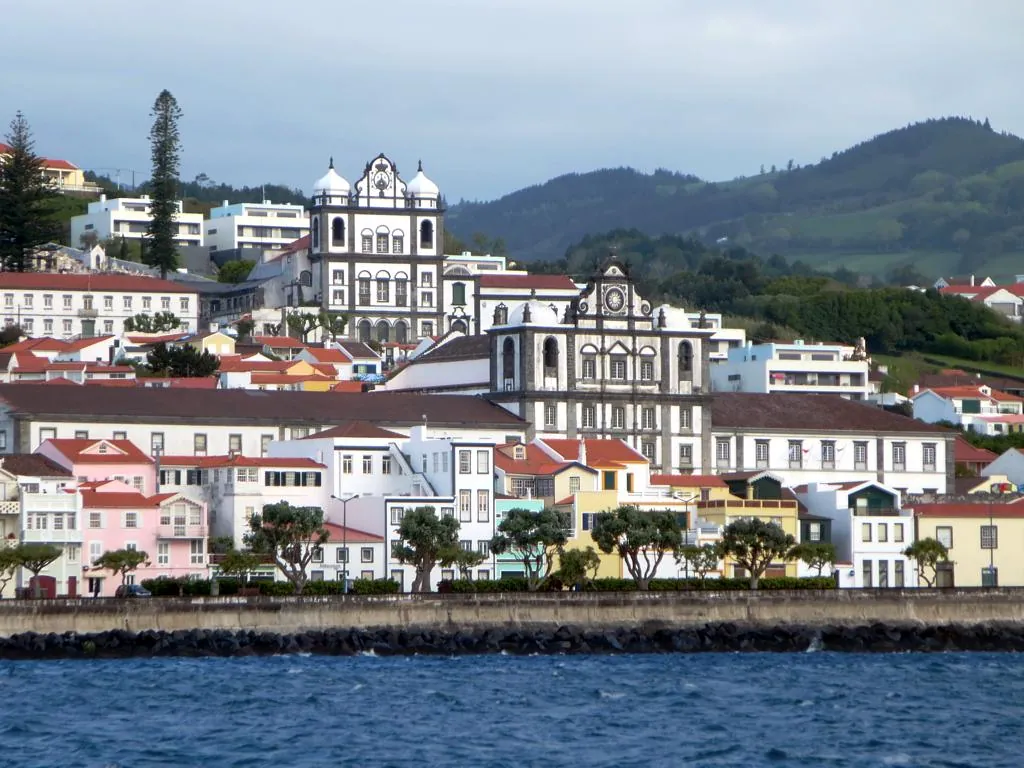
The bay unrolls like a blue theatre-curtain, hemmed by Ponta da Espalamaca to the north and Monte da Guia to the south. At 08:00 the Atlantic still smells of night salt, but inside Café Central—trading since 1898 on the corner of Rua Vasco da Gama—the coffee roaster is already ticking like a metronome. Steam ghosts out, meets the sea air and turns to incense. Above the pavement, Faísca’s 1970s colour chart lives on: guillotine windows in ochre, sea-green, sky-blue, framing wrought-iron balconies where late sun prints lace-work shadows onto basalt cobbles. Within these 180 hectares that tilt from Monte Carneiro down to the harbour mole, the civic heart of Faial keeps time.
Breathing room at 91 metres
Horta (Matriz) packs 2,435 souls into barely a square mile, enough density to keep the streets humming yet still leave space for greetings. The gradient helps: lanes climb 91 m from dock to Travessa do Seminário, each corner a memory card—black basalt steps polished by 170 years of shoes, stone walls tufted with moss. Children spill out at 15:30 from the D. Fernando primary school, opened in 2012, while pensioners occupy the 1865 bandstand in Praça da República, arguing over dominoes beneath jacarandas. Population turnover is low; everyone knows whose grandfather once crewed a whale-catcher, whose grandmother crocheted the altar cloth in the Jesuit college.
Stone that outlived earthquakes
Two monuments anchor the parish materially and psychologically. The Igreja Matriz do Santíssimo Salvador, begun 1512, survived both the 1672 earthquake and the 1957–58 Capelinhos eruption that buried the island’s western end; its volcanic-stone ribs and whale-oil-varnished beams still carry the scent of frankincense and saltpetre. Lower down, Forte de Santa Cruz—ordered by the boy-king Sebastião in 1567—now operates as a pousada, but the gun chambers still remember the crew of the English merchantman Loyal London, imprisoned here in 1591. Master mason João de Aguiar’s late-18th-century recipe—dark basalt dressed with white lime—deflects Atlantic brine better than any modern sealant; walk the ramparts and you can taste the spray on your lips.
Between ocean and verdelho
Matriz is the only parish on Faial where the vine meets the tide. Above the tiled roofs, dry-stone “biscoita” walls corral low-trellised muscat vines planted in 1929 by the Marquês da Praia e Monforte; they yield 35,000 bottles a year of vinho de cheiro, the perfume-wine once traded for Baltimore flour. At 17:30 the church bell tolls the Angelus and the choreography begins: civil servants in short sleeves descend the regional-government buildings, fishermen from the Clube Os Leões coil blue polypropylene on the quay, and São João bakery sells its last corn-bread loaves, still blistered from the 1946 brick oven. The aroma—yeast, must, diesel, brine—belongs only here.
A geography of arrivals
Matriz sits between the transient and the rooted. In 2023, 1,428 yachts and research vessels tied up in Horta marina, painting another layer on the famous breakwater murals. Yet every morning except Sunday, farmers from Faial and neighbouring Pico lay out purple broccoli, passion-fruit and yams on Praça Doutor Dabney, a square donated in 1897 by the American consul whose family mansion is now a museum. Fewer than 45,000 overnight visitors come annually, most between June and September; the four-daily ferry to Madalena and Velas keeps the island chain feeling like a single neighbourhood rather than a cruise destination. Dinner options betray the same hybrid DNA: Canto da Doca (est. 1987) serves conger-eel stew exactly as Maria da Gloria cooked it before the Capelinhos ash cloud took her roof; across the mole, Genuíno (opened by ex-whaler José Azevedo in 1991992) plates limpets sizzled in parsley butter while patrons thumb logbooks from the old Pico whale factory that once financed the town.
At 21:00 the wind swings a few degrees—“virente o vento” locals say—and brings the high-tide iodine up the lanes. Behind the 1860 sash windows of Rua Serpa Pinto, lace curtains still bought from Angústias weavers billow like jellyfish. Three seconds on, three seconds off: the Ribeirinha lighthouse, built the same year as the Bauhaus, signals the Faial-Pico channel. Between the permanence of basalt and the ephemera of tides that rise 2.3 m, Matriz goes on breathing—dense, salt-laced, alive—gripping its shard of volcanic soil in the middle of the Atlantic.