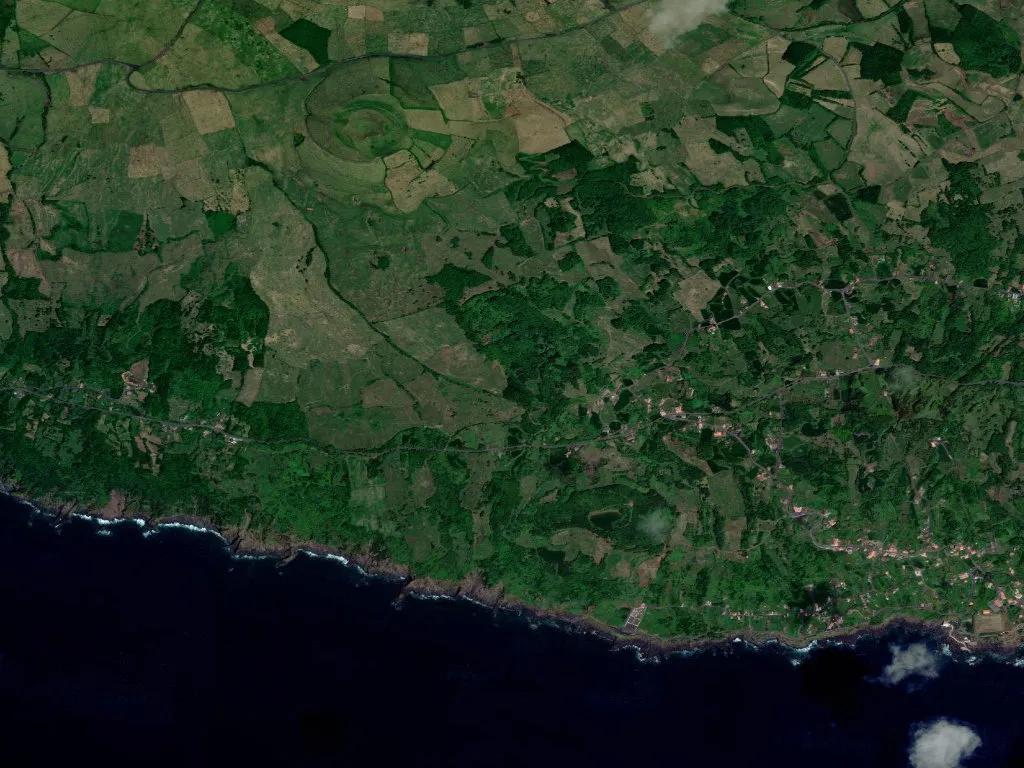
Full article about Calheta de Nesquim: Pico’s Dog-Rooted Wine Cove
Where a terrier saved sailors, whaling boats rest and fog-kissed Verdelho vines crawl between basalt
Hide article Read full article
A dog called Nesquim
The bark of a ship’s dog still rings through the toponymy of this southern cove on Pico. Local legend claims that three Brazilian castaways staggered ashore in the 16th century after following the frantic yaps of the vessel’s terrier; the animal now occupies the centre of the parish crest, the only coat of arms in Portugal to feature a dog. Below it, black basalt terraces step down to the Atlantic, their geometry interrupted by waist-high walls that corral pocket-handkerchief vineyards and by tidal pools where the afternoon sun takes the chill off the ocean.
Harpoon memory
Beside the slipway, the Casa dos Botes shelters a 10-metre cedar whaling boat, its copper spear-holder still riveted to the bow. Projected on the back wall, scratchy 8 mm footage from 1969 shows the same craft lunging through spray, oars rising and falling like pistons. Calheta de Nesquim sent men to sea until 1986; today sperm whales return as spectators, not quarry, and rubber RIBs leave the tiny harbour from April to October bristling with telephoto lenses instead of lances.
Twin-belfried São Sebastião (1852) surveys the scene from its lava-built platform. January brings the saint’s own procession, August fires off the Bom Jesus fireworks, and in November the parish honours São Martinho with new-season wine and chestnuts roasted on oil-drum braziers, wood-smoke drifting through lanes barely two metres wide.
Walls of wine
Above the village, basalt dykes climb the slope like dark vertebrae. Inside each enclosure, vines hug the ground to escape the salt-laden gales that scythe across the channel from Faial. The UNESCO-listed vineyard culture covers only a few hectares here – no grand quintas, no gift-shop labels – yet the corral wines, poured in back-kitchen cellars from Canada da Saúde to the Fetais, deliver a pale, briny Verdelho that tastes unmistakably of Atlantic fog.
Dinner starts with yam-thickened fish broth, proceeds to discs of home-cured pork sausage still carrying the scent of laurel smoke, and ends with candied purple yam in muscovado. The obligatory companion is dense, saffron-yellow corn bread, baked in a wood-fired oven that doubles as village laundry in the cooler months.
Lookout to ocean trail
The PRC11PIC way-marked loop leaves the church square, climbs for three hours through the humid Fetais laurel forest, and emerges at an abandoned vigia – a stone whale-lookout now colonised by moss and silence. From here the path drops to Poça das Mujas, a lava-scooped swimming hole where seawater slides in through a basalt keyhole and the rock underfoot warms like a storage heater.
Low-density living
With 318 souls spread across 13.8 km², Calheta de Nesquim registers one of the lowest population densities on Pico. Azorean novelist Dias de Melo retreated here to write; Guglielmo Marconi’s wireless station on Morro do Cão relayed Great-War signals between the archipelago and the European mainland. What remains is the metronome of swell against basalt, the iodine smell of kelp at low tide, and – if you listen on a still night – the faint echo of a dog that refuses to be forgotten.