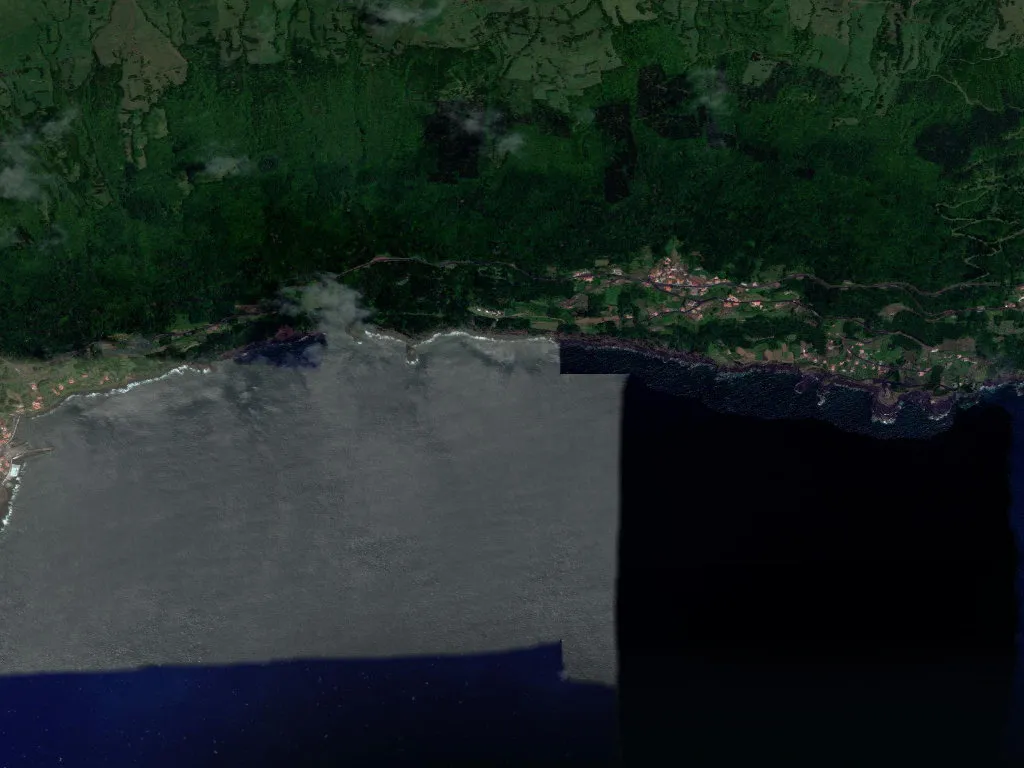
Full article about Ribeiras
Basalt vineyards, scarred jetty and chapel clocks tuned to Atlantic swells
Hide article Read full article
Stone, salt and the sound of whales
The wind insinuates itself between the basalt stones the way a regular slips into the café without knocking. On the pier the Atlantic slops and fizzes like a badly pulled pint, then retreats, affronted. Dusk works its way uphill over the currais—the tiny, walled vineyards that stitch the lower slope—slowly, as if feeling for loose cobbles. Each plot is a fist-sized field, the dry-stacking so hurried it looks as though the builder simply downed tools when the boat whistle blew. Out beyond the harbour a common dolphin surfaces once, purely to prove it still has the right of way.
A jetty scarred by Lorenzo and time
Ribeiras began as a place you lived only because the stream at the bottom of the plot guaranteed water for maize and potatoes. People punched in twice a day: once on the land, once on the sea. Before the parish had a council, the chapel of Santa Cruz doubled as the WhatsApp of its day—gossip, weather forecasts, speculation on when the whaler São João might reappear. When sperm whales still paid the mortgage, the harbour was a forest of masts and 48-hour stares. The 1903 breakwater still carries the grazes left by Hurricane Lorenzo in 2019; repairs have been “in progress” since 2021, which locally means the glass is exactly half empty.
Upstream, the parish church, built 1842, is proud of its plainness—no baroque swirls, just stone thick enough to outlast faith itself. Nearer the water, the smaller Capela de Nossa Senhora da Boa Viagem was positioned so that no fisherman wasted valuable minutes running to mass. The lava-stone houses refuse to admit the 21st century: four-water roofs, wooden gutters that still discharge more stories than rain. At Lagoa do Peixinho, a shallow crater pond, the stream becomes a chain of pocket waterfalls—an excuse for sandpipers and teal to break their Atlantic crossing.
What arrives on the boat stays on the table
Fish soup turns up late but forgiven: wreckfish and blackmouth grouse simmered in tomato, a belt of Verdelho wine added like punctuation. Octopus stewed with bay and allspice is the neighbour who shouts across the road—you don’t forget him. Limpets hit the plate still popping, with garlic-butter and parsley, on bolo do caco that doubles as crockery and carb. Pico DOP cheese nods politely, then slaps you awake; it marries the island white like cousins who already know each other’s secrets. On feast days the liver sauce appears—tomato thickened with ox-liver—and the unsolicited but welcome sweets: syrup-drenched encharcados, meringue sighs, cavacas that glue sugar to your molars. Fig-brandy is the base for passion-fruit or pineapple liqueur: summer stoppered in a bottle.
Between walled vines and the whale-road
The Vineyard Trail is three kilometres of conversation starter—dry-stone to your left, irrigation channel to your right, a sudden balcony that frames Faial’s outline and justifies a breather. Lagoa do Peixinho is really just a glorified puddle, yet the migratory radar of wigeon and coot insists otherwise. Santa Cruz’s natural pools were excavated free of charge by the Atlantic itself; the coast is a crumble of fajã lava shelves where vines cling like someone holding onto a glass at closing time. Uphill, laurisilva forest keeps tree ferns the size of golf umbrellas and trunks that have never heard a calendar tick. The entire shoreline lies inside the Azorean Whale Sanctuary; sperm whales, sei and bottlenose dolphins clock in year-round, commuters with season tickets.
Festivals that taste of soil and brine
During the Holy Spirit feasts the império—a tiny, candy-striped chapel—becomes a soup kitchen and conflict-resolution centre. The Romaria de Santa Cruz, third Sunday in May, welds procession, open-air mass and a dance floor that behaves like sprung maple. Chamarrita verses and call-and-response songs are the parish’s preferred method for saying what the priest mustn’t. August’s Noite da Tuna gathers string players who treat the viola as an extra limb: Azorean waltzes and fo’c’sle ballads that taste of salt and saudade. Ray-fishing techniques and net-making still pass from father to child like the family bread receipt. At the Ship-owners’ Association you can learn knots that won’t unpick a promise, or weave a rope mat to decorate the hallway and remind you who really writes the timetable.
When night finally folds over the channel, Faial’s lights ignite one by one, like a smoker taking his time with a match. The clatter of wave against pier syncs with the chink of glasses in the tavern—Verdelho on the table, cheese sweating, conversation no invoice can itemise. The wind drags fig-wood smoke down the lane and, somewhere out past the red buoy, a dolphin whistles—a casual invitation to stay a little longer. Ribeiras never begs. It simply lets you choose; and those who choose to stay always outstay their own estimate.