Full article about São Mateus: Pico’s Black-Walled Vine Maze Above the Atlantic
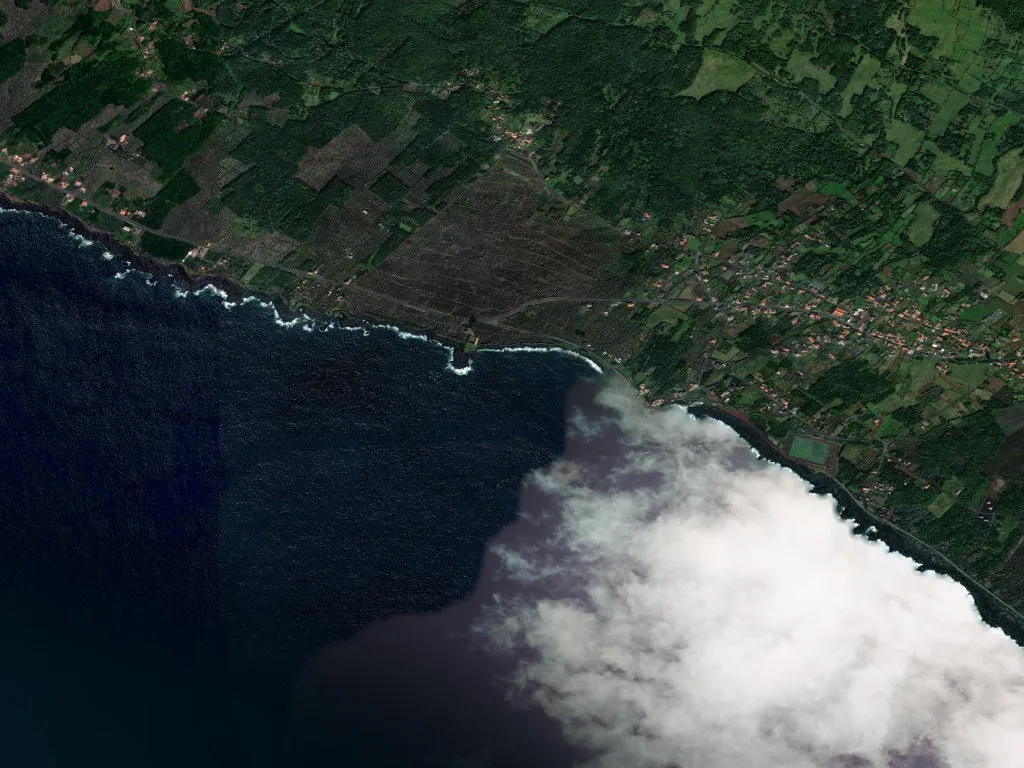
18th-century basalt corrals cradle Verdelho vines on lava slopes outside Madalena, Azores.
Hide article Read full article
The Atlantic light strikes the south coast of Pico with such force you have to narrow your eyes. Jet-black basalt walls, stacked chest-high without mortar, grid the slope like a chessboard; between them Verdelho vines lie prostrate on bare lava, roots hunting for moisture in the fissures. Each rectangle – a curraleta – was hand-built in the 18th century to steal a few degrees of warmth from the sea and keep salt wind off the grapes. From the roadside at São Mateus the lattice drops 200 m to the water, an area three times the size of Madalena town yet home to only 675 people. UNESCO listed the whole performance in 2004; nothing has interrupted it since.
Between volcano and tide
The parish road ends where the 1718 lava flow met the ocean, creating a low black shelf called Fajã de São Mateus. At dawn the flow’s jagged edge is still warm from yesterday’s sun; by midday fishermen are balanced on it, flicking lines into tide-pools for parrot-fish and trigger-fish. Behind them the basalt continues uphill, reincarnated as church walls (1877), cellar roofs, even the 16 °C interior of the cooperative winery where the harvest is pressed every September.
António Silveira begins his descent at 07:30, pruning shears over one shoulder. The track between his curraletas is 60 cm wide – too narrow for a quad-bike, let alone a tractor. “Machines can’t read stone,” he says, levering a shard until it locks like a three-dimensional puzzle. The technique travelled here from the Minho, but Pico’s lava demanded lower walls and tighter angles; after phylloxera wiped out continental Europe in the 19th century those differences became the island’s insurance policy.
The grey season
July fog is routine. When the north-easterly veers in at 60 km/h the vineyard maze turns monochrome and disorientating; photographers swear the Atlantic has been switched off. Maria José, who converted her grandfather’s farmhouse into three guest rooms, reassures guests that by mid-August the sky is “so clear you can clock the time on the clocktower in Horta” – 18 km away across the channel.
Below the walls the sea provides the soundtrack: waves detonating against the fajã, the hollow clank of aluminium boats at the tiny harbour, the 18:30 bus grinding up the hill with returning schoolchildren. Of the 86 pupils, most are the sons and daughters of Brazilians who came to build hotels or lay geothermal pipe; the primary school on Rua da Igreja closed in 2009 and now houses the parish council.
Stone that remembers
São Mateus joined the Azores Geopark in 2013, but geologists have been coming since 1957, when the Capelinhos eruption turned neighbouring Faial into a lunar film-set. Here the interest is older: a 1562 lava layer provided dimension stone for the parish church; cellars dug into the 1718 flow keep a constant cellar-cool temperature without electricity. Walk the cliff-top footpath at dusk and you tread on ropey pahoehoe still glossy after three centuries of salt and shoe-leather.
The same basalt shapes the swimming club (opened 2018), the picnic tables of the Parque da Furada, the very benches where card-players slam down sueca hands in Café São Mateus at sunset. When the last ferry hoots out of nearby Calhau the game breaks up, but the sea keeps talking – a low, unending conversation between volcano and ocean that no visitor ever quite forgets.