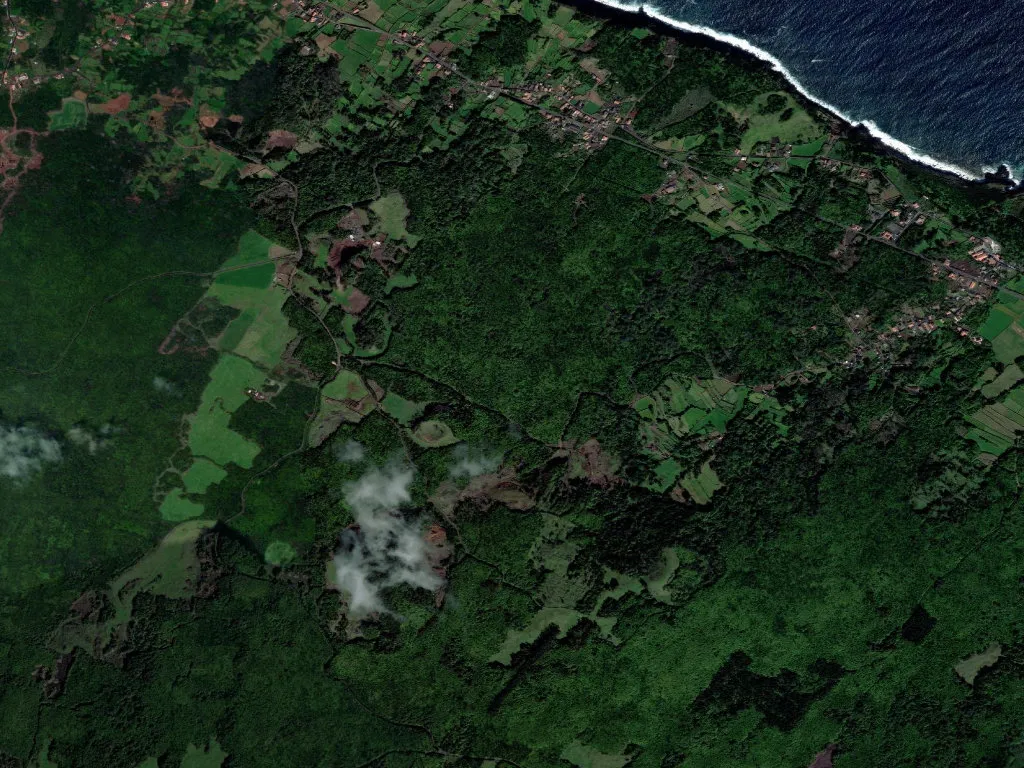
Full article about Santo António: Pico’s Bell, Basalt & Brine
Santo António village on Pico Island: hear the 1789 bell, swim lava pools, walk basalt walls and taste garage wine with locals.
Hide article Read full article
The Bell at Seven
The parish bell tolls at seven, but no one here needs a clock. Cast in 1789, the iron note rolls downhill through the cow-stone walls and the dogs answer first. Sea fog climbs the slope, mingling with hearth smoke from kitchens where women are firing loaves. Moss is not “vegetation”; it is a living rug my mother scrapes away each year with her vine-pruning knife before it loosens the bricks.
When the first settlers tired of sliding down to São Roque for Mass they built their own church, hauled Our Lady and St Anthony up in an ox cart, and parked the saint here because the dogs barked less at night. In June the statue still comes out, but children now carry the candles while parents flip sardines over rented plastic tables.
Walls that Speak
The basalt walls are measured not in kilometres but in stories my grandfather told while his hands, on autopilot, fitted stone on stone. Each stretch remembers a death: my uncle tumbled from the fig tree; Sebastião snapped a leg vaulting a wall to escape PIDE men during the Salazar years. The PR05PIC trail is pretty on the leaflet, yet walkers add twenty minutes to greet Sr Américo, accept grapes sliced with an earth-black knife and hear how his daughter “went to Canada and never wrote”.
Black Coast, Salt Heart
There is no beach, only a lava lip where my grandmother dived head-first to rescue a wind-snatched hat. Three rock bowls form the natural pools where toddlers learn to swim before they can walk: one day the water is warm as tea, the next it stings like ice – nobody knows why. When the Atlantic turns nasty the roar slips through windows and conversation stops; chins tilt toward the pane as if to say, listen.
Garage Winery
“Wine of the smell” is sold from front doors. It is not Verdelho or Touriga Nacional, just the surplus of last year’s harvest, decanted into plastic flagons that once held olive oil. A hand-painted sign is a recent concession; formerly the scent of ferment drifting through an open door was invitation enough. Dad ages aguardente in barrels liberated from the supply ship – he insists the staves are Tennessee oak, but even he doesn’t believe it.
Kitchen Measures
Sausages smoke over rhubarb stalks because the bay laurel died out. Yam soup is thickened with salt pork the neighbour brings in a tea-towel: “Your pig ran fatter this year, it’s only fair.” The eve-of-festival cake has no recipe – you know the batter is ready when the spoon stands up alone. Holy Spirit soup now carries less pepper; the grandchildren complain, yet the bread is unchanged: two days rising in a wood oven that is opened only every four hours so the fire won’t “get frightened”.
When Albertino Says Go
Harvest starts the morning Albertino, 84, declares it. He alone recalls the year rain burst the grapes on the vines. The challenge-song circle has dwindled to two septuagenarians and an out-of-tune cavaquinho, yet when the wine burns in their throats the whole village finds the chorus. The football pitch still bears the warp of the 1995 storm; kids weave goals between the stones because the new ball exploded on the first kick.
Eight O’clock Curtain
At sunset the scent of firewood is the same as 1950. Shadows at the wayside cross are not granite – they are the place Dad stopped to tell me life was this: watch the sea, wait for the boat, hope it brings diesel and news of those who left. The bell rings again, eight this time: shut the hens, put the soup on. Fog slides down the slope like an old cat, silent, until it covers our mouths and reminds us there will be another day.