Full article about Santa Luzia: the lava-stone heart of Angra do Heroísmo
Santa Luzia, Angra do Heroísmo: UNESCO-listed lanes of volcanic stone, baroque gold and Atlantic milk-light.
Hide article Read full article
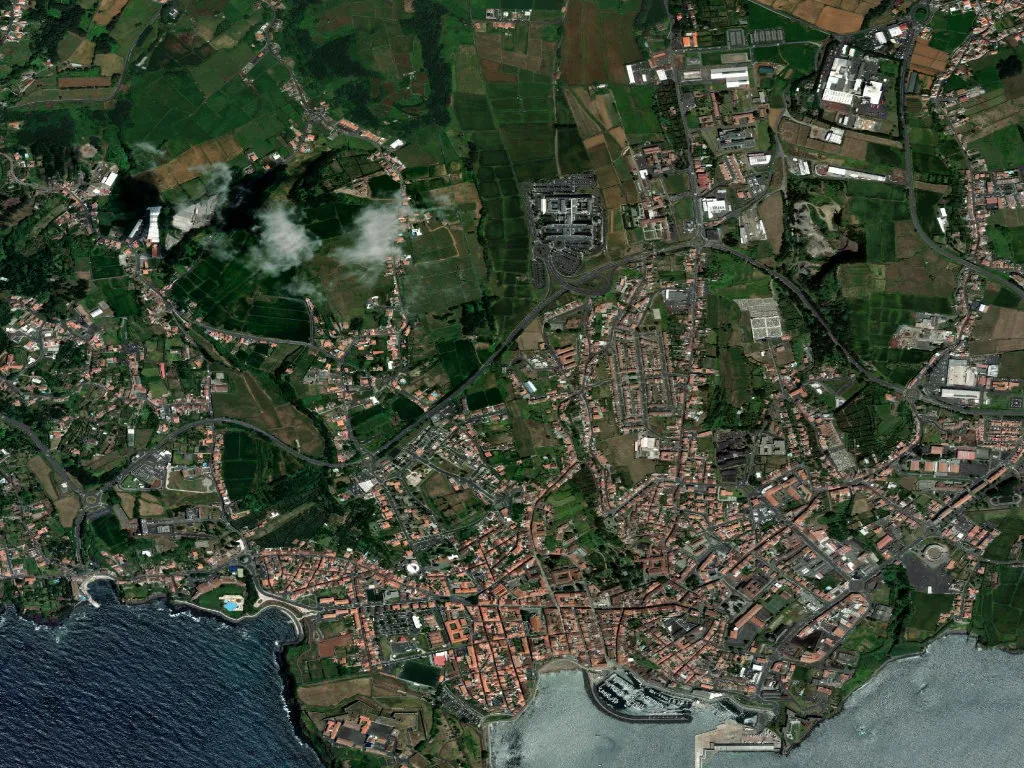
Santa Luzia: the district Angra was built around
The sound reaches you first. Footsteps ricochet through a chute of basalt, the stone so dark it drinks daylight. Somewhere above, a balcony hinge squeals; someone is hanging out laundry the colour of Portuguese flags. By the time you reach Rua de São João the Atlantic’s low milk-light has found the walls, picking out the grain in each block of lava that came ashore 3,700 years ago when Terceira’s volcano last flexed its jaw. Angra do Heroísmo was declared a World Heritage Site for its grid of Renaissance streets, but Santa Luzia is the hinge the whole city turns on – the parish founded before the fortifications, before the 15th-century harbour that stocked Vasco da Gama’s fleet, before even the name Angra.
Black stone, white lime
Basalt here is not scenery; it is punctuation. Architects alternated it with lime-wash the colour of sea-salt, so façades read like Morse: dark-dark-light, dark-light-dark. Fifteen buildings carry the State’s “Public Interest” seal inside 126 hectares – one listed monument every 8.5 hectares, a density higher than in central Porto. The Bettencourt Palace, finished in 1714 for a family who bankrolled Brazil–Lisbon sugar runs, is the loudest. From the pavement you can feel its ashlar quoins correcting your posture; the window-rhythm is almost nautical, as if someone transposed the rhythm of a caravel’s oar-ports into stone.
A baroque battery for daylight
Inside the parish church the light switches tactic. After the mineral gloom of the street, gold leaf on 17th-century carved wood fires back the little daylight that squeezes through lateral windows. The retable seems to inhale luminosity, a visual argument for Saint Lucy – patron of sight – whose third-century martyrdom arrived here with the first settlers in 1450. Azorean humidity keeps the air silvery; the gilding pulses like wet sand when clouds move across the sun.
One city inside another
UNESCO’s boundary wraps the entire 16th-century core, but Santa Luzia keeps its own pulse. Census 2021 counts 2,471 residents, almost 2,000 per km² – numbers more Lisbon-island than mid-Atlantic. Age tilts the curve: 28 % are over 65, only 9 % under 14. Mornings start slowly; conversations stretch across doorways calibrated to the width of two fishing crates. The parish council still posts announcements with a brass thumbtack hammered into basalt at eye-level – no LED screen could survive the salt.
Lava you can lean on
Terceira is a UNESCO geopark, and the rock under your palm is not metaphor: it is a 20,000-year-old flow that cooled into these very prisms. Santa Luzia sits 106 m above sea-level, high enough that from Largo da Madalena you can sight the entire bay where American whalers once watered and where NATO submarines still surface. Below the parish boundary the terrain folds into the “currais” – black-stone walls that lattice the vineyards, each rectangle a windbreak against Atlantic gales. The geometry looks Islamic, but it is pure Azorean pragmatism: grow verdelho grapes tight to the ground so salt spray skims overhead.
Silence with a specific weight
By late afternoon the basalt has stored the day’s thin heat; it now exhales a chill you can feel through linen. Footsteps lengthen, a door-knocker lands with the timbre of bronze on bronze, and the echo has time to die before the next sound arrives. What lingers is not the textbook fact of World Heritage but the exact moment when your knuckles graze 500-year-old lava and, somewhere inside the wall, a mortar joint ticks – the audible heartbeat of a city that quarried its own geology and decided to stay.