Full article about Feteira
Whitewashed walls, Atlantic vines and children’s laughter echo between pasture and ocean
Hide article Read full article
The White Light of Feteira
Atlantic sunlight strikes the whitewashed façade of the parish church and ricochets back in a glare sharp enough to make you squint. At noon, when the sun hangs directly overhead, Feteira appears to hover—its low houses suspended between emerald pasture and the cobalt band of ocean that glints beyond the last row of cottages. A steady breeze carries the saline bite of the Azores Current cut with the warmer scent of Holstein cattle grazing the terraced fields. Forty-three metres above sea level, the village keeps time to the slowest metronome on Terceira.
A Landscape in Transition
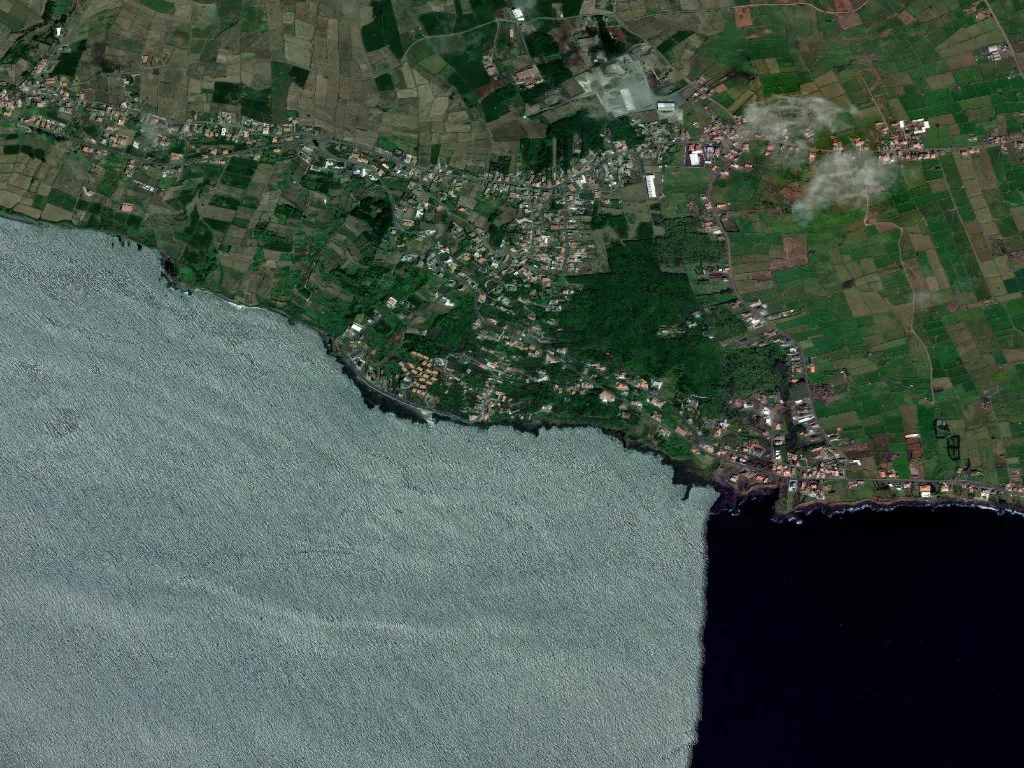
Feteira’s 524 hectares roll rather than rear. There are no plunging calderas or basaltic ridges here, only a gentle swell of land that lets vineyards breathe. Dry-stone walls, the colour of cooled lava, parcel the fields into chessboard squares, each protecting low, wind-trained vines that produce the archipelago’s pale, Atlantic-tasting DOC wines. At 255 residents per km², space feels generous rather than sparse: every house commands its own pocket of terroir, a vegetable plot and a strip of tethered vineyard no wider than a London bus.
Demographics tilt gently towards the future. Census data list 218 children under fifteen and 196 residents over sixty-five; at 3.30 p.m. the primary school disgorges a spill of backpacks that weave between cane-walking pensioners occupying the stone benches outside the chapel of Nossa Senhora da Conceição. Enough life to keep the café-pub on Rua Direita open all week; too little to disturb the hush that settles after the single evening bus has wheezed away.
Within Sight of a World Heritage City
Seven kilometres south-east, Angra do Heroísmo’s Unesco-listed harbourfront—merchants’ houses, arcaded mansions and 16th-century São João Baptista fortress—lies five minutes down the VE1-2A. The commute crosses open pasture where black-and-white cattle graze indifferent to the occasional rental car. On clear winter mornings you can pick out the cathedral’s twin towers above the haze, but Feteira keeps its own tempo.
The entire parish sits inside the Azores Geopark, recognised by Unesco in 2013, though you will find no fumaroles or selfie-ready lava tubes here. Instead, geology announces itself modestly: iron-rich laterite paths that blush rust-red after rain, basalt cobbles mined from local quarries and used to build pig-pen walls, and grass so verdant it only grows on young, mineral-laden volcanic soils.
Daily Rhythms, Atlantic Flavours
Saturday mornings, the padaria at the crossroads turns clay pot oven. Tray-size alcatras—either beef rump slow-baked with bay and allspice, or swordfish layered with tomatoes and peppers—emerge to be carried home under tea-towels. Onion-laced linguiça, stained scarlet with massa de pimentão, grills at street stalls during the Festa do Espírito Santo, when a pink-and-white império (Holy Spirit chapel) rises beside the mother church and volunteers ladle meat-rich sopas de pão to anyone holding out a bowl. Sweet bread, dense and faintly citrusy, arrives wrapped in butter from the Lajes dairy cooperative.
Public transport is an exercise in optimism: bus 104 trundles into Angra at 7.15 a.m. and back at 5.45 p.m., weekdays only. Hire a car if you want to stay for dusk, when the pastures turn a dark, almost jewel-like green and the church bell tolls once—not the festive peal heard in town, but a single, deliberate note that lingers longer than physics should allow, as though the landscape itself is holding its breath.