Full article about Raminho: Terceira’s Stone-Walled Edge Above the Atlantic
Basalt lanes, salt-kissed vines and 464 souls in a cloud-dappled Azorean aerie.
Hide article Read full article
The road climbs slowly past walls of black basalt, their edges softened by cushions of moss, until the Atlantic suddenly fills the windscreen. At 149 m above sea level, Raminho announces itself with nothing more than a scatter of low, white-and-ochre houses and a row of hydrangeas the colour of deep water. Gulls wheel overhead, their cries mixed with the lowing of dairy cattle and the faint creak of wooden gates salted by seventy years of spray.
Volcanic pastureland
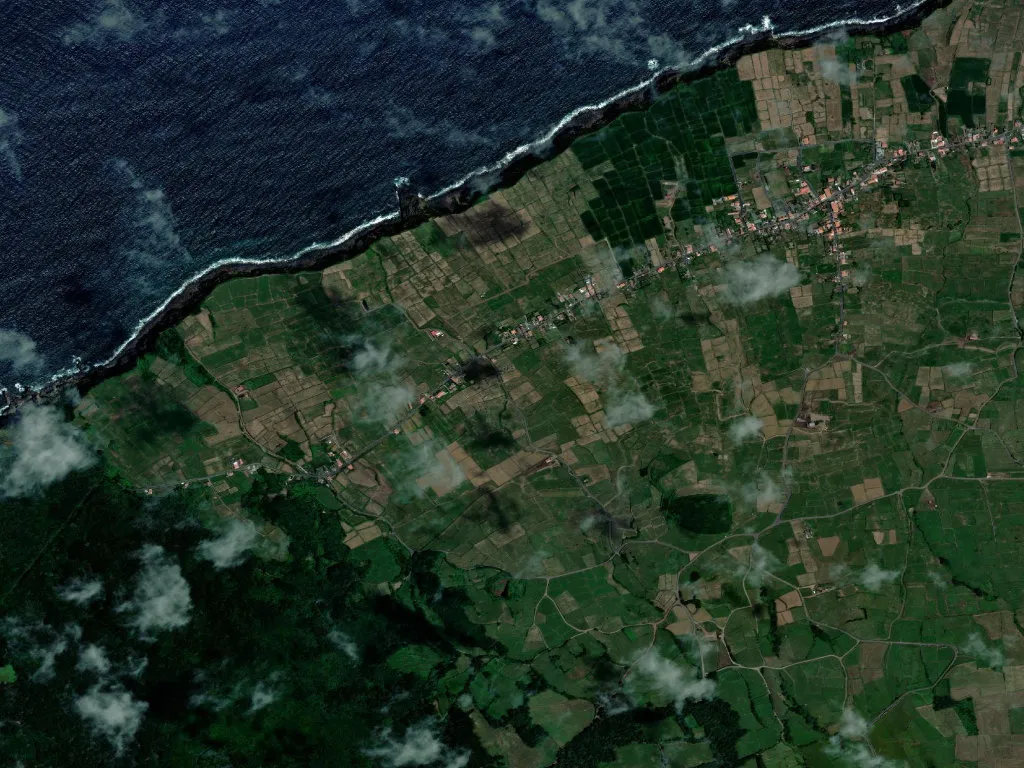
Every stone underfoot here cooled in 1761, when the Pico do Fogo fireworked basalt across the island’s centre. Farmers simply gathered the spoil and built their boundaries, so the parish is ring-fenced by its own geology. From the brow of the lane you look south across a staircase of pastures that change hue with the cloud cover: emerald when the sun finds a hole, slate-blue when the mist slips off the ridge. This is the western edge of the Biscoitos wine zone; the first low vineyards appear, each vine crouched inside a horseshoe of dry-stone no higher than your knee—curraletas that keep the Atlantic gales from stripping the fruit. The grapes they shelter are thick-skinned, tasting faintly of flint and salt.
A census of 464
The 2021 roll call reads like most Azorean interiors: 58 children, 111 pensioners. At dawn the elderly walk the lane to collect the pão de milho left cooling on a neighbour’s step; by eight the yellow “Atlântico” school bus has carried the younger cohort the 7 km down to Angra do Heroísmo, UNESCO city and daily lesson in baroque stone. Return at dusk and the tempo drops again—no streetlights, no café, just the slow percussion of cowbells and the smell of woodsmoke drifting from chimneys wide enough to roast a pig.
Inside, the houses obey 18th-century thermodynamics: walls a metre thick, windows the size of a prayer book, interiors that stay at 19 °C whether August is blowing roses or January is hurling rain. Behind each dwelling a plot the size of a London garage supplies potatoes, cabbages and maize for the chickens; fresh cheese arrives daily from the milking parlour across the road. Self-sufficiency is not a hashtag here, it is the only grocery delivery service that has never missed a day.
Atlantic twilight
The sun drops into the ocean beyond Monte Brasil and the basalt absorbs its last warmth, turning the colour of burnt toffee. Hydrangeas shift from sky-blue to bruise-violet, and the footpaths—nothing more than compacted earth between walls—stretch into corridors of shadow. Stand still and you feel the parish’s true scale: not the 11 km² on the map, but the widening silence between your eye and the horizon, a hush that only an island this small, this high, can grant.