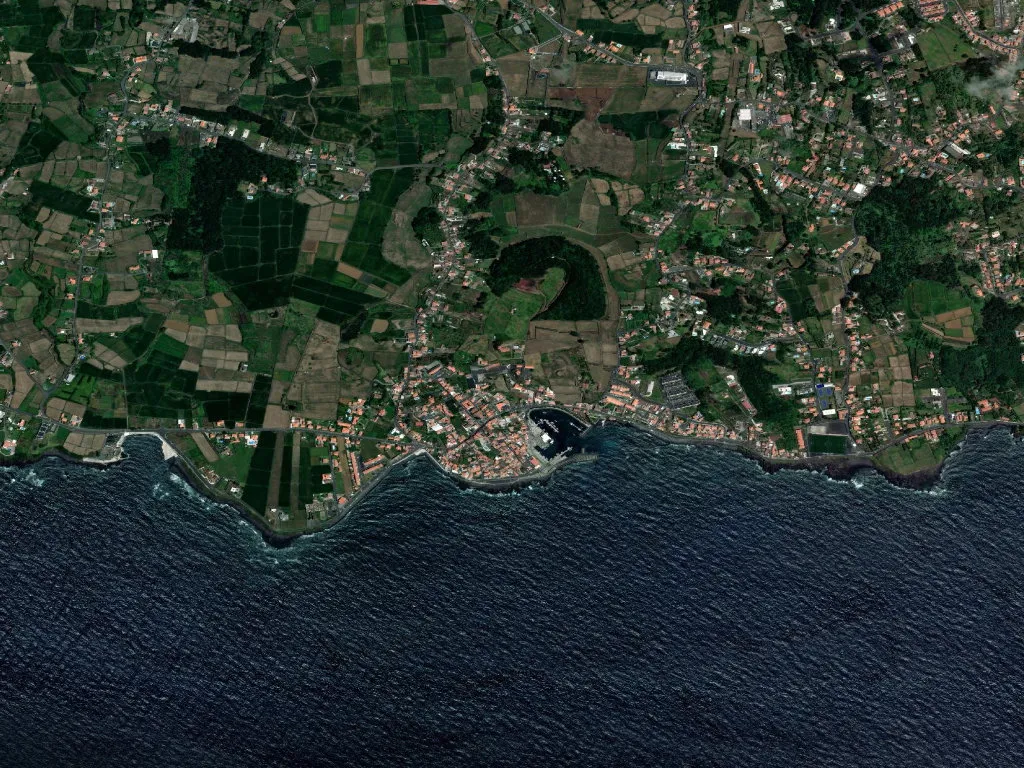
Full article about São Mateus da Calheta
Evening auctions, 16th-century forts and eight whitewashed chapels frame Terceira’s fishing village
Hide article Read full article
At 17:30 the diesel engines cut and the first gaff hook clangs against the quay. São Mateus da Calheta’s fishing fleet—painted in peeling blues and sun-bleached ochres—slides into the narrow harbour on the rising tide. By the time the sun touches the basalt cliffs, the wharf sounds like a market floor: prices called in Portuguese euros per kilo—chicharro (horse mackerel) €4–5, pargo (red snapper) €8–12—cash only, no intermediaries, salt still glinting on the scales.
The coast’s first landmark
Sixteenth-century caravels returning from Goa looked for the squat profile of Igreja Velha, stranded between the coves of Terreiro and Negrito. A hurricane on 28 August 1893 levelled the building; parishioners spent eighteen years fundraising before the new Igreja de São Mateus opened in 1911. Seven altars, 820 m² of dressed stone, the largest rural church on Terceira—paid for by a village that never numbered more than 4,000 souls.
Two forts of chocolate-coloured lava still guard the approach. Forte Grande, praised in 1776 by the royal engineer Cunha as “the finest on this coast”, surveys the outer anchorage; Forte do Negrito (1581) keeps its parapets intact and hosts summer exhibits on the Azorean whaling industry that replaced piracy as the village’s economic mainstay.
A constellation of chapels
Seven whitewashed ermidas punctuate the lanes, one per bairro: Nossa Senhora da Candelária, São Tomás da Vila Nova, Santo António dos Milagres, São João Baptista, São Diogo, São Francisco das Almas, São Vicente. Add Ermida da Luz (1888) on Canada da Luz and the tally rises to eight. The Holy Ghost festivals are kept alive by two imperios—Cantinho (1860) and Terreiro (1873)—whose façades are repainted green and white every spring.
Tomorrow’s fish, tonight’s dinner
There is no formal auction hall; buyers simply step onto the pontoon. What doesn’t sell within thirty minutes is wheeled uphill to the restaurants along Rua da Igreja. Order grilled limpets followed by black-eyed pea stew with yesterday’s catch; count on €12–15 with house wine poured from an unlabelled jug.
Salt water, black stone
Prainha’s natural pools—basalt cisterns refilled by each Atlantic swell—sit 200 m west of the fort. Water temperature hovers at 18–20 °C in August; entry is free, parking impossible after 11 a.m. Smaller coves lie eastwards, reachable only by footpaths that demand grippy soles and a disregard for selfie vertigo.
When the church bell strikes seven, bronze, gulls and surf fuse into a single chord that drifts over the tiled roofs. Day ends not with spectacle but with the reassurance that tomorrow the engines will start again at dawn.