Full article about Serreta: Terceira’s Wind-Carved Edge
Basalt cliffs, cloud cattle and lava-walled silence above the invisible Atlantic
Hide article Read full article
Windward Edge
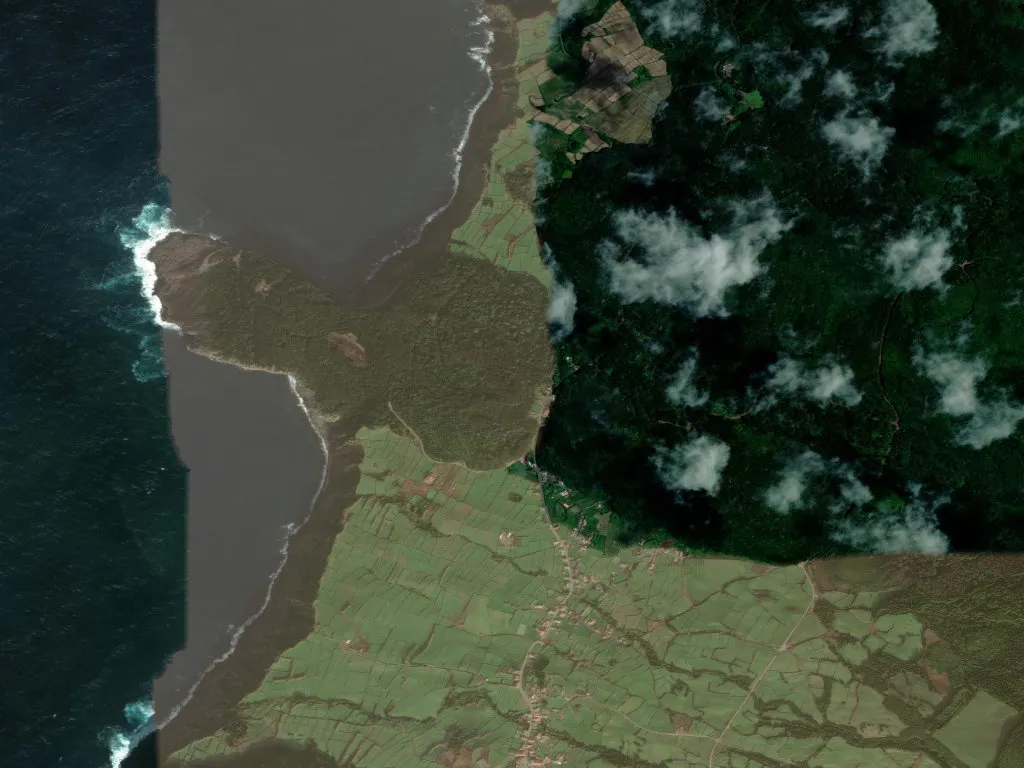
The wind hits Serreta head-on. At 214 metres above the Atlantic, the parish perches on a basalt lip where the ocean announces itself without ever coming into view—salt crusts the roadside grasses, the low houses whistle like flutes, dampness blackens the lava-stone walls. Only 316 people share 1,500 hectares of emerald pasture stitched together by dry-stone walls; the maths works out at twenty-two souls per square kilometre, room enough to breathe and still feel alone. Cattle graze through rising vapour, indifferent to the cloud that forms and dissolves around them. The road surface thins without warning into compacted earth; yesterday’s pothole you swerved around may be today’s crater—rain and Atlantic gales excavate overnight.
Geography at the Brink
Serreta occupies the north-western extremity of Terceira, the first line of defence against whatever the weather systems have brewed between Newfoundland and the Azores. Even the cats learn to walk tilted. Trees taller than a hedge are theoretical; low, wind-combed incense plants and hydrangeas mark field boundaries instead. When the fog lifts you can sight the ocean from almost any gate, yet most days arrive in monochrome, convincing sun-seekers on the south coast that the north is another country. The entire parish lies inside the Azores Geopark, and its volcanic curriculum is legible in every paddock—black aa lava pokes through the sward, temporary lagoons collect in explosion craters after heavy rain, iron-rich basalt weathers to rust-red clay that will ruin pale trainers in minutes. Locals keep a pair of wellingtons in the car for any errand, café included.
Wine and Salt Memory
Viticulture clings on as private folklore rather than commerce. A handful of currais—tiny stone windbreaks shaped like horseshoes—still shelter a few vines, their grapes destined for demijohns in cellar corners thick with spider lace and the smell of standing time. There is no vineyard to visit, but if you loiter long enough at Bar das Bicas, Mr Armindo may tell you how his grandfather foot-trod the grapes while someone played an accordion to “keep the berries happy”. What reaches the table now is fish stew when the sea allows, beef from the same pastures you have been walking past, and cheese that hardens in the salt-laden air. There are no restaurants; you eat in kitchens or during one of the Holy Spirit festivals when every backyard sprouts a cauldron and the parish council closes the lane so tables can be laid end-to-end. Accept any invitation to a Santo António barbecue—wood-smoke dragged seaward by the breeze is seasoning you cannot buy.
Inhabited Silence
Take the lane east of the church and the Atlantic hush closes in. A cowbell clunks two fields away, a rusted gate complains, a distant tractor works in low gear—each sound is pinpointed by the absence of background hum. After dark the absence continues upwards: no streetlights means the Milky Way reverts to its original job as a celestial footpath, close enough to spill into your raised glass. The wind never entirely drops; even on a “calm” night it combs the telephone wires and carries the mixed scent of seaweed and manure through open windows. Weeks later, back in a city park, you will find yourself staring at a regimented row of upright plane trees and think: how do they balance without the wind to lean on?