Full article about Vila de São Sebastião: Where 1590 Still Echoes
Stone portals, salted wind and a plague-born church frozen in Atlantic time
Hide article Read full article
A corner that forgot to move on
The stone portal of Igreja de São Sebastião pokes out at the junction as though someone wedged it there yesterday and never came back. Close-up, you can still trace the 16th-century chisel scars—tiny commas that soften when the sun drops and the side wall turns the colour of wet rice paper. Inside, the quiet is physical; even the kneeler’s complaint sounds like gossip carried on the air. This is Vila de São Sebastião, the first parish on Terceira to be written into the records in 1590 and, since 1983, the kernel of Angra’s UNESCO-listed heart—beaten to World-Heritage status before anywhere else in Portugal.
The geography of those who stayed
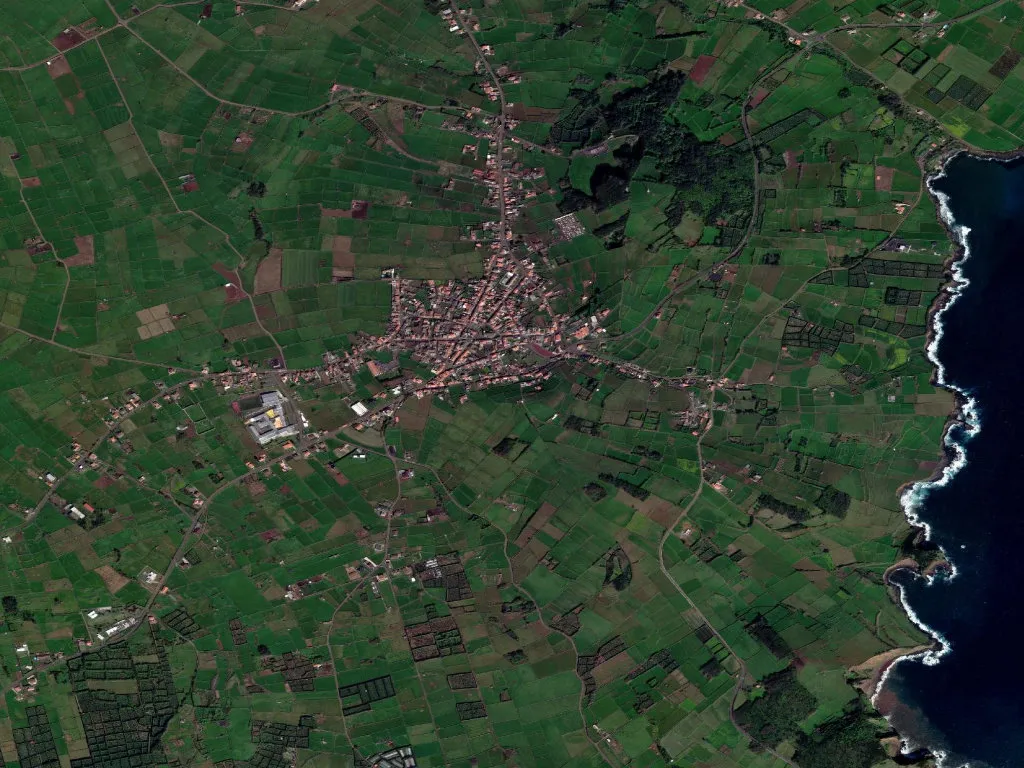
At 157 m the land lies as flat as a chessboard, slipping gently to the harbour. Early settlers liked the easy gradient and the breeze that carried ship smells uphill. While Angra turned itself into an Atlantic pit-stop—every carrack from Lisbon to Goa was obliged to call—São Sebastião became the corridor between farmland and customs house. The northern boundary is still stitched into square pastures, basalt walls waist-high, where the wind arrives salted and chatters like neighbours across a hedge.
A vow made during plague
No architect ever drew this church. It was fear that sketched it: during the 16th-century plague the town council vowed a temple to Saint Sebastian if the deaths stopped. They did. The result mixes Manuino ribs with Baroque curves the way islanders dilute red wine with water—without apology. Step inside and the temperature drops three degrees; stone has stored four centuries of brine and incense. It is air-conditioning by Atlantic memory.
Cycles of devotion
January belongs to the saint. Mass and procession still close the main street; there are no wristbands or rehearsed photo calls, only folding chairs and coats that smell of wood smoke. At Easter the heavy biers sway down lanes barely wider than cart tracks, their silver angels rocking like figureheads. On 24 December the Cantar dos Reis—King’s Chant—fills the nave with unaccompanied voices that rise to the vault, hover, then settle back into the pews. Festival here is conjugated in the first-person plural.
Atlantic matter
The parish sits inside the Azores Geopark, which means the very stone is a lava memoir. No signed trails are needed: walk ten minutes to the shore and watch hexagonal basalt pick a fight with the swell. The view is not postcard material; it is daily punctuation—open fields, wild incense poking through cracks, pasture so green it makes the occasional outcrop of grey tuff look like a mistake.
Living inside a listed building
A stroll here is a shuffle across centuries without changing shoes. Balconies of wrought iron creak above sash windows painted whichever blue or green the owner woke up liking. Gates, blackened by salt and time, admit you to 18th-century groceries and one-room cafés where coffee costs seventy cents. The primary school occupies a manor house whose coat of arms is slowly being erased by lichen. Monument and life are the same substance; history does not cordon itself off. At dusk the bell rings the Ave Maria down the street, ricochets off whitewash and loses itself over the Atlantic, leaving only a metallic aftertaste that seems to promise: tomorrow, same time.